Technical Specifications
| Parameter Name | Parameter Value |
|---|---|
| Product Model | Honeywell 900S75S-0360-00 |
| Manufacturer | Honeywell (ControlEdge HC900 / ControlEdge 900 platform) |
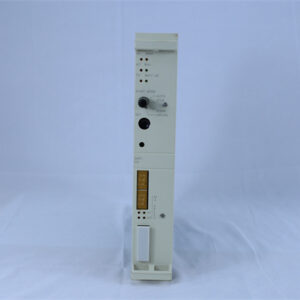
| Product Type | 2-Port Safety I/O Scanner Module (I/O Scanner 2) |
| Platform | ControlEdge HC900 Process and Safety System |
| Core Function | Deterministic remote I/O scanning and controller-to-rack communication |
| Communication Ports | 2 independent I/O ports (Port A to CPU-A, Port B to CPU-B) |
| Physical Layer | IEEE 802.3 Ethernet 100Base-TX on RJ45 (star or ring topology) |
| Safety Certification | SIL 2 per IEC 61508 / IEC 61511, TÜV certified |
| Additional Standards | Cat. 3 per EN 954-1; PL d per EN ISO 13849-1 |
| Compatible CPUs | 900C30S, 900C50S, 900C70S, 900C75S SIL CPUs |
| Compatible Racks | 4-, 8-, and 12-slot HC900 I/O racks, including redundant-power variants |
| Data Integrity | CRC error checking, sequence numbering, watchdog on each scan |
| Rack Addressing | DIP switches on the module PCB set the remote I/O rack number |
| Backplane Power | 5 V DC from HC900 rack supply, 770 mA max (some revisions quoted up to 950 mA) |
| Hot-Swap Capability | Supports insertion and removal under power |
| Status Indication | Scanner status LED (red/green); receive/transmit LEDs per I/O port |
| Operating Temperature | 0 °C to +60 °C |
| Storage Temperature | -40 °C to +85 °C |
| Humidity | 5–95 % RH, non-condensing |
| Mounting | HC900 rack slot (backplane) |
| Approximate Dimensions | 137 × 38.1 × 137 mm |
| Approximate Weight | 0.36 kg (360 g) |
| Hazardous Area Suitability | Suitable for Ex-Zone 2 / Class I, Division 2 installations (per variant and certification) |
Note: Several reseller pages misstate this product as SIL 3 or as a Safety Manager CPU. The consistent technical specification across the most detailed sources is SIL 2, TÜV-certified, for the ControlEdge HC900 platform. Verify the exact revision and certificate against your system’s safety case before use.
Main Features and Advantages
The primary feature of the Honeywell 900S75S-0360-00 is its dual-port, redundant communication architecture. By maintaining simultaneous, synchronized scan sessions with both CPU-A and CPU-B, the scanner ensures that controller failover is completely transparent to the field I/O. The Lead controller changes, the scanner’s active path changes, and shutdown-valve feedback, solenoid commands, and diagnostic data keep flowing without a rack dropout. This eliminates the hidden single point of failure that a conventional single-path scanner introduces into an otherwise redundant control system.
A second major advantage is certified data integrity. Every message on the scan is protected by CRC error checking and sequence numbering, with a watchdog running on each scan cycle. If a message is corrupted, lost, duplicated, or delayed, the scanner detects it and reports the condition so the controller can execute a predefined safe action. This prevents the system from continuing to operate on silently corrupted data — a critical requirement in any safety instrumented function.
The 900S75S-0360-00 also provides comprehensive diagnostics at the module level. It continuously monitors the health of the I/O modules in its rack and reports faults to the controller as they are detected, rather than waiting for the next proof test. In a safety system, diagnostic coverage is what converts dangerous undetected failures into scheduled maintenance, and the scanner contributes directly to that coverage across every module in the rack.
Installation and maintenance are practical as well as safe. Rack addressing is set by DIP switches on the module PCB, and the scanner auto-configures with the controller, so a remote rack can often be brought online without a laptop session. In a redundant configuration, the module supports removal and insertion under power, turning a failed scanner replacement into a minutes-long swap rather than a unit shutdown. Because one scanner is required per I/O rack — not one per station — correct addressing and physical placement are engineering essentials.