Application Scenarios
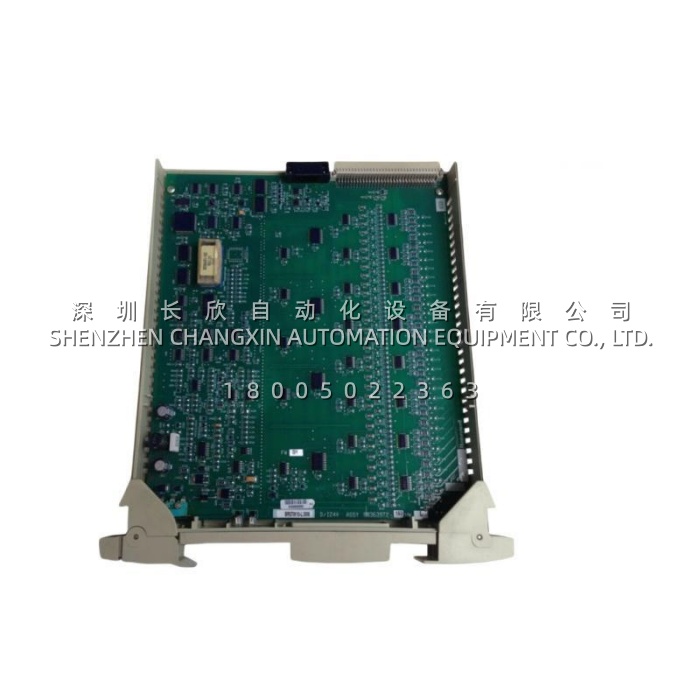
In a chemical processing facility running a Honeywell HC900 hybrid controller, the operations team faced a recurring issue: solenoid valves on the reactor feed lines required 230VAC actuation, but the controller’s standard output cards provided only low-voltage logic signals. Adding interposing relays for each valve meant additional panel wiring, increased failure points, and higher installation labor costs. The Honeywell 621-2200RC solved this problem directly — its eight isolated relay contacts wire straight to the solenoid coils, eliminating sixteen interposing relays across two reactor trains. Maintenance technicians can now confirm each output channel’s status through the per-channel LED indicators, and the relay’s dry-contact design means a failed module never backfeeds voltage into the sensitive controller backplane.
For oil and gas facilities operating legacy Honeywell TDC 2000 or TDC 3000 systems, the 621-2200RC serves as a critical spare for burner management and emergency shutdown applications. When a fuel gas shutoff valve must be de-energized on a flame failure signal, the relay output’s deterministic response time and galvanic isolation provide the reliability that safety instrumented functions demand. The module’s ability to switch 500VA loads directly allows safety actuators to be driven without additional interface hardware, simplifying the safety loop and reducing diagnostic complexity.
Parameter
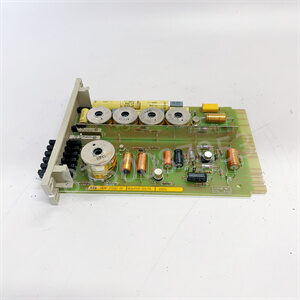
| Parameter | Value/Description |
|---|---|
| Product Model | Honeywell 621-2200RC |
| Manufacturer | Honeywell |
| Product Category | Digital AC Output Module (Relay Type) |
| Compatible Systems | IPC 620 PLC, HC900 Hybrid Controller, TDC 2000/3000 |
| Output Channels | 8 channels, independent |
| Output Type | Electromechanical relay, Form A (SPST-NO) |
| Contact Rating | 2A @ 230VAC (resistive load) |
| Max Switching Voltage | 250VAC |
| Max Switching Power | 500VA (AC) / 60W (DC) |
| Common Configuration | CH1-4 share one COM; CH5-8 share one COM |
| Isolation | Relay coil-to-contact isolation; channels share COM |
| Response Time | ~10-15ms pick-up/drop-out |
| Status Indication | Per-channel LED (logic ON/OFF) |
| Backplane Power | +5VDC logic / +24VDC relay coil (from rack) |
| Wiring | Pluggable terminal block |
| Electrical Life | >1,000,000 operations (load dependent) |
Technical Principles and Innovative Values
Direct 230VAC Load Switching Without Interposing Relays: The 621-2200RC incorporates eight electromechanical relays, each capable of switching 2A resistive loads at 230VAC. This design eliminates the need for external interposing relays when controlling solenoids, small contactor coils, or alarm horns — reducing panel space, wiring labor, and potential failure points by consolidating the interface into a single module.
Grouped Common Architecture for Flexible Field Wiring: Rather than providing one common terminal per channel, the 621-2200RC groups its eight outputs into two banks of four channels sharing a single common connection. This configuration supports separate field power sources for each group, allowing mixed loads operating from different phases or supply circuits while maintaining the simplicity of a 16-terminal wiring scheme.
Galvanic Isolation Between Control and Field: The relay coil and contact circuits within the 621-2200RC maintain electrical isolation, preventing voltage transients, surges, and faults originating in the 230VAC field wiring from reaching the sensitive controller backplane. This isolation is particularly valuable in facilities with variable frequency drives, motor starters, and other high-noise equipment sharing the same electrical environment.
Deterministic Relay Response for Safety-Critical Outputs: With pick-up and drop-out times in the 10-15ms range, the 621-2200RC provides predictable switching behavior suited for emergency shutdown sequences and burner management interlocks. The dry-contact output also supports proof-testing protocols where technicians verify the physical contact state with an ohmmeter during safety validation procedures.