Application Scenarios
A gas turbine facility operating a Mark VI TMR control system depends on synchronized communication between redundant control channels and distributed I/O racks. During a load change, a minor coaxial connection fault in one IONet segment could otherwise appear as a broad “communication lost” event. With the GE IS215VCMIH2CB, port-level TX, RX, and carrier indicators help technicians isolate the affected cable segment while the board’s Fail status remains available for distinguishing a network fault from a board fault. This shortens troubleshooting and helps avoid unnecessary turbine trips.
In combined-cycle power plants, the same board supports reliable exchange of speed, temperature, protection, and actuator-related data between control and I/O equipment. It is particularly valuable where remote racks, high electrical noise, or strict maintenance windows make communication stability a priority. For plants maintaining aging Mark VI assets, the IS215VCMIH2CB is a practical critical spare because loss of VCMI communication can remove an entire rack from the turbine control network.
Parameter
| Main Parameters | Value/Description |
|---|---|
| Product Model | IS215VCMIH2CB |
| Manufacturer | GE / GE Fanuc |
| Product Category | VME communication interface board, VCMI bus master |
| Control Platform | GE Speedtronic Mark VI |
| Processor | Texas Instruments TMS320C32 32-bit DSP |
| Form Factor | 6U VME board, single-slot width |
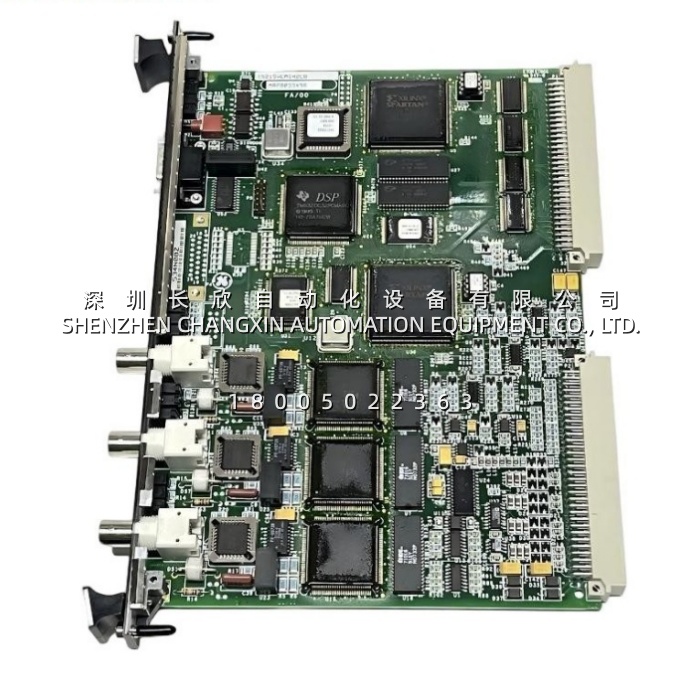
| IONet Ports | 3 × 10Base2 BNC, 10 Mbps |
| Serial Interface | 1 × RS-232C diagnostic port |
| VME Function | Bus master, board-ID management, backplane data scheduling |
| Power Supply | +5 V DC from VME backplane |
| Operating Temperature | −30 °C to +65 °C, subject to system and installation limits |
| Protection | Conformal-coated PCB |
| Diagnostic Indicators | Run, Fail, Status, 1/2/4/8 ID LEDs, and per-port TX/RX/CD |
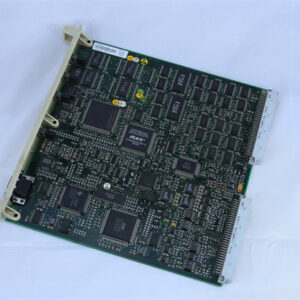
The three independent IONet ports are a defining feature of the H2 hardware version, supporting separate R, S, and T communication paths in TMR systems. Dual-port memory allows the onboard processor and VME side to exchange data efficiently without adding unnecessary load to the main turbine controller.
Technical Principles and Innovative Values
Innovation Point 1: Dedicated DSP-based bus control.
The GE IS215VCMIH2CB uses a TMS320C32 processor to manage bus arbitration and communication timing independently. This lets the main controller focus on turbine control laws rather than routine data movement.
Innovation Point 2: Native three-path IONet architecture.
Its three 10Base2 ports provide dedicated paths for R, S, and T channels. This supports coordinated TMR communication without requiring an external network switch to create the basic redundant structure.
Innovation Point 3: Deterministic data exchange.
The board supports Mark VI frame timing, including 10 ms simplex operation and application-dependent 20 ms or 40 ms TMR operation. Consistent timing helps redundant controllers process closely aligned I/O snapshots.
Innovation Point 4: Practical diagnostics at the board level.
Front-panel status, identity, and port activity LEDs make communication problems easier to see during commissioning or outage work. The IS215VCMIH2CB also monitors internal power rails and receives diagnostic feedback associated with the power distribution module.
Innovation Point 5: Enhanced build for demanding environments.
The CB build is commonly identified with improved electromagnetic filtering and thermal robustness compared with earlier variants. Its conformal-coated circuit board is suited to turbine enclosures exposed to contamination, vibration, and temperature variation.