Application Scenarios
Picture a high-speed horizontal form-fill-seal machine running 180 film cycles per minute: the cross-seal jaw accelerates through a 60° rotary stroke every 333 ms, drawing nearly three times its continuous torque on every bite. A drive sized on continuous rating alone would trip on overload; a drive sized on peak rating alone would run hot and waste panel space. The DST1405 was engineered for exactly this regime — “pulse duty” — using its 24 A peak capability to deliver the bite and its 8 A continuous rating to carry the dwell, all inside a 70 mm-wide chassis that stacks alongside neighbouring axes on a shared backplane. The same logic applies to rotary knife cutters on web presses, pick-and-place Z-axes on assembly robots, print-cylinder registration drives, and injection-moulding take-out manipulators. Across these machines the pain points the DST1405 resolves are consistent: cabinet-space pressure from stacked single-axis drives, nuisance overload trips on fast duty cycles, and the engineering cost of re-cabling a panel whenever the fieldbus protocol changes.
Parameter
| Parameter | Value / Description |
|---|---|
| Product Model | Emerson / Control Techniques DST1405 (Digitax ST series) |
| Manufacturer | Control Techniques, a brand of Nidec — Kidsgrove, UK |
| Product Category | Single-axis AC servo drive (position, velocity and torque control) |
| Input Voltage | 380–480 V AC three-phase, ±10 %, 48–65 Hz |
| Continuous Output Current | 8.0 A rms |
| Peak Output Current | 24.0 A rms (~3× overload for pulse-duty cycles) |
| Switching Frequency | 3 / 4 / 6 / 8 / 12 kHz selectable |
| Control Loop Bandwidth | Current loop 1100 Hz; speed loop 160 Hz; speed accuracy 0.01 % |
| DC Bus Capacitance | 220 µF internal; up to 660 µF external allowed |
| Internal Brake Resistor | 70 Ω (25 °C), 50 W average (60 s duty) |
| Digital / Analog I/O | 3 dedicated DI, 3 bidirectional DI/DO, 1 relay (Drive OK, 2 A @ 240 V AC); 1 × 16-bit ±10 V analog input, 2 universal analog inputs, 2 analog outputs, 1 × 1 µs freeze input |
| Feedback Interface | Incremental, absolute, SinCos, resolver (option); encoder response up to 500 kHz |
| Communication | Two-wire RS-485 Modbus RTU 115 200 bps onboard; 2 × option-module slots for EtherCAT, EtherNet/IP, PROFIBUS-DP, CANopen (SM series) |
| Functional Safety | Onboard Safe Torque Off — EN 61800-5-2 SIL 3, EN ISO 13849-1 PL e, EN 954-1 Cat. 3 |
| Enclosure / Environment | IP20 (UL Type 1 / NEMA 1); 0–50 °C ambient (derate above 40 °C); 95 % RH non-condensing; 1000 m rated altitude (to 3000 m derated) |
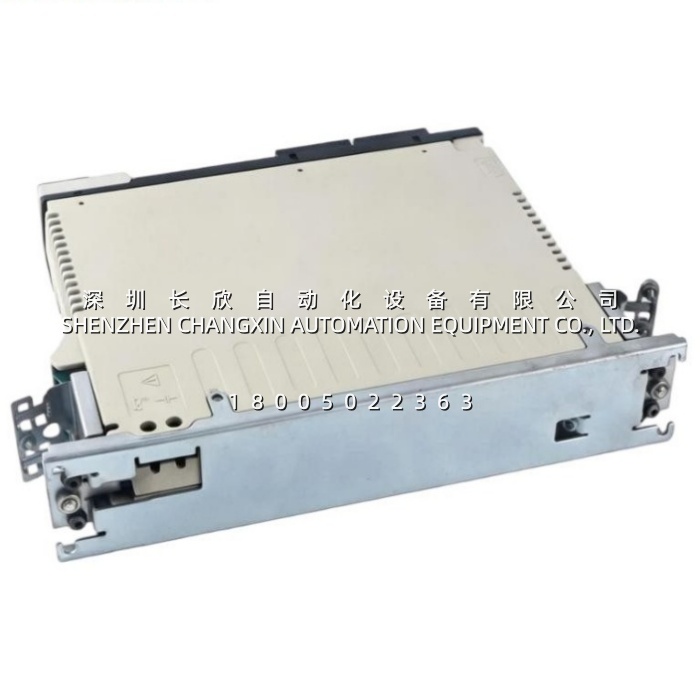
| Mechanical | Approx. 330 × 70 × 230 mm; 2.1 kg net weight excluding keypad and option modules |
| EMC Compliance | EN 61800-3 (second environment); EN 61000-6-3 / -6-4 with optional EMC filter |
Technical Principles and Innovative Values
- Innovation Point 1 — Pulse-duty architecture optimised for real machine cycles. Rather than quoting a single continuous rating and forcing the user to derate, the DST1405 is designed from the start around short-burst torque demand: 8 A continuous against 24 A peak with a 70 Ω internal brake resistor and 220 µF DC bus sized to absorb regeneration from fast indexing without an external braking module. This is the structural reason Digitax ST occupies roughly one-third of the panel volume of a conventional V-class servo drive of the same peak current.
- Innovation Point 2 — Dual option-module slots for protocol independence. Two SM-series slots on the DST1405 accept EtherCAT, EtherNet/IP, PROFIBUS-DP, CANopen, or a second encoder-feedback module without replacing the drive. An OEM exporting the same machine to plants with different PLC estates fits a different comms card and keeps the drive, motor, panel layout and software baseline unchanged — a significant spares and inventory advantage.
- Innovation Point 3 — Integrated Safe Torque Off at PL e / SIL 3. The STO circuit in the DST1405 is certified to EN 61800-5-2 SIL 3, EN ISO 13849-1 PL e and EN 954-1 Cat. 3, allowing the safety architect to implement a category-0 stop on the drive terminals directly, without an external contactor pair — typically saving a contactor, an auxiliary relay and a panel slot per axis.
- Innovation Point 4 — High-resolution current loop for tight torque fidelity. The 16-bit + sign analog setpoint input paired with a 1100 Hz current-loop bandwidth gives the the dynamic stiffness to hold torque on web-tension, torque-controlled winding and force-feedback joints, with speed control accuracy of 0.01 % across the rated range — figures that remain competitive against current-generation drives.
- Innovation Point 5 — Shared DC bus for multi-axis regeneration. Multiple drives in the same panel can be linked on a common DC bus, allowing a decelerating axis to feed a motoring axis directly and eliminating the need for a brake resistor on each drive — a 20–30 % reduction in overall regeneration losses on multi-axis machines.