Application Scenarios
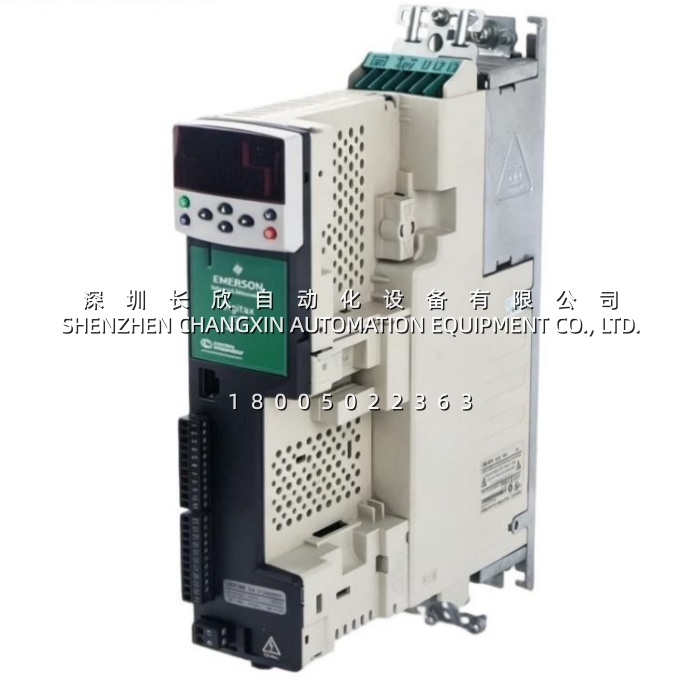
On the cross-sealing axis of a high-speed packaging machine, the servo motor must deliver a sharp torque pulse at the instant the sealing jaw closes, then drop back to a low-load following profile. This is a classic pulse-duty application: specify by continuous current alone and the drive is over-sized, wasting cost and cabinet space; specify by peak demand and every acceleration cycle trips the overload protection. The DST1405 sits precisely at this sweet spot in the Digitax ST lineup—its 3× peak capability (24 A for 0.25 s) covers the sealing jaw’s instantaneous impact, while the 8 A continuous rating keeps the drive compact enough that the cabinet layout needs no additional clearance. When the machine builder later needed an EtherCAT option module to tighten synchronization between the film feed axis and the cross-seal axis, the same DST1405 chassis accepted the plug-in communication card directly—no drive replacement, no change to the panel cutout or wiring layout.
Parameter
| Parameter | Value / Description |
|---|---|
| Product Model | DST1405 (Manufacturing Part No. 3098-0070) |
| Manufacturer | Emerson / Control Techniques (now Nidec) |
| Product Series | Digitax ST Servo Drive, 400V class |
| Input Voltage | 380–480 V AC, three-phase, 48–65 Hz |
| Continuous Output Current | 8.0 A rms |
| Peak Output Current | 24.0 A rms (3× overload for 0.25 s) |
| Supply Power (no choke) | 3.32 kW |
| Supply Power (with choke) | 3.65 kW |
| Switching Frequency | 3 / 4 / 6 / 8 / 12 kHz selectable |
| Internal DC Bus Capacitance | 220 μF |
| Internal Brake Resistor | 70 Ω |
| Safety Function | Safe Torque Off (STO), SIL 3 / PL e / Cat. 3 |
| Protection Rating | IP20 |
| Weight | Approx. 2–3 kg |
| Dimensions (reference) | Approx. 330 × 70 × 230 mm |
Technical Principles and Innovative Values
- Pulse-Duty Optimization, Not Just “More Power”: The DST1405 is not simply the largest unit in the Digitax ST family—it is positioned specifically for intermittent, peak-dominated load profiles. The 3× overload window (24 A / 0.25 s) and 2.5× window (20 A / 2 s) cover the acceleration spikes of packaging, labeling, and robotic joint axes without derating for peak current. Engineers who size drives strictly by continuous current will systematically under-specify this class of application.
- Option-Slot Architecture Reduces Spare-Parts Burden Across the Lifecycle: Communication and feedback interfaces on the DST1405 are plug-in modules, not fixed onboard ports. A unit shipped with analog command and resolver feedback can later be upgraded to EtherCAT or a second encoder by swapping only the communication and feedback cards—the drive chassis, panel cutout, and mounting holes remain unchanged. For OEMs exporting to multiple regions with different fieldbus preferences, this compresses the spare-parts model count substantially.
- Onboard STO Eliminates a Separate Safety Relay: The DST1405 includes Safe Torque Off as standard, certified to SIL 3 / PL e. In simple safety circuits such as “door open, torque removed,” this removes the need for an additional safety contactor and relay logic—cutting both cabinet space and wiring complexity.
- Current-Loop Bandwidth Supports High Dynamic Response: A 1100 Hz current-loop bandwidth and 160 Hz speed-loop bandwidth mean the establishes torque quickly after receiving a command, suiting sealing, labeling, and pick-and-place sequences where cycle time is critical. With selectable 6–12 kHz switching frequency, noise and losses can be traded off against the actual cabinet environment.