Application Scenarios:
A municipal water treatment plant is adding a third filter train. The control room has one Quantum rack already, built around a 6-slot backplane that was adequate when the plant had two trains and a modest I/O count. Now the new train brings another eighty discrete points — valve position feedbacks, level switches, pump run contacts, differential pressure switches — plus a handful of analog loops, and there is simply no room in the existing chassis. The alternatives are not attractive: a second rack means a second power supply, a second CPU or a remote I/O drop, more panel space, more engineering and more commissioning time.
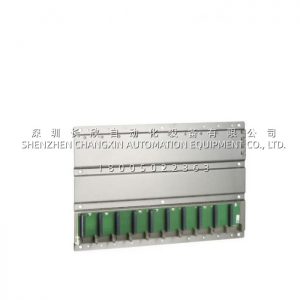
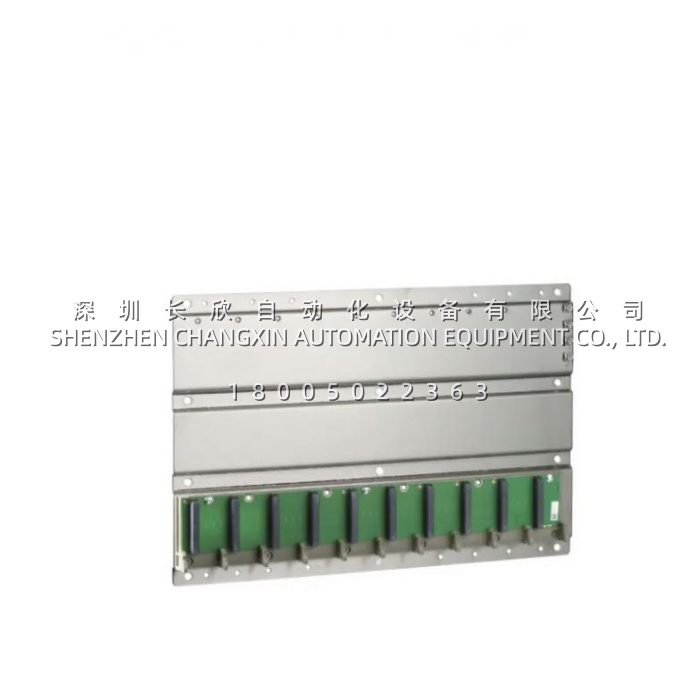
Replacing the 6-slot baseplate with the 140XBP01000 resolves it in one step. Ten slots against six means the CPU, the power supply, the communication modules and all the I/O — old and new — live in a single local rack. The existing field wiring, terminal strips and cabinet stay where they are; the modules are transferred slot by slot into the new backplane, and the configuration, because Quantum addressing is tied to slot position, is mapped deliberately rather than left to chance. There is no remote I/O network to commission, no additional processor to license, and no latency added between the CPU and its I/O.
That is the recurring value proposition of the 140XBP01000 across industries. In power generation, it serves as the local rack for boiler or turbine auxiliary control where deterministic local I/O matters more than distributed flexibility. In oil and gas, the same backplane is used the other way round — as a remote I/O drop in a field skid, where a network adapter module occupies a slot and the remaining positions carry the field I/O close to the process. In discrete manufacturing, mining and materials handling, it is the standard home rack for machine and line control where the I/O count is moderate but the environment is not. The pain point it answers is always the same: how to fit the required module count into available cabinet space without paying for distributed architecture you do not need.
Parameter:
Physical dimensions and weight are reported inconsistently across supplier listings for this part, so the table below gives the consistently stated figures and flags the ranges you should verify against your panel layout.
| Parameter | Value / Description | What it means for you |
|---|---|---|
| Product Model | 140XBP01000 | Schneider Electric catalogue number for the 10-slot Quantum baseplate |
| Manufacturer | Schneider Electric (Modicon) | Genuine Schneider Electric hardware |
| Product Category | Rack backplane / I/O baseplate | Passive module carrier, not an intelligent module |
| Host Platform | Modicon Quantum automation platform | Fits only Quantum 140-series modules — not M340, Premium or Compact |
| Slot Capacity | 10 slots | Accommodates CPU, power supply, communication and I/O modules in one chassis |
| Usable I/O Slots | Typically 8–9 after the power supply and CPU | Slot 1 normally takes the power supply, slot 2 the CPU; plan the remainder for I/O |
| Supported Architectures | Local I/O, remote I/O (RIO) drops, distributed I/O | One backplane model serves centralised and remote duties across a plant |
| Bus Type | Proprietary high-speed parallel Quantum backplane bus | Deterministic module-to-module exchange without network jitter |
| Active Electronics | None — fully passive interconnect | No firmware, no configuration, no capacitors or processors to fail |
| Power Distribution | Distributes backplane logic power to all installed slots | Total current is limited by the power supply module, not the backplane |
| Hot-Swap Support | Yes for I/O modules, subject to compatible CPU and configuration | Module replacement without a full rack shutdown — confirm your CPU supports it |
| Mounting | Screw fixation to a flat mounting plate (typically 4 fixings) | Mount on a rigid, grounded metal panel; DIN-rail kits are used in some installations |
| Material | Ruggedised metal frame / aluminium-steel construction | Structural rigidity plus a large-area grounding path for EMI drainage |
| Operating Temperature | 0 °C to +60 °C | Standard control-cabinet rating; governed partly by the modules installed |
| Storage Temperature | −40 °C to +85 °C | Spares can be stored without special conditions |
| Humidity | 5% to 95% non-condensing | Suitable for humid plant environments inside an enclosure |
| Environmental Ratings | Approximately 15 g shock (11 ms) and 2 g vibration from 5 to 150 Hz | Holds connectors seated in turbine halls, pump stations and crusher houses |
| Protection Rating | IP20 — cabinet installation required | Not for field mounting without an enclosure |
| Certifications | CE, UL 508, CSA C22.2 No 142, FM Class I Division 2 | Approved for industrial and hazardous-location panels |
| Dimensions | Commonly quoted around 428 × 290 mm face, roughly 104–155 mm deep | Listings vary — verify against your cabinet cut-out before ordering |
| Weight | Commonly quoted around 1 kg, with listings ranging to roughly 2.7 kg | Confirm with the supplier if shipping weight matters |
| Power Supply | Not included — purchased separately | Budget for a 140CPS-series module in slot 1 |
| Slot Covers | Not included — order blank plates separately for unused slots | Keeps dust out and preserves airflow across populated modules |
| Lifecycle Status | Legacy Quantum platform hardware; supported through specialist spares channels | Hold spares if you are maintaining an installed Quantum base |