
Application Scenarios
Picture a fossil-unit auxiliary switchgear room. The 125 V DC station battery feeds valve-limit contacts, breaker auxiliary blocks and VFD ready/fault relays scattered across three buildings. A control house panel brings those dry contacts into a ControlLogix 1756-A13 rack beside the operator. For years the original 1756-IB16Is were patched in with a shared DC return, and every thunderstorm or large motor start wrote a ghost event into the alarm historian — a “breaker tripped” that never happened, acknowledged and logged at 3 a.m. by a tired operator.
The fix was not another surge suppressor. The plant re-terminated that group onto a 1756-IH16I, one channel per device, each with its own floating reference. The ghost events stopped on the first scan after cutover. What the maintenance crew noticed second was the troubleshooting win: with per-point isolation and a green LED per channel, a bad contact, a broken shield or a swapped polarity shows up at the terminal block, not as a vague “rack comms degraded” in RSLinx. The module paid for itself the first time a false trip didn’t become a turbine-protective logic investigation.
Parameter
| Main Parameters | Value / Description |
|---|---|
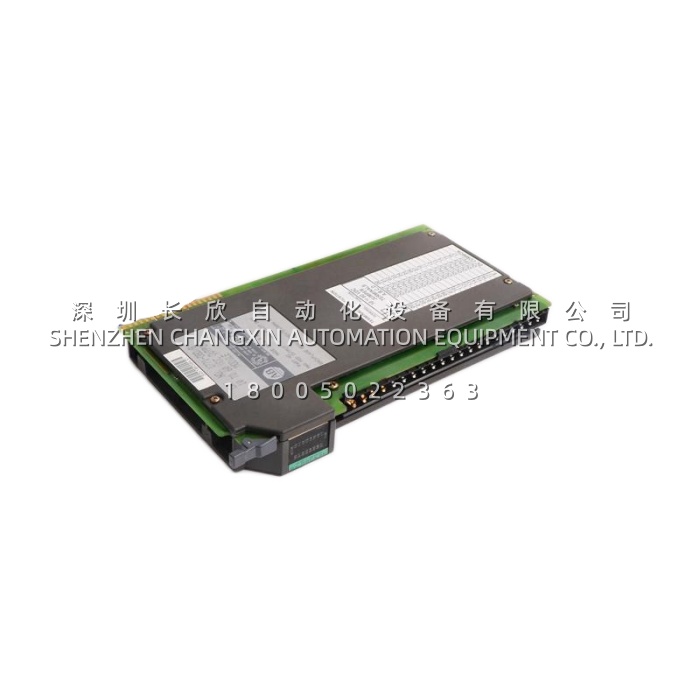
| Product Model | 1756-IH16I — ControlLogix 125V DC isolated discrete input, 16 pt |
| Manufacturer | Allen-Bradley, Rockwell Automation (USA / Japan origin) |
| Product Category | ControlLogix 1756 chassis I/O module — digital (discrete) input |
| Number of inputs | 16, individually isolated (no common bus, no group shared return) |
| Voltage category | 125 V DC nominal, sink/source (field devices source or sink current) |
| Operating range | 90…146 V DC. Temperature-derated: 16 ch @ ≤30 °C and ≤125 V; at 50 °C / 146 V only 12 ch may be driven; 14 ch at 55 °C / 132 V. Design the panel for the ambient, not the brochure |
| Input current | 1 mA min @ 90 V DC (ON threshold) → 3 mA max @ 146 V DC. OFF-state current ≤0.8 mA, OFF-state voltage ≤20 V DC |
| Input delay | 6 ms hardware delay plus user-selectable filter: 0 / 1 / 2 / 9 / 18 ms per channel (OFF→ON ≈ 1 ms hardware, ON→OFF ≈ 4 ms hardware) |
| Isolation | 250 V DC continuous channel-to-channel and channel-to-backplane; functional isolation tested to 1500 V AC class. This is what kills ground loops |
| Backplane load | 5.1 V DC: 125 mA typical; 24 V DC: 3 mA. Module power ≈0.6 W, dissipation ≤5 W @ 60 °C (~17 BTU/h) |
| Field wiring | 36-pin removable terminal block, not included — order 1756-TBCH (screw) or 1756-TBS6H (spring clamp). 22…14 AWG stranded, 2 mm², 1.2 mm insulation |
| Diagnostics / indicators | 16 per-channel input LEDs + Module OK / Fault / Force Active. Filter, electronic keying, change-of-state and timestamp data exposed in Logix Designer |
| Time capability | Cyclic update down to 200 µs class; timestamp source is the backplane time sync. For μs-level SOE, use the 1756-IH16ISOE instead |
| Environment | 0…+60 °C, 5…95% RH non-condensing; IEC 60068 vibration/shock; Pollution Degree 2. Open-style module, needs the chassis and cabinet |
| Certifications | UL Listed (UL 508, File E65584), CSA, CE (EN 61326-1, EN 61131-2, Zones A/B), C-Tick, FM / c-UL Class I Div 2 A,B,C,D |
| Software / firmware | Studio 5000 Logix Designer (RSLogix 5000) with 1756 Discrete I/O AOP / EDS. Confirm module series against controller firmware rev before you flash anything |
| Lifecycle | Active per Rockwell Product Compatibility tool, with firmware builds through v3.004 and current AOP releases — unlike the HMI and comms spares in this family, this one still draws OEM stock |
Conflicts in the field data are worth naming. Some sellers list the 1756-IH16I as 10–30 V DC, 120/240 V AC, or 1500 V “continuous” isolation. Those are other 1756 input families (IB/IV and IA/IC). The OEM decode is unambiguous: IH = 125 V DC, isolation is 250 V continuous with 1500 V AC as the test/dielectric class. Buy against the nameplate, not the listing copy.
Technical Principles and Innovative Values
Innovation Point 1 — Isolation is per point, not per group. Most “isolated” input cards isolate the block from the backplane and then tie eight points to one common. The 1756-IH16I puts a barrier on every single channel, so channel 3 can sit on a battery-backed DC supply in Building A while channel 4 reads a sensor whose negative is tied to a drive-frame ground in Building B. There is no return-current path between them. That is why the module ends up in substations and not in standard machine-tool panels — it solves a wiring topology problem, not a density problem.
Innovation Point 2 — 125 V DC is a deliberate voltage choice. Station battery, elevator hoistway contacts, crane runway limits, legacy pulp-machine DC clutches, turbine lube-pump auxiliaries — they all live at 125 V DC because a dry contact at that potential survives arc, corrosion and insulation leakage better than a 24 V signal over 300 m of tray. The 1756-IH16I lets you land those signals straight into a Logix rack without an interposing relay, a separate barrier or a 24 V translation supply that becomes its own failure point.
Innovation Point 3 — Filter by channel, not by card. Contact bounce on a 500 A breaker auxiliary is not the same noise profile as a solid-state proximity output. The 1756-IH16I lets you set 0/1/2/9/18 ms independently per point in the I/O configuration, so the fast points stay fast and the noisy mechanical contacts stop chattering — without buying a second module or adding ladder debounce timers that hide the real event from the event task.
Innovation Point 4 — Producer/Consumer means one input, many consumers. Because ControlLogix moves I/O over the backplane as CIP produce/consume data, the state of a point can be consumed by the local controller, a second controller in the same chassis, and an EtherNet/IP node across the plant — no duplicate wiring, no “we need another contact” relay. For interlocking a shared piece of equipment between a DCS and a PLC, this is the cleanest trick in the rack.
Innovation Point 5 — Hot swap is real, if you respect the rules. The 1756 chassis supports removal and insertion under power for the , which means a failed channel bank can be swapped without dropping the processor or the rest of the I/O scan. The caveat is discipline: verify electronic keying matches, keep the RTB wiring intact on the dead unit until the live one is seated, and expect the controller to flag a brief module fault. Done right it is a coffee-break repair; done casually it is a nuisance trip.
Innovation Point 6 — The SOE cousin is one slot away. Need microsecond event ordering for protective-relay forensics? The 1756-IH16ISOE is the same form factor with a 75 µs hardware path and SOE event buffering. The stays the right call when you need ordinary, bulletproof discrete status with per-point isolation and you would rather not pay for timestamp silicon you will never query.


