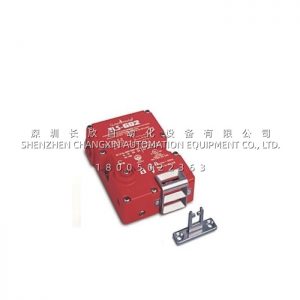
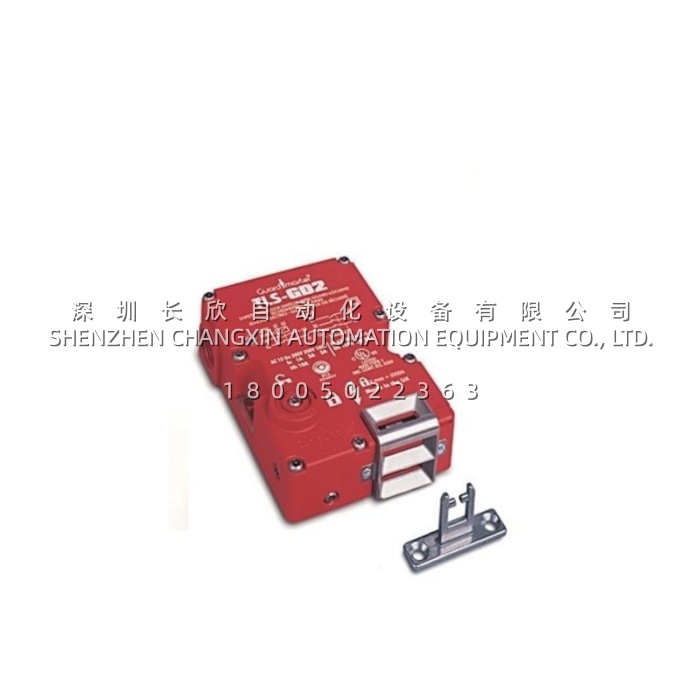
Application Scenarios:
A tier-one automotive supplier runs a robot welding cell where the manipulators take close to nine seconds to coast to a standstill after a stop command. The cell doors were fitted with standard non-locking interlocks. In theory, operators waited for the standstill lamp. In practice, on a line running to a tight takt time, they pulled the door the moment the cycle stopped — and more than once reached into a cell that was still moving.
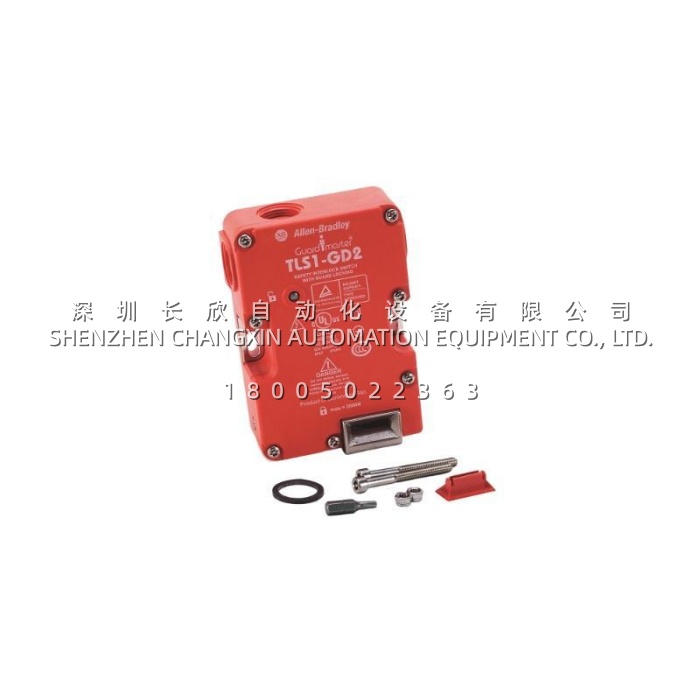
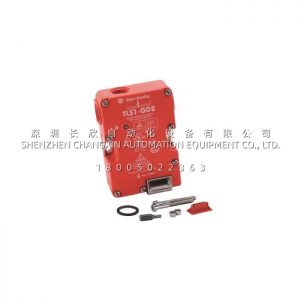
Fitting Allen-Bradley 440G-T27181 units to those doors removed the human factor from the equation. The guard stays bolted while the coil is de-energised, and the safety controller only energises it after the stopped-motion detector confirms zero speed. Pull the handle as hard as you like against 2,000 N of holding force — roughly 450 lbf — and the door does not move. The same behaviour pays off on packaging machines, palletisers, and any process where opening a guard mid-cycle damages tooling or spoils product, not just where it injures people.
Parameter:
| Parameter | Value/Description |
|---|---|
| Product Model | 440G-T27181 (UPC 611320489552) |
| Manufacturer | Allen-Bradley / Rockwell Automation, Guardmaster brand; country of origin Dominican Republic |
| Product Category | Guard locking safety interlock switch (solenoid-controlled, positive-mode tongue operated) |
| Series / Configuration | 440G TLS-GD2, model type TLS-3 GD2; TLS-3 is the variant built for clean interfacing into dual-channel safety relays |
| Locking Principle | Power to release — the guard stays locked while the solenoid is de-energised and can be opened only when an external signal energises the coil (typically from a timer relay or stopped-motion detector) |
| Solenoid Voltage | 24 V AC/DC (50/60 Hz AC or DC), approx. 7 W continuous — one part number covers both AC and DC control supplies |
| Holding Force (Fzh) | 2,000 N (450 lbf) — the static pull the locked bolt withstands before the guard can be forced |
| Safety Contacts | 2 N.C., forced (positive) opening, break-before-make — both channels must close before the safety circuit is made |
| Auxiliary Contact | 1 N.O., used for door-position or lock-status feedback to the PLC / HMI |
| Solenoid Monitoring Contacts | 2 N.C. — verify the actual position of the lock bolt rather than just the electrical command to it |
| Contact Ratings | Ith 10 A; AC-15 (A600): 6 A at 120 V, 3 A at 240 V, 1.2 A at 600 V; DC-13: 2 A at 24 V; minimum switching load 3 mA at 18 V DC |
| Insulation / Impulse Withstand | Ui 500 V, Uimp 2.5 kV — adequate for direct use on industrial control circuits |
| Actuator / Head | GD2 standard actuator supplied; stainless-steel actuator guide; rotatable head with two entry slots giving four approach directions, blanking plug included |
| Conduit Entry | M20 body thread with 1/2 in NPT adapter fitted |
| Enclosure Rating | IP66 / IP67 as standard; IP69K rated, so it survives high-pressure, high-temperature washdown |
| Housing Material | Glass-filled plastic, uncoated |
| Operating Temperature | -20 °C to +60 °C (-4 °F to +140 °F) |
| Mechanical Life | 1,000,000 operating cycles minimum |
| Dimensions / Weight | Body approx. 126 × 86 × 43 mm (H × W × D); net weight 0.585 kg; confirm the exact TLS-3 envelope on the Rockwell 2-D drawing before panel layout |
| Standards / Certifications | Conforms to ISO 14119 (EN 1088) and IEC/EN 60947-5-1; also referenced to IEC/EN 60204-1, NFPA 79, ANSI B11.19, AS 4024.1. Marked CE, cULus, TÜV, CCC, KC, EAC; UL Listed as of 2025-04-26 |
| Functional Safety | Intended for dual-channel safety architectures; achievable PL per ISO 13849-1 and SIL per IEC 62061 depend on the complete circuit and must be validated by the machine risk assessment |
| Escape Release | Not fitted on this variant — see the alternative products below if full-body access applies |
| Lifecycle Status | Active (not discontinued) |
Technical Principles and Innovative Values:
- Innovation Point 1 — release follows the machine, not the operator: with Allen-Bradley 440G-T27181, the coil is de-energised whenever the guard is held. Opening becomes a deliberate act by the control system, gated on a timer relay or a stopped-motion detector. On machines that coast, that single property is the difference between a safe cell and a lucky one.
- Innovation Point 2 — bolt position is monitored, not assumed: many guard locks report only that the solenoid has been commanded. The 440G-T27181 carries two N.C. solenoid monitoring contacts wired back to the safety relay, so the circuit sees whether the bolt actually moved. A coil that has burned out or a mechanism that has jammed shows up as a fault rather than as a false “unlocked” signal.
- Innovation Point 3 — TLS-3 solves a wiring problem most integrators hit: dual-channel safety relays dislike solenoid locks, because monitoring the safety contacts and the lock feedback in series can leave you short of channels. The TLS-3 configuration exists specifically to remove that conflict, which is why this variant is specified on 440G-T27181 rather than the simpler TLS-1 build.
- Innovation Point 4 — the head rotates, so the door does not have to be perfect: two entry slots, four approach directions, and a stainless-steel actuator guide that absorbs misalignment from guard sag and hinge wear. On a sliding door that has been in service for years, that guide saves the switch from being destroyed by a tongue arriving a millimetre off-centre.
- Innovation Point 5 — it is built for the washdown, not just the datasheet: IP69K means hot high-pressure water, the environment that kills ordinary interlock switches on food, dairy, and pharmaceutical lines. Combined with a glass-filled housing and a stainless actuator, 440G-T27181 tolerates the cleaning regime that the rest of the plant already runs.
Application Cases and Industry Value:
Case 1 — robot welding cell, automotive tier-one: Six cell doors were retrofitted with after a near-miss during a tool-change window. The integrator wired the solenoid release through a stopped-motion detector rather than a fixed timer, so the lock releases on proof of standstill instead of on an assumed delay. Measured across the following twelve months, the cell recorded no unauthorised entries during motion, and — unexpectedly — cell availability improved slightly: because the release is granted on confirmed standstill, operators no longer hesitated or cycled the door twice before entering. Maintenance reported the switch needed nothing beyond the weekly function check.
Case 2 — ready-meal production line, food manufacturer: The plant was replacing interlock switches on cooker and filler guards roughly every four months. Water was getting past the seals during the nightly 80 °C caustic washdown, and the stainless tongues were galling against misaligned door hardware. Switching those positions to addressed both failure modes: the IP69K enclosure stopped the ingress, and the stainless actuator guide absorbed the misalignment that had been chewing through tongues. Switch replacements on that line dropped to zero over the next two audit periods, and the engineering team standardised on the part for all new washdown-area guarding.