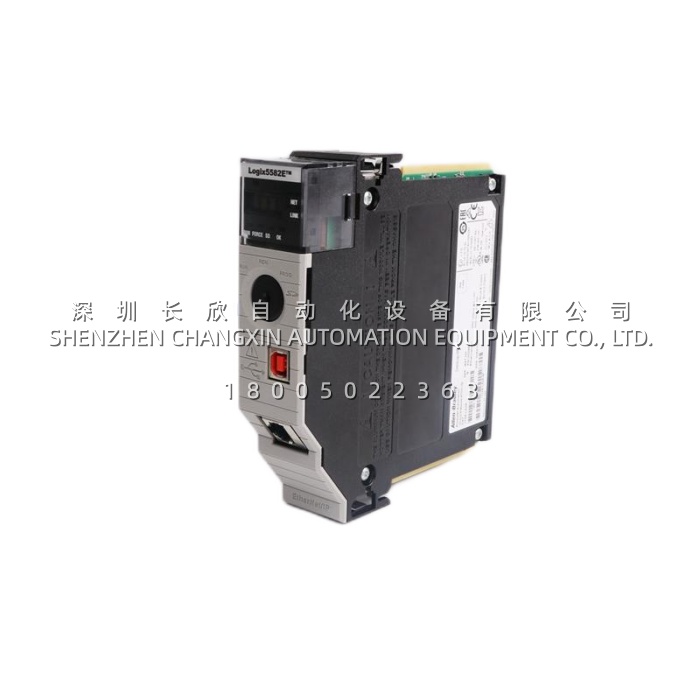
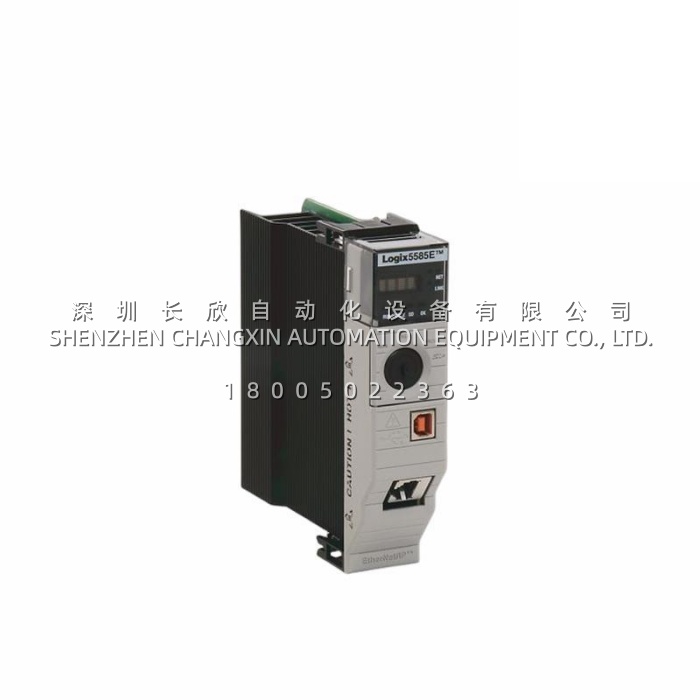
Application Scenarios
A tier-one automotive supplier commissioned a flexible body-shop line with 38 welding robots, 12 servo-driven fixtures, and over 200 distributed EtherNet/IP devices spanning four control zones. The original architecture relied on multiple mid-range controllers with inter-controller messaging for zone coordination, but synchronization delays during model changeovers caused fixture collisions and forced conservative line speeds. The engineering team consolidated the line under a single 1756-L85E, using its 300-node EtherNet/IP capacity to host the entire device population and its 256-axis motion support to integrate the servo fixtures alongside the robot controllers on the same network . During the first changeover after commissioning, the controller executed the full reconfiguration sequence—fixture repositioning, robot program selection, and weld schedule loading—without the inter-controller handshakes that previously added several seconds of dead time. The line now runs at the higher speed tier, and the maintenance team reports that having a single tag database for the entire line has simplified fault tracing from the HMI down to individual drive parameters.
Parameter
| Parameter | Value/Description |
|---|---|
| Product Model | 1756-L85E |
| Manufacturer | Allen-Bradley / Rockwell Automation |
| Product Category | ControlLogix 5580 programmable automation controller |
| User Memory | 40 MB |
| EtherNet/IP Nodes Supported | 300 (Logix Designer v28 or later) |
| Communication Ports | 1× USB 2.0 full-speed Type B; 1× EtherNet/IP (10/100/1000 Mbps) |
| Integrated Motion | Up to 256 axes on EtherNet/IP |
| Controller Tasks | 32 tasks; 1,000 programs per task |
| Programming Languages | Ladder Diagram (LD), Structured Text (ST), Function Block Diagram (FBD), Sequential Function Chart (SFC) |
| Backplane Power | 5 mA @ 1.2 V DC; 1.20 A @ 5.1 V DC |
| Power Dissipation | 6.2 W at full load |
| Display | 4-character alphanumeric |
| Lifecycle Status | Active |
Key parameter notes: the 300-node EtherNet/IP capacity is firmware-dependent—Logix Designer version 28 or later is required to reach the full limit . The 1 Gb Ethernet port supports high-performance communication, I/O, and motion control on a single network, eliminating the need for a separate motion bus in most servo applications. The “E” suffix denotes enhanced features including the embedded 1 Gb port and expanded memory compared with earlier 5580 variants.
Technical Principles and Innovative Values
- 40 MB User Memory for Large Tag Databases and Recipe-Heavy Processes: The 1756-L85E provides five times the memory of the 1756-L83E (10 MB) and double the 1756-L84E (20 MB), accommodating applications where extensive recipe management, historical buffering, or complex interlocking logic would otherwise force program segmentation across multiple controllers . In a pharmaceutical packaging line with hundreds of SKU-specific parameter sets and batch record buffering requirements, the 40 MB capacity allows a single controller to retain all active recipes in memory without round-tripping to external storage during changeovers—reducing changeover time and eliminating a class of communication-related faults.
- 1 Gb EtherNet/IP Backbone with 300-Node Capacity: The embedded 1 Gb port on the 1756-L85E is not merely a faster programming connection; it serves as the primary control network backbone. With 300 directly configurable EtherNet/IP nodes, the controller can host large device populations—drives, remote I/O, safety modules, and third-party gateways—without cascading managed switches or adding communication modules . For a packaging hall with 150+ servo axes and distributed I/O across multiple machines, the single-controller approach simplifies network architecture and removes inter-controller messaging latency from the control loop.
- 256-Axis Integrated Motion on EtherNet/IP: The 1756-L85E supports up to 256 motion axes over the same EtherNet/IP network used for I/O and controller-to-controller communication, a capability that traditionally required dedicated Sercos or analog motion interfaces . In a converting line with dozens of synchronized servo rolls, this integration means motion commands, position feedback, and I/O status share a common time base without gateway translation. The practical benefit appears during tuning and troubleshooting: motion and I/O data are visible in the same Studio 5000 tag browser, and a single network capture can reveal whether a registration error originated in the drive, the feedback device, or the controller’s motion planner.