
Application Scenarios
Picture a robotic weld cell with a light curtain, two safety mats, a three-position enabling device, and a servo press that must observe Safe Limited Speed during teach mode. The standard logic is unremarkable — conveyor interlocks, weld schedules, HMI pop-ups. The safety logic is not: it has to cross-validate the curtain inputs, kill STO to the drives inside the certified timing window, and leave an auditable signature that nobody changed the trip setpoint last Tuesday.
That cell was originally commissioned on a 1756-L63S. It ran for years, but the program grew: more analog blocks for the weld schedule, more AOIs for the newer servos, and the safety task was bumping the 3.75 MB partition. Dropping in a 1756-L73S doubled the safety memory and doubled the standard partition again, with no new chassis, no new network, and no re-certification of the safety function itself — only the required safety validation and re-sign. The e-stop still lands on the same two terminals, the drives still see the same CIP Safety telegrams, and the audit trail is cleaner than it was on the original hardware.
Parameter
| Main Parameters | Value/Description |
|---|---|
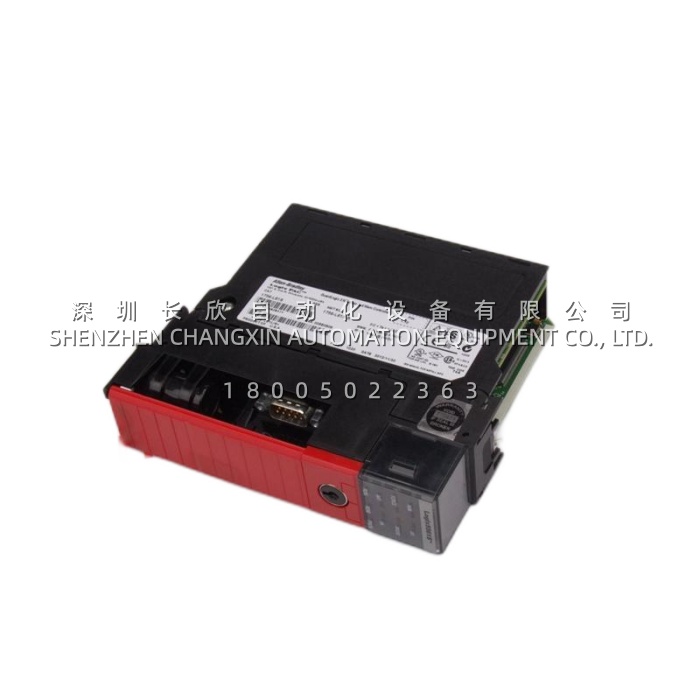
| Product Model | 1756-L73S — primary GuardLogix 5573S processor; “A”/“B” denote Series letter |
| Manufacturer | Allen-Bradley, Rockwell Automation |
| Product Category | Safety Programmable Automation Controller (GuardLogix 5570 processor module) |
| Standard Memory | 8 MB user memory — logic, data, HMI tag mirror, AOI expansion |
| Safety Memory | 4 MB, independently partitioned and signed; invisible to the standard task |
| I/O Memory | 0.98 MB (shared model with the standard L73) |
| I/O Capacity | 128,000 digital, 4,000 analog, 128,000 total — distributed across the 1756 backplane and remote networks |
| Controller Connections | 500 CIP connections, shared across standard and safety traffic |
| Tasks | 1 safety task + 31 standard tasks; up to 100 programs per task; safety task has its own priority and watchdog |
| Safety Architecture | 1oo2: primary + 1756-L7SP partner in the slot immediately to the right; both streams execute on diverse silicon and cross-check |
| Certifications | IEC 61508 SIL 3, ISO 13849-1 PL e / Category 4, ANSI/PMMI B155.1 — certification is pair-dependent |
| Integrated Motion | 100+ axes over EtherNet/IP (CIP Motion); drive-based STO/SS1 from v30, controller-based SS1/SS2/SOS/SLS/SLP/SDI from v31 |
| Communications | No onboard Ethernet — USB 2.0 for programming/firmware only; EtherNet/IP, ControlNet, DeviceNet via 1756-ENxT / 1756-CNx / 1756-DNB |
| Nonvolatile Storage | 1 GB SD card (1784-SD1) ships with every controller; 2 GB (1784-SD2) optional |
| Energy Retention | Capacitor ESM — 1756-ESMCAP ships installed; no lithium battery to schedule, no cells to leak |
| Backplane Load | 800 mA @ 5.1 V DC, 5 mA @ 1.2 V DC — 2.5 W dissipation, 8.5 BTU/hr |
| Isolation / Environment | 30 V continuous (basic, USB-to-system, type-tested 980 V AC / 60 s); 0…60 °C, 5…95% RH non-condensing; open-style, T4A / T4 |
| Chassis Fit | 1756-A4(K), A7(K), A10(K), A13(K), A17(K); occupies two adjacent slots (primary + partner) |
| Dimensions / Weight | ≈145.2 × 34.6 × 139.6 mm, ≈0.25 kg (primary only) |
| Programming | Studio 5000 Logix Designer / RSLogix 5000 v20 or later, GuardLogix safety profile |
| XT Variant | 1756-L73SXT — conformal coated, -25…70 °C, must pair with 1756-L7SPXT; note the XT envelope is -25…60 °C when mixed with non-XT parts |
| Status | Active Mature — new designs are steered to GuardLogix 5580; 5570 spares remain a maintenance-critical line item |


