
Application Scenarios
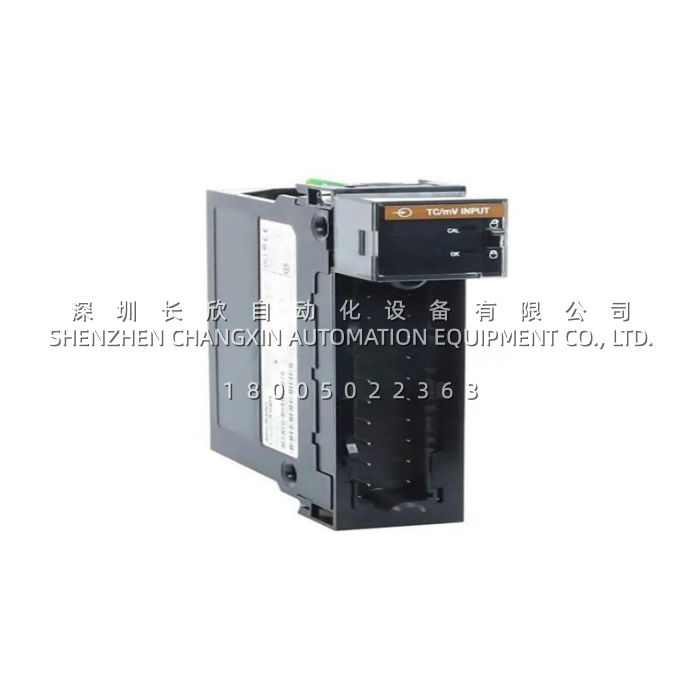
A specialty chemical reactor trains requires tight temperature control across six independent reaction zones, each monitored by a Type K thermocouple. The zones operate at different potentials due to resistive heating elements and variable-frequency drives sharing the same grounded enclosure. A non-isolated input module in this environment would create ground loops that introduce measurement drift and, in worst cases, damage the module’s front end. The 1756-IT6I addresses this directly: its 250 V continuous channel-to-channel isolation breaks the ground loop path, allowing each thermocouple to float at its own common-mode potential without corrupting adjacent readings. During a batch run where an exothermic reaction can escalate temperature by 15°C per minute, the module’s 16-bit resolution and configurable digital filter provide the control system with stable, responsive temperature data—enough to trigger cooling interlocks before the reaction reaches the safety limit. For processes where a single inaccurate temperature reading can mean a ruined batch or a safety incident, the 1756-IT6I provides the measurement integrity that the application demands.
Parameter
| Parameter | Value/Description |
|---|---|
| Product Model | 1756-IT6I |
| Manufacturer | Allen-Bradley / Rockwell Automation |
| Product Category | ControlLogix isolated thermocouple/millivolt input module |
| Number of Inputs | 6, individually isolated |
| Input Signal Ranges | -12 to 78 mV; -12 to 30 mV (high-resolution range) |
| Thermocouple Types | B, C, E, J, K, N, R, S, T |
| Resolution | 16-bit |
| Isolation | 250 V continuous between inputs |
| Data Format | Integer mode and IEEE 32-bit floating point |
| Real Time Sample (RTS) | 25 ms to 10,000 ms (50 ms minimum when linearizing to temperature) |
| Backplane Current | 250 mA at 5 V DC; 125 mA at 24 V DC |
| Power Dissipation | 4.3 W maximum |
| Operating Temperature | 0 to 50 °C |
| Removable Terminal Block | 1756-TBNH or 1756-TBSH |
| Lifecycle Status | Discontinued (March 31, 2017); functional replacement available |


