
Application Scenarios
Take a batch reactor skid with six Pt100 elements on the jacket, two Type K probes in the vapor line, and a mV-output pressure transmitter that nobody bothered to route through a separate card. The old rack had a 1756-IR6I and a 1756-IT6I side by side, and the maintenance team still had two open channels they could not use because mixing sensor families meant re-wiring into a different module. When the IR6I started flagging spurious opens during the mixer’s high-vibration cycles, the fix was not another 6-channel card.
Dropping in a 1756-IRT8I/A consolidated the skid onto one slot: 4-wire RTDs on the first four channels, Type K on the next two, and the mV transducer on channel 7, with channel 8 held as the hot spare the plant had been asking for. The 250 V channel-to-channel isolation killed the ground-loop noise that had been riding the shared return, and the 1 ms module scan meant the PID loop no longer lagged the exotherm. Same backplane, same tags after a remap, one-third the cabinet real estate.
Parameter
| Main Parameters | Value/Description |
|---|---|
| Product Model | 1756-IRT8I/A — “A” = Series A hardware revision; Series B is the later CJC/EMC-refined build |
| Manufacturer | Allen-Bradley, Rockwell Automation |
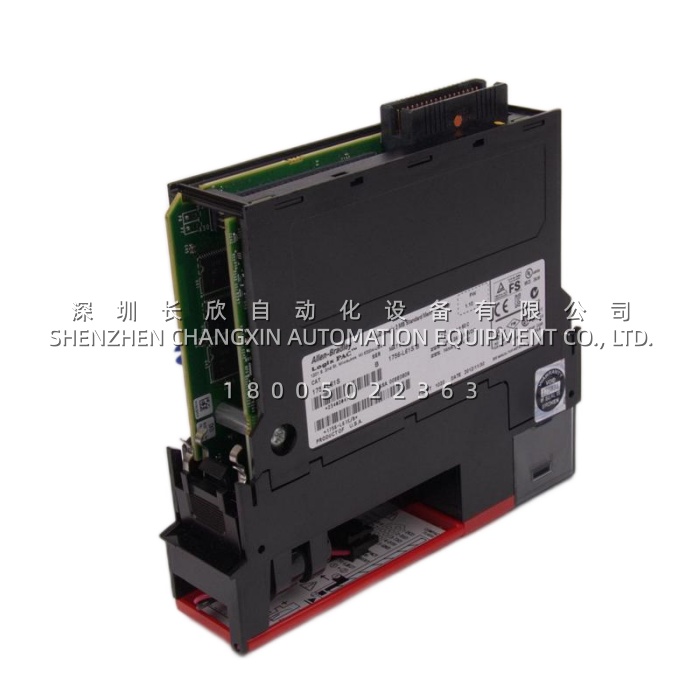
| Product Category | Analog Input Module, ControlLogix 1756 I/O family (temperature/low-level) |
| Input Channels | 8 individually isolated differential inputs — mix RTD, TC, resistance and mV freely, per channel |
| Input Types | RTD: Pt100/200/500/1000 (α=385, α=3916), Ni100/120/200/500 (α=618, α=672), Cu10 (α=427); TC: B, C, D, E, J, K, N, R, S, T, TXK/XK (L); mV: ±100 mV |
| Measurement Ranges | 1…500 Ω, 2…1000 Ω, 4…2000 Ω, 8…4000 Ω, −100…+100 mV |
| Resolution | 24-bit sigma-delta ADC; 0.06 mΩ/count (0…510 Ω), 0.01 µV/count (mV) — the finest granularity in the 1756 temp family |
| Data Format | IEEE 32-bit floating point, delivered as engineering units straight into the controller tag |
| Module Scan Time | 1 ms minimum — fast enough that the module is never the limiting term in a PID loop |
| Accuracy | 0.05% calibrated accuracy at 25 °C; 0.1% across the full operating range; CJC ±0.3 °C |
| Isolation | 250 V continuous; reinforced inputs-to-backplane, basic channel-to-channel — breaks ground loops cold |
| Diagnostics | Open-wire detect (2 s for TC/3-wire RTD, 5 s for 4-wire RTD), over/under-range, CJC fault, lead-resistance compensation |
| Backplane Load | 5.1 V DC: 200…250 mA; 24 V DC: 150 mA — 4.6 W max, 15.7 BTU/hr; no field power supply required |
| RTD Excitation | 600 µA current source, input impedance ≈1 GΩ, ±30 V DC overvoltage protection |
| Noise Rejection | 75 dB normal mode @ 60 Hz; 125…160 dB common mode (depends on filter/differential setting) |
| CJC Provision | Two module-supplied CJC reference sensors, ±0.3 °C; 1756-CJC kit for external/IFM mounting is ordered separately |
| Terminal Block | 36-pin removable RTB, ordered separately: 1756-TBNH (screw), 1756-TBSH (spring clamp), 1756-TBCH (cage-clamp option) |
| Environmental | 0…60 °C operating, 5…95% RH non-condensing; RIUP hot-swap supported on current backplane/firmware |
| Certifications | UL 508 / UL 61010-1, CSA, CE, ATEX / IECEx, KC, RCM, EAC, CCC (confirm rev-specific cert sheet) |
| Configuration | Studio 5000 / RSLogix 5000, AOP-based; firmware family v3.2 → v5.2 |
| Status | Mature/end-of-new-lifecycle platform part — supplied as tested surplus, reconditioned, or exchange stock |
Technical Principles and Innovative Values
Innovation Point 1 — Per-channel isolation changes the wiring rules. On a non-isolated temp card, every sensor shares a return and every ground potential difference becomes a measurement. The 1756-IRT8I/A puts 250 V of continuous isolation between channel and channel and between channel and backplane, so a sensor strapped to a vessel at a different earth potential no longer contaminates its neighbor. In practice that means you stop “chasing ghosts” with a multimeter and start trusting the trend.
Innovation Point 2 — One slot, four signal families, zero jumpers. Older ControlLogix temp I/O was split by sensor: RTDs on one card, thermocouples on another, mV nowhere. The 1756-IRT8I/A lets each channel be declared independently in the AOP — Pt100 on 1, Type K on 2, mV on 3 — so the I/O tree finally matches the skid instead of the catalog. No re-terminating, no spare-card gymnastics.
Innovation Point 3 — 24 bits of sigma-delta, delivered as a float. The converter oversamples and noise-shapes the tiny RTD delta or thermocouple microvolt, then hands the controller a 32-bit IEEE float already in engineering units. At 0.06 mΩ per count on the low resistance range, a Pt100 moving 0.0039 Ω per 0.01 °C is no longer rounded off before the PID sees it. You feel this as stability in the last decimal place, not as a headline spec.
Innovation Point 4 — CJC that does not bake in its own heat. The module uses two reference junctions and the 1756-CJC kit extends them to the actual terminal point. Compare that with the single-CJC design of the legacy 1756-IT6I, where self-heating and a covered terminal block could push the reference 5…16 °F off ambient. The 1756-IRT8I/A architecture is one of the reasons it is the preferred replacement rather than a like-for-like swap.
Innovation Point 5 — Diagnostics that fail safe, not silent. An open wire, a CJC fault, and an over-range each get their own status bit in the channel tag, and the process value can be driven to a configured upscale or downscale fault value. That lets the logic execute a safe-state routine — trip the heater contactor, hold the valve, page the on-call tech — instead of quietly holding the last good number while a probe falls out.
Application Cases and Industry Value
Case 1 — Batch reactor, chemical specialties, ControlLogix 5570. The skid carried six 4-wire Pt100s on a 1756-IR6I plus two Type Ks on a 1756-IT6I. During agitation, the IR6I channel 4 would drift 1.8 °C and flag open, throwing the jacket PID into manual and costing roughly one off-spec batch per month. The plant dropped in a 1756-IRT8I/A, re-homed all eight probes plus a spare onto the same module, and used the 4-wire RTD excitation with the module’s lead-resistance compensation enabled. The 250 V channel isolation removed the coupled noise, and the 1 ms scan tightened the PID response enough that the exotherm overshoot dropped from 4.2 °C to 1.6 °C. Maintenance’s verdict: one module, one spare slot freed, and the “ghost drift” disappeared. The only rework was the I/O tag remap and a new 1756-TBSH block — no conduit, no new chassis.
Case 2 — Cement kiln nose-ring instrumentation, ATEX Zone 2. A kiln upgrade needed eight temperature points across the hood, and the existing rack was full. Running a second chassis for one more 6-channel card was a non-starter, and the probes were a mix of Pt100 (jacket cooling) and Type K (shell and gas). A took the whole ring in one slot, with the CJC kit mounted at the terminal entry so the hot cabinet wall could not become the reference junction. The open-wire detect fired within two seconds when a pull-cord thermocouple fractured during a clinker surge — fast enough that the DCS alarmed the operator before the shell temperature crossed the trip setpoint. The site’s gain was not just density; it was that a broken probe no longer looked like a process event.


