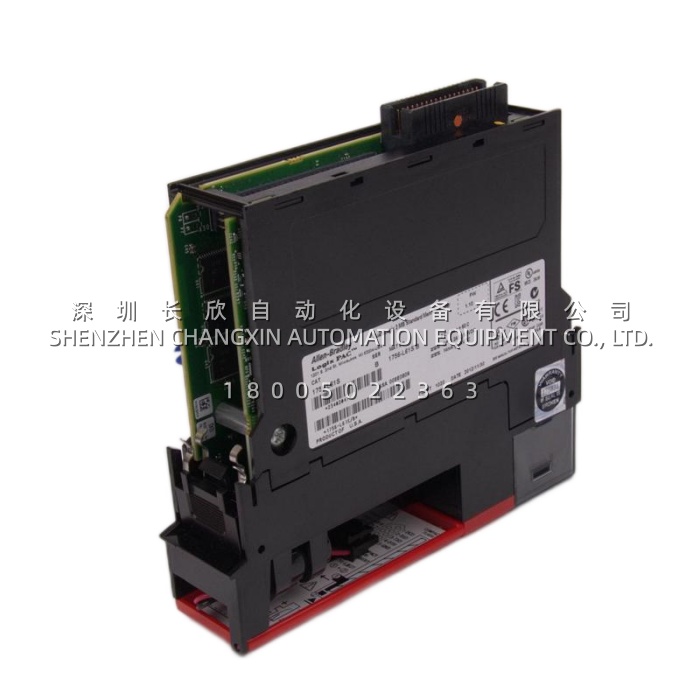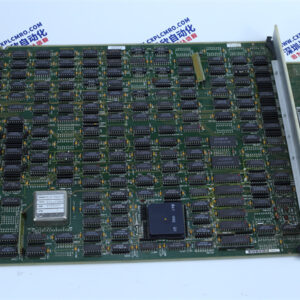
Technical Specifications
| Parameter Name | Parameter Value |
|---|---|
| Product Model | 1752-L24-24AWA (controller); 1752-L24BBE (expansion I/O) |
| Manufacturer | Rockwell Automation / Allen-Bradley |
| Product Type | SmartGuard 600 Standalone Safety Controller / Safety I/O Expansion Module |
| Product Family / Platform | Bulletin 1752 SmartGuard 600 |
| Safety I/O Points | 24 (8 inputs, 4 solid-state outputs, 4 configurable I/O) |
| Expansion Module Points | 24 (8 safety inputs, 16 safety outputs) |
| Maximum System Safety I/O | 128 points; up to 16 safety outputs |
| Input Voltage | 24 V DC |
| Input Current Rating | 4 A |
| Input OFF-State Current | Less than 1.3 mA |
| Input Channel Type | Single-channel or dual-channel (2 input channels per 1 safety input) |
| Output Type | Solid state |
| Output Voltage | 24 V DC |
| Output Current | 0.5 A |
| Output Fusing | 2 A |
| Output Leakage Current | 1.3 mA |
| Output ON Voltage Drop | 2.5 V at 0.5 A |
| Output Surge Current | 4 A for 10 ms |
| Reaction Time | 12 ms typical |
| Cycle Time | 7 ms |
| Internal Relay (wetting voltage) | 24 V DC, 0.1 A, 0.25 A surge for 10 ms |
| Power Supply Input | 24 V DC, 8 W |
| Power Dissipation | 8 W |
| Thermal Dissipation | 27.3 BTU/hr |
| Communication Ports | RS-232 serial; DeviceNet (DeviceNet Safety capable) |
| Expansion Connection | Expansion I/O cable to 1752-L24BBE modules |
| Programming Software | RSLogix 5000 v16.03.00+; Studio 5000 Logix Designer v21.00.00+ |
| Safety Program Protection | Password protected |
| Enclosure Type Rating | None (open-style) |
| Dimensions (controller) | 3.7 x 4.1 x 2.8 in (93.7 x 103.1 x 70.4 mm) |
| Dimensions (expansion module) | 3.7 x 4.1 x 2.1 in (93.7 x 103.1 x 53.6 mm) |
| Weight | 0.64 lb (0.29 kg) |
| Operating Temperature | 0 to 55 °C (32 to 131 °F) |
| Storage Temperature | -40 to 85 °C (-40 to 185 °F) |
| Relative Humidity | 5 to 95%, non-condensing |
| Certifications | CE, CSA, C-UL, FM, ATEX, IECEx, RCM, CCC, EAC, KC |
| Lifecycle Status | Active |
Main Features and Advantages
A standalone safety decision, not a dependent module:
The 1752-L24-24AWA runs the safety program on board and drives its outputs directly, so the safety function does not wait for a main controller scan or depend on the main PLC being healthy. This is the defining advantage of a standalone safety controller over a safety I/O module: the safety logic continues to execute and the outputs continue to be driven correctly even if the main controller is faulted, updating, or offline.
Function-block safety logic with password protection:
Rather than asking engineers to reproduce safety functions in ladder, the 1752-L24-24AWA configures safety through dedicated function blocks in RSLogix 5000 and Studio 5000 Logix Designer. Emergency stop, two-hand control, muting, safety mat, and lockout functions are assembled from tested building blocks, and the safety program is password protected so unauthorized changes cannot be made on the floor. This both reduces engineering effort and strengthens the change-control discipline that safety systems require.
Dual-channel input architecture:
Each safety input on the 1752-L24-24AWA uses two input channels, so a single-field device such as an emergency-stop button or a safety gate switch is monitored for both contacts. A discrepancy between the two channels is treated as a fault, which is how the controller detects a welded contact, a broken wire, or a defeated switch. The result is a safety input that fails toward a known, safe state rather than silently degrading.
Scalable to 128 safety I/O without changing platforms:
The 1752-L24-24AWA supports up to 128 safety I/O points across the controller and its 1752-L24BBE expansion modules, with up to 16 safety outputs. The expansion connection uses a dedicated cable rather than a network, so adding points does not consume DeviceNet or Ethernet bandwidth and does not introduce network latency into the safety reaction time. For machine builders, this means one controller family covers a small single-cell machine and a larger multi-cell line.