Technical Specifications
| Parameter Name | Parameter Value |
|---|---|
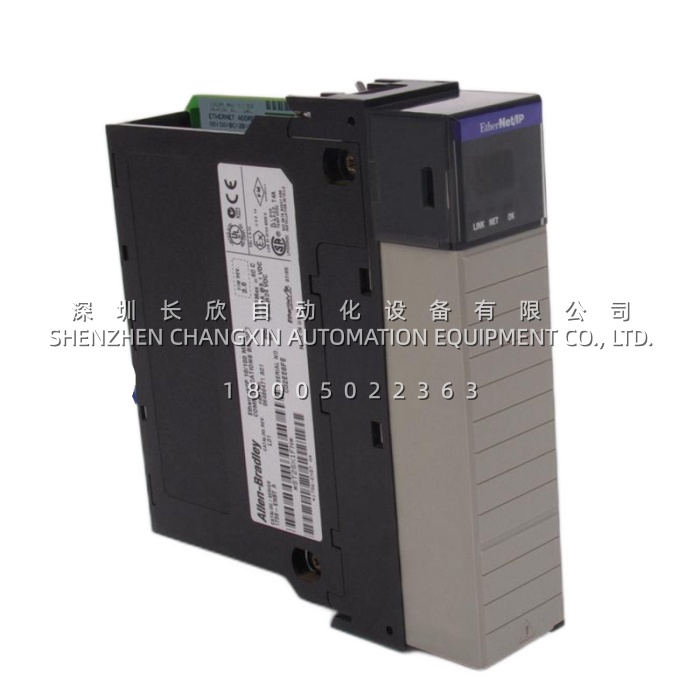
| Product Model | Allen-Bradley 1747-L553/C SLC 500 Processor |
| Manufacturer | Rockwell Automation (Allen-Bradley) |
| Product Type | Modular programmable controller (CPU) |
| Product Family | SLC 500, 5/03 generation |
| Series / Revision | Series C (-C) |
| User Program Memory | 64 KB |
| Data Logging Memory | 32 KB |
| Total I/O Capacity | 4096 points |
| Local I/O Racks | 3 racks |
| Communication Channels | 1 x DH-485, 1 x RS-232 (DB-9) |
| DH-485 Data Rate | 57.6 KBaud |
| RS-232 Configuration | Program, PanelView terminal or printer capable |
| Instruction Execution | 1 ms typical for bit and word instructions |
| Backplane Current Draw | 480 mA at 5 V DC |
| Power Dissipation | 3.5 W maximum |
| Programming Software | RSLogix 500 |
| Supported I/O | 1746 digital, analogue, specialty and communication modules |
| Chassis Requirement | 1746-A4, A7, A10 or A13 with 1746 power supply |
| Indicators | Run, Fault, Battery, Force, DH-485 activity, RS-232 activity |
| Battery | 1747-BA lithium battery for program and data retention |
| Dimensions (H × W × D) | 144.5 × 34.6 × 130.2 mm (5.69 × 1.36 × 5.12 in) |
| Weight | 0.22 kg (0.49 lb) |
| Operating Temperature | 0 °C to +60 °C (32 °F to 140 °F) |
| Storage Temperature | -40 °C to +85 °C (-40 °F to +185 °F) |
| Relative Humidity | 5 % to 95 % non-condensing |
| Shock and Vibration | 30 g operating shock; 2 g @ 10–500 Hz vibration |
| Certifications | UL 508, CSA C22.2 No. 213, CE, C-Tick; CSA Class I Division 2 Groups A–D where marked |
Main Features and Advantages
Mid-range memory that matches the installed base: The 64 KB of user program memory in the Allen-Bradley 1747-L553/C SLC 500 Processor is the feature that defines its market position. It is large enough to hold meaningful discrete logic, several analogue loops, data logging and math routines, yet it does not carry the cost of the 128 KB 1747-L554. The separate 32 KB data logging area is the important detail: trend data and recorded values do not consume program space, and the processor can retain useful process history through short power interruptions when the 1747-BA battery is healthy. For plants that have watched their logic grow over a decade of incremental changes, this separation is what keeps the original controller viable.
Dual communication interfaces without a dedicated module: The combination of a DH-485 channel and a dedicated RS-232 port gives the Allen-Bradley 1747-L553/C SLC 500 Processor connectivity that would otherwise consume a second chassis slot. The DH-485 network carries programming traffic from RSLogix 500 and supports the 1747-KE and 1747-KY interface modules for connection to DH+ and other networks. The RS-232 port, meanwhile, can drive a PanelView operator terminal, feed a serial printer or support a direct connection to a laptop. In a chassis that may already contain an analogue module, a motion module and a remote I/O adapter, retaining that slot is a genuine advantage.
Fast instruction execution for a mature platform: A 1 ms typical execution time for bit and word instructions is more than adequate for the relay ladder logic, timer/counter sequences and PID loops that constitute the bulk of SLC 500 applications. The processor’s predictable scan behaviour makes timing calculations straightforward, which is one reason the platform remains popular in applications where the control strategy must be understood by successive generations of maintenance staff. The 4096 total I/O capacity and 3-rack local I/O addressing provide room for expansion without redesigning the panel.
Series C refinements and broad compatibility: The -C revision of the Allen-Bradley 1747-L553/C SLC 500 Processor incorporates the firmware and hardware refinements of the 5/03 generation and is the version most commonly specified for replacement today. It is the designated replacement for the 1747-L541 and 1747-L542, which means a large installed base can be standardised on a single spare part number. Compatibility with the full range of 1746 I/O modules—digital, analogue, temperature, motion and specialty—preserves the field wiring and termination investment that often exceeds the value of the controller itself.
Lifecycle and supply-chain value: The SLC 500 installed base is among the largest in industrial automation, and the 5/03 generation is particularly common because it introduced DH-485 and RS-232 as standard. The Allen-Bradley 1747-L553/C SLC 500 Processor therefore enjoys strong aftermarket availability, and its role as a direct replacement for earlier processors broadens the applicability of a single spare. Stocking a tested, correctly revision-matched unit is one of the lowest-cost safeguards against a rack-down event, and it protects the substantial investment represented by existing I/O configurations, DH-485 network addresses and validated control logic.