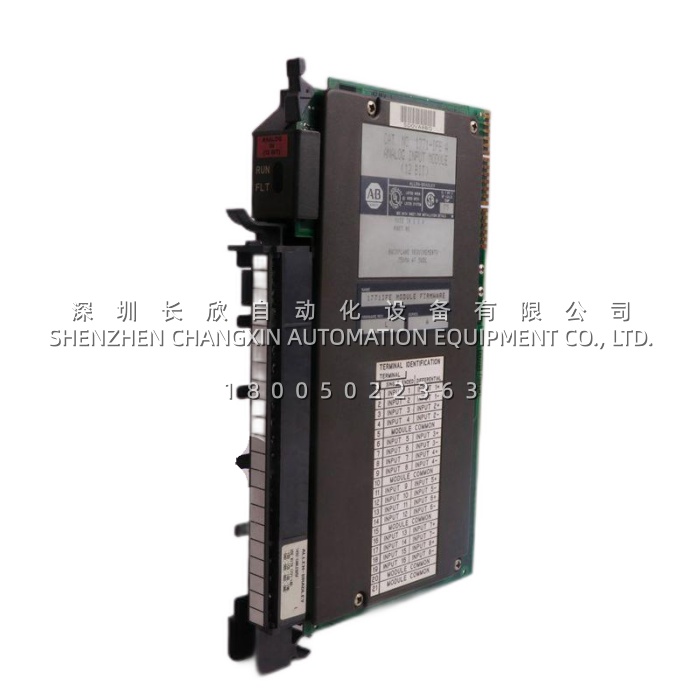
Technical Specifications
| Parameter Name | Parameter Value |
|---|---|
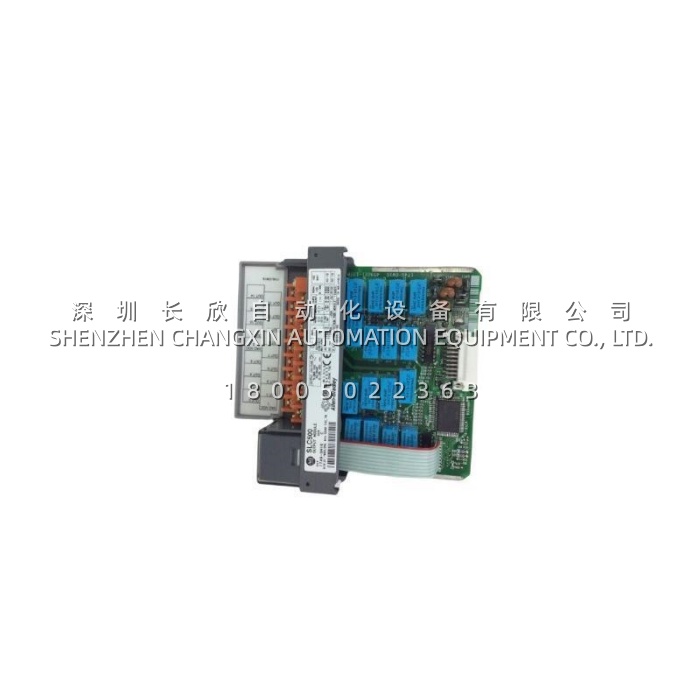
| Product Model | 1746-OW16 |
| Manufacturer | Rockwell Automation / Allen-Bradley |
| Product Type | SLC 500 Relay Output Module |
| Product Family / Platform | Bulletin 1746 SLC 500 |
| Number of Outputs | 16, normally open (Form A / SPST-NO) |
| Output Type | Electromechanical relay, dry contact |
| Isolation | Electrically isolated outputs |
| Contact Rating @ 250 V AC | 2 A per point (resistive) |
| Contact Rating @ 125 V AC | 4 A per point (resistive) |
| Contact Rating @ 24 V DC | 2 A per point |
| Contact Rating @ 48 V DC | 1 A per point |
| Maximum Load Current | 2 A per point; 32 A total backplane |
| Surge Current | 10 A for 100 ms |
| Minimum Load Current | 10 mA |
| Initial Contact Resistance | 30 mΩ |
| Life Expectancy (mechanical) | 10,000,000 operations |
| Life Expectancy (load dependent) | 1,000,000 operations at rated load |
| Maximum AC Switching Voltage | 250 V AC |
| Maximum DC Switching Voltage | 125 V DC |
| Off-State Leakage Current | 0 mA |
| On-State Voltage Drop | Less than 1 V |
| Backplane Current @ 5 V DC | 780 mA |
| Backplane Current @ 24 V DC | 2 mA |
| Power Dissipation | 4.5 W (at 60 °C) |
| Thermal Dissipation | 15.4 BTU/hr (at 60 °C) |
| Field Device Wiring Terminals | 20 |
| Fusing | Individually fused and overload protected |
| Status Indicators | 1 green module-status LED; 2 red overload/fuse-blown LEDs |
| Module Location | Any slot in SLC 500 chassis (fixed or modular) |
| Module Width | 1 SLC 500 slot |
| Weight | 0.32 kg (0.70 lb) |
| Operating Temperature | 0 to 60 °C (32 to 140 °F) |
| Storage Temperature | -40 to 85 °C (-40 to 185 °F) |
| Relative Humidity | 5 to 95%, non-condensing |
| Certifications | CE, CSA, C-UL, FM, ATEX, IECEx, RCM, CCC |
| Lifecycle Status | Discontinued effective October 31, 2023; “Other” replacement |
Main Features and Advantages
True dry-contact switching with no leakage:
Because every output on the 1746-OW16 is an electromechanical relay rather than a transistor or triac, the off-state leakage current is zero. That is a material advantage when the load is a sensitive device, a low-current solenoid, or a circuit where even a few milliamps of leakage would cause a false operation. The contact is a genuine open circuit when de-energized, and the less-than-1 V on-state drop means negligible power loss in the module itself.
One module covers AC and DC switching:
The 1746-OW16 is not limited to a single voltage class. Its contacts switch up to 250 V AC at 2 A and up to 125 V DC, with a 4 A rating at 125 V AC and 1 A at 48 V DC. A single module type can therefore serve indicator lamps, small solenoids, contactor coils, motor starters, and DC control circuits across the panel. For OEMs and spare-parts programs this universality reduces the number of output-module variants that must be stocked.
Independence and isolation simplify the panel:
The sixteen outputs of the 1746-OW16 are independently fused and electrically isolated from one another, so a shorted field device or a blown fuse on one point does not disable the other fifteen. This is the kind of fault containment that prevents a single wiring error from taking down an entire machine function, and it removes the need for external interposing relays in many applications.
Diagnostic visibility without a laptop:
The 1746-OW16 carries three status LEDs — one green for module health and two red for overload and fuse-blown conditions. A technician standing in front of the cabinet can identify a blown fuse or an overloaded point instantly, without opening the programming software or removing the module. In a high-volume production environment this is the difference between a five-minute repair and a protracted fault-finding session.