Technical Specifications
| Parameter | Value |
|---|---|
| Product Model | V18345-2010521001 |
| Manufacturer | ABB |
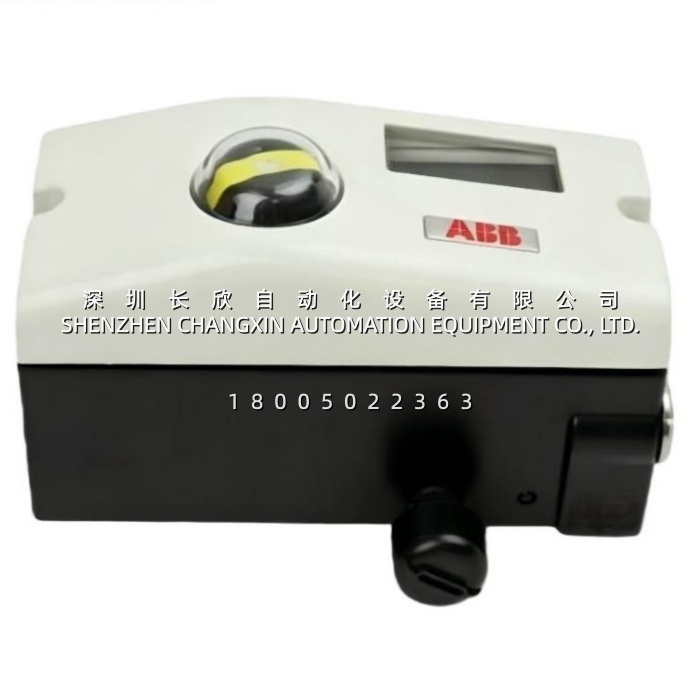
| Product Type | Intelligent Electro-Pneumatic Valve Positioner |
| Product Family | TZIDC (Positioner3) |
| Actuator Type | Single Acting, Linear |
| Signal Type | 4–20 mA + HART |
| HART Revision | 5 or 6 |
| Operating Voltage | 90–240 VAC |
| Supply Air Pressure | 1.4 to 7 bar (20 to 100 psi) |
| Fail-Safe Mode | Fail-Safe to Open (spring return) |
| Control | Piezoelectric pilot valve, digital signal processing |
| Temperature Range | -40 to +85 °C (-40 to +185 °F) |
| Enclosure Rating | IP66 / NEMA 4X |
| Housing Material | Stainless Steel |
| Approximate Dimensions | 175 × 152 × 93 mm |
| Approximate Weight | 3.3 kg |
| Mounting | Direct to actuator (NAMUR or bracket) |
Main Features and Advantages
Digital control delivers measurable positioning performance. The V18345-2010521001 uses fully digital signal processing rather than the mechanical force-balance mechanisms found in conventional positioners. This gives it high positioning accuracy, excellent repeatability, and resistance to vibration and temperature effects that can cause analog positioners to drift. The piezoelectric pilot valve consumes air only during positioning correction, reducing instrument air consumption and making the positioner well suited to installations where compressed air supply is constrained or costly.
HART communication turns every positioner into a diagnostic point. With HART 5/6 support carried over the 4–20 mA loop, the V18345-2010521001 can be configured, calibrated, and interrogated remotely using a handheld communicator or asset management system. This means setpoint characterization, dead band adjustment, split-range configuration, and alarm limits can all be changed without removing the valve from service or opening the positioner housing. For maintenance teams, the ability to retrieve valve signature and travel survey data remotely changes valve management from a periodic strip-down activity into a condition-based program.
Self-calibration reduces commissioning time. The TZIDC family supports automatic calibration, allowing the V18345-2010521001 to characterize the actuator’s travel range and adapt its control parameters without manual adjustment of cams, levers, or range springs. This is particularly valuable on linear valves with non-linear inherent characteristics, where correct positioning requires setpoint characterization rather than a simple linear transfer function.
Rugged housing for harsh environments. The stainless-steel enclosure with IP66 / NEMA 4X protection allows the V18345-2010521001 to operate in environments with moisture, corrosive atmospheres, and temperature extremes. The specified operating range of -40 to +85 °C covers outdoor installation in cold climates, high-temperature process areas, and sun-exposed pipe racks without requiring environmental conditioning.
Fail-safe-to-open behavior supports process safety requirements. In single-acting, fail-safe-to-open configuration, the V18345-2010521001 moves the valve to its open position on loss of signal or air supply. This behavior is specified for processes where flow-on-failure is the safer state — cooling water valves, vent paths, and certain relief and bypass applications. The correct selection of fail direction is determined by the process safety case, and must be verified against the valve specification before installation.
Application Field
The is deployed across process industries wherever a pneumatic control valve requires accurate, responsive positioning and the associated diagnostic capability. In oil and gas production and transmission, it controls separator level and pressure control valves, gas metering valves, and emergency shutdown valve auxiliary positioning, where the cost of a valve performance deviation can be measured in lost throughput or environmental exposure.
In chemical and petrochemical plants, the positioner is used on reactor feed, reflux, steam, and utility valves. Here, the HART diagnostic capability allows control valve performance to be monitored as part of the plant’s asset management program, identifying issues such as packing friction increase, actuator diaphragm degradation, and positioner calibration drift before they affect product quality or cause a trip.
Power generation represents another significant application area. The is installed on boiler feedwater, condensate, desuperheating, and extraction steam valves, where precise positioning directly affects both efficiency and unit stability. In these services, fail-safe-to-open behavior may be specified for valves whose open position supports safe plant shutdown or supports post-trip cooling.
Water and wastewater treatment, pulp and paper, food and beverage, and pharmaceutical manufacturing complete the range of applications. In pharmaceutical and biotech service, the positioner’s stainless-steel housing and cleanability support installation in sanitary and washdown areas, while its digital communication capability supports the validation and change-control documentation required by GMP-regulated facilities.
Across all of these sectors, the solves the same core problem: converting a 4–20 mA control signal into accurate valve position while providing the visibility needed to detect and correct performance degradation before it becomes a process event.