Technical Specifications
| Parameter | Value |
|---|---|
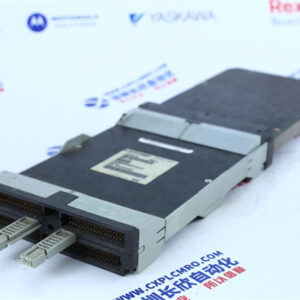
| Product Model | 81EU01E-E (Order No. GJR2391500R1210) |
| Manufacturer | ABB |
| Product Type | Universal Input Module (Generic Input Card) |
| System Compatibility | Procontrol P13 / Procontrol P14 DCS Platform |
| Number of Channels | 16 channels, independently configurable |
| Analog Input Signal | 4-20mA current, 0-10V voltage (from 2-wire/4-wire transmitters) |
| Digital Input Signal | Binary signals from switches, pushbuttons, relay contacts, inductive starters |
| Signal Amplification | 16× signal gain capability |
| Signal Linearization | Thermocouple nonlinearity compensation supported |
| Communication Interface | Procontrol Station Bus / Local Bus |
| Self-Diagnostics | Open-circuit & short-circuit detection with LED alarm |
| Front-Panel Indicators | LED status & fault indication |
| Configuration Method | Software-configurable per channel (digital or analog) |
| Power Supply | Via Procontrol backplane bus |
| Diagnostic Functions | Real-time fault detection, front-panel alarm display |
| Operating Temperature | 0°C to +60°C (typical industrial control cabinet environment) |
| Dimensions (L×H×W) | 198 mm × 261 mm × 20 mm |
| Weight | Approx. 0.5 kg |
| Country of Origin | Switzerland / Germany |
| Lifecycle Status | Legacy “Classic” product – available as certified spare or refurbished unit |
| Application Sector | Power generation, turbine control, substation automation, DCS |
Main Features and Advantages
The defining strength of the 81EU01E-E GJR2391500R1210 is its universal channel flexibility. Each of the 16 input channels can be independently configured via software for either digital or analog signal acquisition, allowing a single module to handle diverse field device types without hardware changes. Whether interfacing with a simple limit switch, a relay contact, or a sophisticated 4-20mA smart transmitter, the 81EU01E-E GJR2391500R1210 adapts seamlessly to the application requirements, dramatically reducing spare parts inventory complexity for maintenance teams managing large-scale automation systems.
Signal conditioning excellence sets the 81EU01E-E GJR2391500R1210 apart in the legacy Procontrol ecosystem. The module’s built-in 16× signal amplification capability ensures reliable acquisition from low-level field signals, while integrated thermocouple linearization processing compensates for nonlinear temperature-response characteristics, delivering accurate and ready-to-use data to the control system. This eliminates the need for external signal conditioners and simplifies panel wiring, reducing both material costs and engineering effort.
Intelligent self-diagnostics represent a major reliability advantage of the 81EU01E-E GJR2391500R1210. The module continuously monitors each channel for open-circuit and short-circuit conditions, immediately alerting operators through front-panel LED indicators when faults are detected. This proactive fault detection capability enables maintenance personnel to identify and resolve wiring issues before they escalate into process disruptions, significantly improving mean-time-between-failures (MTBF) and reducing unplanned downtime.
Seamless Procontrol P13/P14 integration ensures the 81EU01E-E GJR2391500R1210 operates as a native component of ABB’s proven power plant control platform. Communicating via the dedicated station bus interface, the module delivers deterministic data exchange with the central control level, supporting the millisecond-level response times required for turbine control, boiler protection, and substation automation. The module inherits the full robustness of the Procontrol P13 architecture, a system that has been providing safe and reliable power plant operation for over 30 years across more than 500 units worldwide.
Lifecycle assurance through ABB’s “Evolution without obsolescence” commitment gives owners of the long-term confidence. Although categorized as a “Classic” lifecycle product no longer recommended for new installations, ABB continues to manufacture certified spare parts and offer professional refurbishment services for the series, ensuring that existing power plants can maintain their automation infrastructure for decades to come. This sustained support, combined with the module’s inherent reliability, makes the an exceptionally low-risk investment for legacy system maintenance.