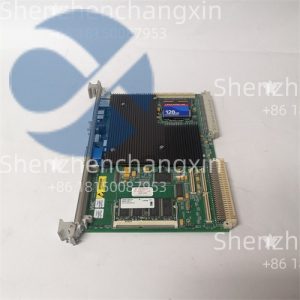
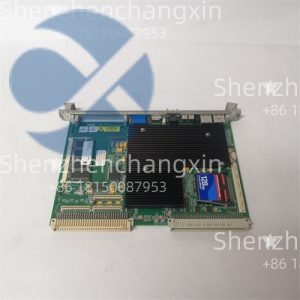
GE VMIVME-7452 | Dual-Port Shared Memory Board: The Ideal Choice for VMEbus Real-Time Applications
In fields with extremely high real-time requirements, such as industrial automation, aerospace, and defense technology, the VMEbus architecture has become a core component of critical mission systems due to its high bandwidth, low latency, and reliability. The VMIVME-7452 dual-port shared memory board, introduced by GE Fanuc (now part of GE Industrial Systems), is designed to meet the stringent demands of these scenarios. This article will delve into its technical characteristics, application scenarios, and industry value, providing engineers with selection guidance.
I. Product Overview: A Shared Memory Solution Optimized for Real-Time Applications
The VMIVME-7452 is a high-performance VMEbus dual-port shared memory board from GE Fanuc, utilizing a shared memory architecture that allows two independent processors to directly access the same memory area via the VME bus. This design significantly reduces data transfer latency and avoids the protocol overhead of traditional bus communication, making it particularly suitable for real-time systems requiring high-speed data exchange.
Key Features
Dual-port design: Supports simultaneous access to shared memory by two VME master devices, enabling parallel data processing and improving system throughput.
Large memory capacity: Onboard 256MB of shared memory to meet the needs of large-scale real-time data processing, expandable to 512MB.
Low-latency access: Shared memory access latency is as low as nanoseconds, far lower than the microsecond latency of traditional bus communication.
VMEbus compatibility: Complies with the VME64 standard, supporting a 32-bit data bus and a 64-bit address space, ensuring seamless integration with existing VME systems.
Real-time operating system support: Compatible with real-time operating systems such as VxWorks and RT Linux, ensuring precise task scheduling.
II. Technical Analysis: How Shared Memory Architecture Improves Real-Time Performance
1. Shared Memory vs. Traditional Bus Communication
Traditional VME bus communication requires data exchange through a protocol stack, which has the following bottlenecks:
Protocol overhead: Data packet encapsulation, verification, and retransmission mechanisms consume extra bandwidth.
Arbitration delay: When multiple master devices compete for the bus, they must wait for arbitration to complete.
Interrupt handling: Data arrival triggers an interrupt, increasing CPU load. The VMIVME-7452’s shared memory architecture achieves the following advantages through physical memory sharing:
Zero-copy data transfer: Data can be moved directly between memory locations, avoiding CPU involvement.
Arbitration-free access: The dual-port design allows parallel access, eliminating bus contention.
Deterministic latency: Access time is fixed, meeting the stringent response time requirements of real-time systems.
2. Actual Performance Comparison
In an avionics test system, engineers compared the performance of the VMIVME-7452 with traditional VME bus communication:
Data transfer rate: In shared memory mode, the data transfer rate increased threefold, reaching 200 MB/s.
Reduced latency: Latency decreased from 10 μs with the traditional bus to 2 μs, meeting the real-time requirements of avionics systems.
Reduced CPU load: Data exchange requires no CPU intervention, improving overall system performance by 40%.
III. Application Scenarios: From Industrial Automation to Defense Technology
1. Industrial Automation: Real-time Control and Data Acquisition
In the field of intelligent manufacturing, the VMIVME-7452 is used in high-speed motion control systems. For example, a car production line uses this board to achieve synchronous control of multi-axis robotic arms, transmitting motion commands and sensor data through shared memory to ensure precise synchronization of each axis’s movements, shortening the production cycle from 15 seconds to 12 seconds.
2. Aerospace: Real-time Flight Data Processing
In avionics test systems, the VMIVME-7452 is used to process real-time data from flight data recorders (FDRs). Through shared memory, the test system can simultaneously receive data from multiple sensors and perform real-time analysis, ensuring flight safety. One airline reported that after adopting this board, the data loss rate decreased from 0.1% to 0.01%.
3. Defense Technology: Radar Signal Processing
In radar systems, the VMIVME-7452 is used to achieve real-time processing of multi-channel radar signals. Through shared memory, multiple processing units can access the same set of data in parallel, improving the accuracy and speed of target detection. A defense project test showed that the system’s target recognition rate increased by 25% in complex electromagnetic environments.
IV. User Reviews and Expert Recommendations
1. User Feedback
Advantages: Low latency, high bandwidth, easy integration, significantly improving system real-time performance. Challenge: The synchronization mechanism for shared memory requires careful design to avoid data races.
2. Expert Recommendations
Requirements Assessment: Before choosing the VMIVME-7452, clearly define the system’s requirements for real-time performance, bandwidth, and capacity.
System Design: It is recommended to use a dual-port access synchronization mechanism, such as semaphores or mutexes, to avoid data conflicts.
Future Expansion: As VMEbus evolves to VME64x, attention should be paid to the compatibility of the board with the new generation of buses.
V. Conclusion: An Ideal Choice for Real-Time Applications
The VMIVME-7452 dual-port shared memory board, with its superior performance and reliability, has become the preferred solution for VMEbus real-time applications. Whether in industrial automation, aerospace, or defense technology, this board significantly enhances the real-time processing capabilities of the system, meeting demanding application requirements. As real-time technology continues to develop, shared memory architecture will continue to play a vital role in mission-critical systems.