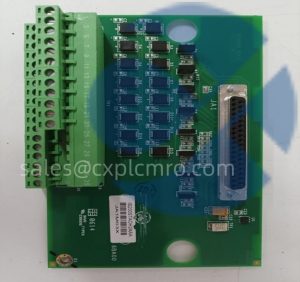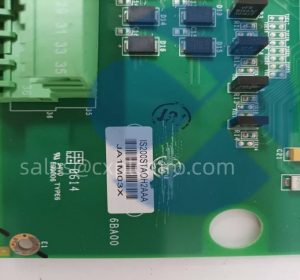
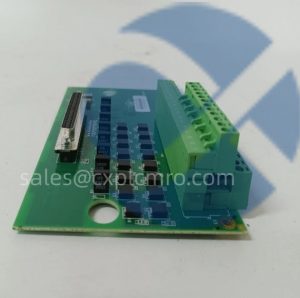
In the field of industrial automation and energy management, turbine control systems are critical equipment, and their stability and accuracy directly impact the efficiency and safety of the entire production process. The GE (General Electric) Mark VIe series servo I/O terminal board—IS200TSVCH1A—is a core component of this system, specifically designed for turbine control applications, providing efficient and reliable signal processing and interface management. This article will delve into the product’s technical characteristics, application scenarios, and industry value, helping readers to fully understand its importance in modern industry.
I. Product Overview: Technical Specifications and Design Philosophy
1.1 Product Positioning and Core Functions
The IS200TSVCH1A is a servo I/O terminal board in the GE Mark VIe series, a key interface module for turbine control systems. Its core functions include:
Signal Processing: Supports various input/output signal types, such as analog, digital, and pulse signals, ensuring seamless integration with the turbine control system.
Interface Management: Provides standardized physical interfaces, simplifying system integration and reducing installation complexity.
Real-time Control: Achieves real-time monitoring and adjustment of turbine parameters through high-speed data processing capabilities, improving system response speed.
1.2 Detailed Technical Specifications
Model Identification: The “TSVCH1A” in IS200TSVCH1A represents a specific functional configuration, which may involve details such as signal types, number of interfaces, or communication protocols.
Compatibility: Highly compatible with other modules in the Mark VIe series (such as control boards and power modules), supporting flexible system expansion.
Environmental Adaptability: Adopts an industrial-grade design, adapting to harsh environments such as high temperature, high humidity, and vibration, ensuring long-term stable operation.
II. Application Scenarios: Broad Coverage from Power Generation to Industrial Drives
2.1 Power Generation Industry: Control of Gas Turbines and Steam Turbines
In power plants, the IS200TSVCH1A is widely used in the control systems of gas turbines and steam turbines. For example:
Gas Turbines: By real-time monitoring of parameters such as gas flow, temperature, and pressure, it adjusts combustion efficiency and improves power generation efficiency. Steam Turbine: Controls the opening of steam valves, optimizes steam flow, and ensures the turbine operates under optimal conditions.
2.2 Industrial Drives: Precise Control of Compressors and Pumps
In the oil, chemical, and metallurgical industries, the IS200TSVCH1A is used to drive equipment such as compressors and pumps, achieving:
Flow Control: Precisely controls fluid flow by adjusting speed or valve opening.
Pressure Management: Monitors system pressure in real time to prevent overpressure or underpressure and ensure equipment safety.
2.3 Case Study: Practice at a Power Plant
A large power plant introduced the IS200TSVCH1A module when upgrading its turbine control system. By replacing the original aging I/O boards, the system achieved:
Reduced Failure Rate: The module’s stability significantly reduced downtime, with an annual failure rate reduction of 40%.
Improved Efficiency: Real-time control optimized turbine operating parameters, increasing power generation efficiency by 5%.
Reduced Maintenance Costs: The module’s standardized design simplified maintenance procedures, reducing annual maintenance costs by 30%.
Three, Industry Value: Dual Guarantee of Improved Efficiency and Safety
3.1 Improved Efficiency: A Closed Loop from Data to Decision
The IS200TSVCH1A achieves real-time monitoring and adjustment of turbine parameters through its high-speed data processing capabilities. For example:
Real-time Feedback: The module can quickly collect data such as turbine speed, temperature, and pressure, and upload it to the control center via communication protocols.
Dynamic Adjustment: Based on the feedback data, the system automatically adjusts valve opening or fuel supply to optimize turbine operation.
3.2 Enhanced Safety: Fault Prevention and Rapid Response
Fault Diagnosis: The module has a built-in self-test function that can monitor signal anomalies in real time and provide early warnings of potential faults.
Redundant Design: Supports dual-channel redundant configuration to ensure that the system can still operate normally in the event of a single point of failure.
3.3 User Feedback: A Transformation from Doubt to Trust
An industrial user reported: “Before introducing the IS200TSVCH1A, we frequently encountered downtime problems caused by I/O board failures. After the replacement, system stability significantly improved, and maintenance workload was greatly reduced.”
Four, Expert Advice: Best Practices for Selection and Maintenance
4.1 Selection Guide: How to Match Your Needs? Signal Type: Select a module that supports the appropriate signal types based on the requirements of the turbine control system.
Number of Interfaces: Evaluate the system size to ensure that the number of interfaces provided by the module meets expansion needs.
Communication Protocol: Confirm the communication protocols supported by the module (such as Modbus, Profibus, etc.) to ensure compatibility with existing systems.
4.2 Maintenance Suggestions: Key to Extending Service Life
Regular Inspection: Inspect the module’s physical connections and signal quality quarterly to ensure there are no loose connections or corrosion.
Software Updates: Pay attention to firmware updates released by GE and upgrade promptly to fix potential vulnerabilities.
Environmental Control: Keep the module’s operating environment clean to prevent dust or moisture from affecting performance.
V. Conclusion: Future Outlook for Turbine Control Systems
As a servo I/O terminal board in the GE Mark VIe series, the IS200TSVCH1A has become the preferred component for turbine control systems due to its efficiency, stability, and safety features. With the advancement of Industry 4.0 and intelligent manufacturing, this module will further integrate with the Internet of Things and big data technologies to achieve more intelligent turbine control. For industrial users, choosing the IS200TSVCH1A is not only a reflection of technological upgrading but also a strategic decision to improve production efficiency and ensure safety.
Choose Shenzhen Changxin, choose peace of mind, worry-free after-sales service! Large stock available, same-day SF Express shipping!!!