
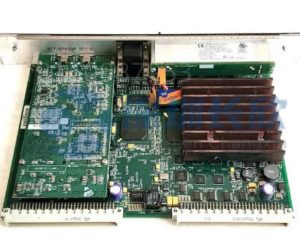
In the demanding world of industrial automation, where milliseconds can mean the difference between stable operation and catastrophic failure, not all controllers are created equal. The GE IC698CPE010-JU stands as a benchmark of reliability, speed, and resilience within General Electric’s PACSystems RX7i platform. Designed for mission-critical applications in power generation, oil & gas, water/wastewater, and heavy manufacturing, this high-performance central processing unit (CPU) module delivers deterministic control, robust redundancy, and decades-long lifecycle support. With its 1 GHz dual-core architecture and native integration into safety-critical workflows, the IC698CPE010-JU has become the trusted brain behind turbine governors, substation automation systems, emergency shutdown logic, and continuous process lines across the globe.
Engineered for Determinism, Not Just Speed
At first glance, the IC698CPE010-JU may appear as just another PLC CPU—but its architecture reveals a purpose-built design for real-time industrial control. Unlike standard programmable logic controllers that prioritize cost or modularity, the CPE010-JU leverages a dual-core PowerPC processor running at 1 GHz, dedicating one core to user application logic and the other to system tasks like communication, diagnostics, and I/O management. This separation eliminates task jitter and ensures consistent scan times—even under heavy network traffic or complex algorithmic loads.
For example, in a combined-cycle power plant, the IC698CPE010-JU can simultaneously execute:
High-speed PID loops for boiler drum level control (scan time < 2 ms)
Sequence-of-events (SOE) logging with 1 ms resolution for breaker status
Redundant Modbus TCP communications to DCS and historian systems
This level of concurrency is essential in environments where control actions must be both fast and predictable. The module supports up to 512 MB of user memory and 1 GB of non-volatile storage, enabling large programs, embedded trending, and data buffering without reliance on external SD cards—a common point of failure in harsh settings.
Built-In Redundancy for Zero-Downtime Operations
One of the most compelling features of the IC698CPE010-JU is its seamless support for hot-standby redundancy when paired with the IC698RMX016 redundancy module. In this configuration, two CPUs synchronize program state, I/O images, and communication sessions over a dedicated fiber-optic or copper link. If the active unit fails—due to power loss, overheating, or component fault—the standby assumes control in less than 20 milliseconds, with no interruption to field devices or ongoing processes.
This capability is not theoretical. A hydroelectric facility in the Pacific Northwest relies on redundant IC698CPE010-JU systems to manage turbine speed governors during grid instability events. During a recent islanding scenario, the backup CPU took over mid-cycle without triggering a trip—keeping the generator synchronized until grid reconnection. “It’s not just redundancy—it’s continuity,” said the site’s control engineer. “We’ve never lost a unit due to controller failure.”
Real-World Resilience Across Harsh Environments
The IC698CPE010-JU excels not only in performance but in environmental toughness. While rated for standard industrial temperatures (0°C to +60°C), it has been successfully deployed in far more extreme conditions—thanks to conformal coating options, wide input voltage tolerance (85–264 VAC), and immunity to electrical noise.
Case Study: Steel Mill Continuous Caster
In an Eastern European steel plant, ambient temperatures regularly exceed 50°C near molten metal lines, and electromagnetic interference from arc furnaces disrupts sensitive electronics. Previous PLCs suffered memory corruption and communication dropouts. After migrating critical mold-level and emergency stop logic to IC698CPE010-JU-based PACSystems racks in ventilated enclosures, the line achieved three years of uninterrupted operation. “Even during summer peaks, the CPU never throttled or rebooted,” reported the automation manager.
Case Study: Offshore Oil Platform
A North Sea platform replaced aging relay-based controls with a PACSystems RX7i system centered on the IC698CPE010-JU to manage seawater injection pumps. Exposed to salt spray, vibration, and temperature swings from -10°C to +45°C, the system required both reliability and diagnostic visibility. The CPU’s built-in watchdog timers and memory parity checks detected a failing RAM module before it caused a fault—triggering a predictive maintenance alert. “It didn’t just run—it told us when it needed help,” noted the electrical supervisor.
Diagnostics and Maintainability: Intelligence Beyond Control
Beyond raw processing power, the IC698CPE010-JU embeds intelligence into everyday operations:
Front-panel LEDs indicate RUN, STOP, I/O FAULT, and REDUNDANCY STATUS—enabling rapid visual assessment during emergencies.
Real-time diagnostics via Proficy Machine Edition software show CPU load, task execution times, and communication health.
Error-Correcting Code (ECC) memory detects and corrects single-bit errors, preventing silent data corruption.
Online change download allows logic updates during live operation—critical for continuous processes that cannot afford shutdowns.
These features reduce mean time to repair (MTTR) and increase operational transparency—key metrics in industries governed by strict uptime SLAs or regulatory compliance (e.g., NERC CIP, ISO 13849).
Expert Guidance for Optimal Deployment
“Respect the CPU’s limits. Keep sustained utilization below 65% if you’re running motion control or high-speed counting. The headroom is there—but only if you plan for it.”
— Senior Controls Engineer, Global Energy EPC Firm
Seasoned integrators recommend:
Use shielded, grounded racks in high-EMI environments; bond all chassis to a single-point ground grid.
Enable watchdog timers in safety-critical routines to force fail-safe outputs if logic stalls.
Leverage Ethernet Global Data (EGD) for deterministic peer-to-peer communication between RX7i and legacy Series 90 systems.
Maintain firmware consistency across all redundant pairs and spare units to avoid compatibility issues during failover.
A Legacy of Trust in an Evolving Automation Landscape
Though GE’s automation business is now part of Emerson, the IC698CPE010-JU remains actively supported, specified, and deployed in new projects worldwide. Its longevity stems from more than technical specs—it reflects a philosophy: that industrial control must be deterministic, diagnosable, and dependable above all else.
In an era of cloud analytics and AI-driven optimization, the GE IC698CPE010-JU reminds us that innovation isn’t always about novelty. Sometimes, it’s about perfecting the fundamentals—so that when the grid falters, the turbine surges, or the furnace roars, the controller doesn’t blink. For engineers safeguarding the world’s critical infrastructure, this CPU isn’t just hardware. It’s the quiet assurance that control will hold—exactly when it matters most.