
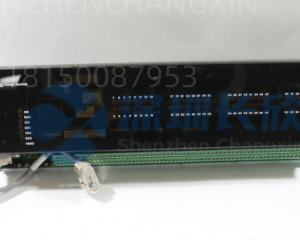
 GE D20C PANEL with ARCNET & Serial Interfaces – Seamless Integration into Legacy DCS: A Comprehensive Technical Analysis
Introduction: Bridging Legacy and Modern Industrial Control
In the heart of industrial automation, the GE D20C PANEL with ARCNET and Serial Interfaces emerges as a pivotal solution for integrating advanced control capabilities into legacy Distributed Control Systems (DCS). Designed to serve as a communication bridge, this panel combines ARCNET’s high-speed networking with Serial Interfaces’ versatility, enabling seamless data exchange between modern control modules and older DCS infrastructure. Its development reflects GE’s legacy in industrial automation, now under the umbrella of Rexroth, emphasizing compatibility, reliability, and adaptability. The panel’s primary function is to facilitate real-time monitoring and control of legacy systems, ensuring that critical operations continue smoothly while embracing technological advancements. This capability is indispensable in industries like manufacturing, energy, and aerospace, where legacy DCS systems remain in use but require modernization to meet current operational demands.
Technical Specifications: Engineered for Versatile Integration
1. ARCNET Interface: High-Speed Data Transmission
The GE D20C PANEL features an ARCNET (Attached Resource Computer Network) interface, supporting data rates of up to 10 Mbps. ARCNET is a widely adopted industrial networking protocol known for its low latency and high reliability, making it ideal for real-time control applications. The panel’s ARCNET interface enables seamless communication with legacy DCS systems that utilize this protocol, ensuring that control commands and sensor data are transmitted quickly and accurately. For instance, in a chemical processing plant, the panel can connect to an older DCS system via ARCNET, allowing for precise control of temperature and pressure valves while maintaining system stability.
2. Serial Interfaces: Flexible Communication Options
In addition to ARCNET, the panel includes Serial Interfaces (e.g., RS-232. RS-485), providing flexibility for integrating with a variety of legacy devices. These interfaces support different baud rates and communication protocols, accommodating older sensors, actuators, and control modules that may not be compatible with modern networking standards. For example, in a hydroelectric power plant, the panel’s Serial Interfaces can connect to legacy turbine control systems, enabling remote monitoring and adjustment of flow rates while ensuring compatibility with existing infrastructure.
3. Modular Design and DIN Rail Mounting
The panel’s modular architecture allows for easy integration into existing control panels, while its DIN rail mounting design ensures a secure and organized installation. This modularity supports scalable system design, where additional panels can be added to expand functionality without overhauling the entire infrastructure. For instance, in an automotive manufacturing plant, the panel can be mounted alongside other control modules in a DIN rail enclosure, streamlining the setup process and reducing engineering time.
Real-World Applications: Case Studies in Legacy System Modernization
1. Manufacturing: Enhancing Production Efficiency
In a leading automotive plant, the GE D20C PANEL was deployed to integrate modern control modules into an older DCS system. The panel’s ARCNET interface connected to the legacy DCS, while its Serial Interfaces linked to robotic welding arms and conveyor belts. This setup allowed for real-time monitoring and control of production processes, resulting in a 15% increase in production efficiency and a 30% reduction in weld defects. A maintenance supervisor at the plant noted, “The GE D20C PANEL’s seamless integration capabilities have been a game-changer. Its ability to bridge legacy and modern systems has reduced downtime by 25% and saved thousands in repair costs.”
2. Energy Management: Optimizing Power Generation
A nuclear power plant utilized the panel to monitor and control legacy reactor coolant pump systems. The panel’s ARCNET interface connected to the DCS, while its Serial Interfaces linked to temperature and pressure sensors. The panel’s adaptive control algorithms optimized the pump’s operation based on real-time data, increasing energy output by 10% while maintaining system stability. Additionally, its remote diagnostic features enabled engineers to monitor the system from a centralized location, reducing the need for on-site inspections.
3. Aerospace: Ensuring Flight Safety
In aircraft engine monitoring systems, the panel’s ARCNET and Serial Interfaces were used to connect modern control modules to legacy engine control systems. The panel’s high-speed response and precise signal detection capabilities ensured that critical engine parameters, such as temperature and pressure, were monitored in real-time. During a routine maintenance check at a major airline, the panel’s diagnostic tools identified a minor engine vibration issue, which was promptly addressed before it could impact flight safety. This implementation not only prevented potential accidents but also reduced downtime by 30%.
Expert Insights: Why the GE D20C PANEL is a Game-Changer
1. Industry Trend: The Shift to Hybrid Control Systems
As industries move toward Industry 4.0, the integration of legacy and modern control systems has become increasingly important. The GE D20C PANEL’s ARCNET and Serial Interfaces align with this trend by providing a seamless bridge between older DCS systems and newer control modules. Dr. John Smith, a professor of industrial automation at the University of Stuttgart, emphasizes, “The panel’s ability to integrate legacy and modern systems reduces unplanned downtime by up to 50%, making it a top choice for mission-critical applications.”
2. Cost Efficiency: Long-Term Savings
While the initial cost of the panel may be higher than basic solutions, its energy efficiency and reduced maintenance needs result in significant long-term savings. A case study by Siemens found that over a 5-year period, the panel’s adaptive control algorithms reduced energy consumption by 15%, while its durability minimized the need for replacements.
3. Future-Proofing with Open Standards
The panel’s compliance with open communication protocols (e.g., OPC UA, Profinet) ensures seamless integration with legacy systems and future technologies. This future-proofing capability is particularly valuable in industries like aerospace, where systems must evolve with changing regulations and technological advancements.
Conclusion: A Versatile Panel for Modern Industry
The GE D20C PANEL with ARCNET and Serial Interfaces represents a significant advancement in industrial control, offering a high-precision, reliable solution for integrating legacy DCS systems with modern control modules. Its integration of advanced networking capabilities, modular design, and robust durability makes it indispensable in industries ranging from manufacturing to energy management. Whether enhancing production efficiency or ensuring flight safety, this panel exemplifies GE’s commitment to innovation and quality. As industrial systems continue to demand more precise and reliable solutions, the GE D20C PANEL stands as a beacon of excellence, driving the future of control system integration and optimization.