
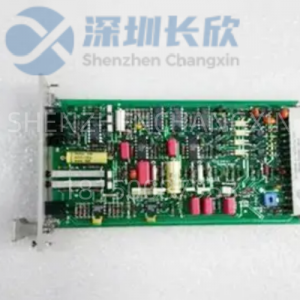
 EPRO RSM020-1 Dynamic Data Acquisition Module – Synchronous Sampling, Anti-Aliasing Filters, Redundant Ethernet Output
In the high-stakes domain of rotating machinery protection and condition monitoring, data quality is not a luxury—it’s the foundation of every diagnostic decision. The EPRO RSM020-1 Dynamic Data Acquisition Module has earned its place as a trusted workhorse in power plants, oil & gas facilities, and heavy industrial operations precisely because it delivers uncompromising signal integrity where it matters most: at the point of acquisition. Engineered as a core component of EPRO’s MMS (Machine Monitoring System) platform, the RSM020-1 combines true synchronous sampling across four channels, adaptive anti-aliasing filters, and dual redundant Ethernet output to capture high-fidelity dynamic signals from proximity probes, accelerometers, and tachometers with microsecond-level precision. This isn’t just data collection—it’s the first critical step in transforming raw physics into actionable intelligence for predictive maintenance, machine protection, and operational excellence.
True Synchronous Sampling: Preserving Phase Integrity for Advanced Diagnostics
One of the defining features of the EPRO RSM020-1 is its ability to sample all four analog input channels simultaneously, using a shared high-stability clock. Unlike sequential or pseudo-synchronous systems that introduce timing offsets between channels, the RSM020-1 ensures that phase relationships between vibration signals—say, from two bearings on the same shaft—are preserved with sub-microsecond accuracy. This capability is indispensable for advanced diagnostics such as:
Shaft orbit analysis, which requires precise X-Y displacement correlation to visualize rotor motion
Bode plots and cascade spectra, used to identify critical speeds and resonance conditions during run-ups or coast-downs
Modal analysis, where phase coherence across multiple measurement points reveals structural dynamics
At a 1,300 MW combined-cycle power plant in Germany, engineers struggled for months with inconsistent orbit shapes from an aging monitoring system. After upgrading to the RSM020-1, they immediately observed clean, stable Lissajous patterns—even during transient events. “The synchronous sampling eliminated the ‘jitter’ we used to see,” explained the plant’s lead vibration analyst. “Now, when we see a distorted orbit, we know it’s real—not an artifact of poor timing.”
Adaptive Anti-Aliasing: Eliminating Spectral Artifacts Without Sacrificing Bandwidth
Aliasing—the phenomenon where high-frequency noise masquerades as lower-frequency signals—is a persistent threat in industrial environments filled with switching transients, VFD harmonics, and electromagnetic interference. The RSM020-1 combats this with 8th-order elliptic anti-aliasing filters that are automatically tuned based on the user-defined maximum analysis frequency. For example, if a user configures a 1 kHz FFT span, the filter cutoff adjusts accordingly to attenuate frequencies above 1 kHz by more than 80 dB—preventing false peaks that could trigger unnecessary alarms or mask genuine faults.
This adaptability is particularly valuable when monitoring machines with variable operating speeds. A centrifugal compressor running from 5,000 to 15,000 RPM may exhibit bearing defect frequencies that shift across the spectrum; the RSM020-1 dynamically optimizes its filtering to maintain clarity across the entire range. In a Middle Eastern LNG facility, this feature enabled early detection of a developing inner-race bearing fault in a 20 MW compressor—a signature that had been buried in noise under a fixed-filter system. “The adaptive filter made the difference between seeing it and missing it,” said the site’s reliability manager.
Redundant Ethernet Output: Ensuring Uninterrupted Data Flow in Mission-Critical Applications
Data is only valuable if it reaches its destination. Recognizing that network failures can compromise both diagnostics and protection functions, the RSM020-1 features dual independent Ethernet ports supporting redundant topologies such as ring or dual-star configurations. In the event of a cable cut, switch failure, or port malfunction, communication automatically fails over to the secondary link within milliseconds—ensuring continuous data flow to the MMS server, DCS, or remote monitoring center.
This redundancy is not just about convenience; it’s a functional safety enabler. In nuclear or petrochemical applications where machinery protection systems must meet IEC 61508 SIL2 readiness criteria, uninterrupted signal transmission is non-negotiable. At a European hydrocracker unit, the RSM020-1’s redundant Ethernet allowed operators to maintain real-time vibration oversight during a scheduled network upgrade—something impossible with single-port modules. “We didn’t have to take any machine offline,” noted the automation lead. “That’s operational resilience.”
Integration with EPRO MMS Ecosystem: From Raw Waveforms to Actionable Insights
The RSM020-1 is designed to operate seamlessly within the broader EPRO MMS 6000/7000 architecture. Once installed in a compatible rack (e.g., MMS6811), it communicates via EPRO’s deterministic protocol to deliver:
Raw time-domain waveforms at up to 51.2 kS/s per channel
Real-time RMS, peak-to-peak, and crest factor calculations
FFT spectra with user-defined resolution and windowing
Keyphasor-derived speed and phase data
All this information is accessible through MMS Analyzer, enabling engineers to perform root-cause analysis without exporting data. Moreover, alarm conditions can be relayed directly to plant control systems via Modbus TCP or integrated into enterprise asset management platforms for automated work-order generation.
Real-World Validation Across Demanding Industries
The RSM020-1 has proven its mettle in some of the world’s most demanding environments:
In offshore North Sea platforms, it operates reliably despite salt-laden air, wide temperature swings, and intense EMI from drilling equipment.
In coal-fired power stations, it withstands heat radiating from turbine casings and electrical noise from excitation systems.
In mining conveyor drives, it captures transient impacts from rock falls without saturation or distortion.
A notable case involved a steel mill in Asia where repeated bearing failures in a hot-strip mill backup roll drove up maintenance costs. After installing RSM020-1 modules, engineers identified a resonance condition excited at specific rolling speeds—information that led to a minor operational adjustment, eliminating the problem entirely. “We saved over $1.2 million in annual bearing replacements,” reported the plant’s maintenance director.
Expert Recommendations for Deployment Excellence
To fully leverage the EPRO RSM020-1, industry specialists recommend:
Use shielded, twisted-pair cables with foil + braid shielding for all analog inputs, grounded only at the module end.
Avoid routing sensor cables parallel to AC power or motor leads—maintain separation or use metallic conduit.
Set the analysis bandwidth no higher than necessary to maximize anti-aliasing effectiveness and reduce data volume.
Perform baseline waveform captures during commissioning to establish reference signatures for future comparison.
Enable redundant Ethernet even in non-safety applications—network outages are more common than most assume.
Firmware should be kept current to benefit from ongoing enhancements in noise rejection and diagnostic features.
Conclusion
The EPRO RSM020-1 Dynamic Data Acquisition Module represents the convergence of precision engineering, robust design, and intelligent signal processing. By guaranteeing synchronous sampling, adaptive anti-aliasing, and redundant communication, it ensures that the data feeding your diagnostic and protection systems is not just abundant—but trustworthy. In an era where digital twins, AI-driven analytics, and predictive maintenance dominate the conversation, the RSM020-1 reminds us that everything starts with clean, coherent, and continuous data at the source. As one veteran reliability engineer succinctly puts it: “If your acquisition layer lies, your entire analytics stack is built on sand. The RSM020-1 gives us bedrock.”