
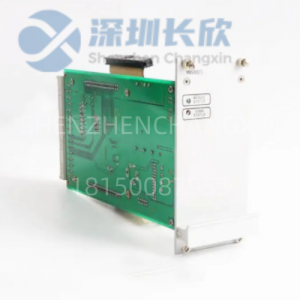
 EPRO MMS6823 9100-00001-05: Essential Interface for Rotating Machinery Health Monitoring Systems
In the high-stakes world of industrial asset reliability, where unplanned downtime can cost millions per hour and mechanical failures risk safety and environmental compliance, continuous machinery health monitoring is no longer optional—it’s foundational. At the heart of many modern condition monitoring architectures lies the EPRO MMS6823 9100-00001-05. a specialized interface module engineered to serve as the critical bridge between field-mounted sensors and centralized diagnostic platforms. Designed for integration within EPRO’s MMS 6000 series machine protection and monitoring systems, this compact yet powerful module delivers precise signal conditioning, real-time data acquisition, and robust communication capabilities tailored specifically for rotating equipment such as turbines, compressors, pumps, and generators. More than just a hardware component, the MMS6823 is an enabler of predictive maintenance strategies that keep critical assets running safely, efficiently, and reliably—often for decades beyond original design life.
Purpose-Built for Rotating Machinery Diagnostics
The EPRO MMS6823 9100-00001-05 is not a generic I/O card; it is purpose-designed to handle the unique signal types and timing requirements of rotating machinery monitoring. It typically interfaces with industry-standard sensors including:
Eddy-current proximity probes (e.g., PR6423 series) for shaft displacement and orbit analysis
Velocity or acceleration sensors for casing vibration monitoring
Keyphasor®/tachometer probes for rotational speed and phase reference
Each input channel features high-resolution analog-to-digital conversion with anti-aliasing filters, ensuring accurate capture of dynamic behavior across frequency ranges from sub-1 Hz (for slow-roll diagnostics) up to several kilohertz (for bearing defect detection). Critically, all channels are synchronously sampled, preserving phase relationships essential for advanced diagnostics like modal analysis or imbalance vector calculation.
At a combined-cycle power plant in Southeast Asia, engineers leveraged the MMS6823’s synchronous sampling to diagnose a subtle 1× vibration rise in a steam turbine during ramp-up. By analyzing the phase shift between bearing probes over multiple startups, they identified thermal bow—a condition easily missed by non-synchronous systems. “Without the MMS6823’s time-coherent data, we might have run the unit into rub,” said the plant’s vibration specialist. “Instead, we scheduled a controlled cooldown and avoided catastrophic damage.”
Seamless Integration with EPRO MMS Ecosystem
As part of the MMS 6000 platform, the MMS6823 9100-00001-05 integrates natively with EPRO’s suite of software tools, including MMS System Manager and MMS Analyzer. This tight coupling enables:
Real-time waveform and spectrum display
Automated alarm generation based on ISO 10816 or user-defined thresholds
Trending of key parameters (e.g., peak-to-peak displacement, RMS velocity) over months or years
Export of raw time-domain data for offline analysis or machine learning models
Moreover, the module communicates via redundant Ethernet or RS-485 links, supporting both local HMI access and remote monitoring through enterprise networks. In a global mining operation, maintenance teams use cloud-connected MMS workstations to review MMS6823 data from ore crushers across three continents—enabling centralized expertise to support remote sites with limited local resources.
Rugged Design for Continuous Operation in Industrial Environments
Deployed in turbine control rooms, compressor shelters, or offshore platforms, the MMS6823 must endure electrical noise, temperature fluctuations, and mechanical vibration. To meet these demands, it features:
Operating temperature range of 0°C to +60°C (with derating above 50°C)
Conformal-coated circuit boards resistant to humidity, dust, and chemical vapors
Galvanic isolation between channels and backplane (typically 500 VDC) to prevent fault propagation
Compliance with IEC 61000-6-2/6-4 for industrial EMC immunity
These attributes ensure stable performance even when mounted near large motors, switchgear, or variable-frequency drives—environments where lesser modules suffer from signal drift or communication dropouts.
A European refinery reported zero MMS6823 failures over seven years across 40+ units installed in its hydrocracker train, despite ambient temperatures regularly exceeding 50°C and high EMI from nearby rectifiers. “Reliability isn’t just about uptime—it’s about data trust,” noted their reliability manager. “When our analysts see a trend, they know it’s real—not noise.”
Enabling Predictive Maintenance and Digital Transformation
Beyond basic monitoring, the MMS6823 9100-00001-05 serves as a foundational element in digital transformation initiatives. Its high-fidelity, time-synchronized data feeds into:
Digital twins for virtual commissioning and performance simulation
Machine learning algorithms that detect early-stage bearing wear or misalignment
Enterprise asset management (EAM) systems for work-order automation
For instance, a North American utility integrated MMS6823 vibration trends with its SAP PM module. When shaft displacement exceeded a predictive threshold, the system automatically generated a maintenance ticket with historical context and recommended actions—reducing mean time to repair by 35%.
Expert Recommendations for Optimal Deployment
To maximize the value of the EPRO MMS6823. industry experts advise:
Use high-quality, shielded cables for all sensor connections, with shields grounded only at the MMS6823 end to avoid ground loops.
Ensure proper probe mounting—even minor mechanical looseness can introduce false vibration signatures.
Configure anti-aliasing filters based on maximum expected frequency content to avoid spectral leakage.
Perform baseline measurements during commissioning or post-maintenance to establish “healthy” reference data.
Regularly validate calibration using simulated inputs or portable analyzers, especially in safety-critical applications.
Additionally, always verify firmware compatibility between the MMS6823 and the host MMS controller—updates often include enhanced diagnostic features or improved noise rejection algorithms.
Conclusion
The EPRO MMS6823 9100-00001-05 exemplifies how specialized hardware can elevate machinery monitoring from reactive troubleshooting to proactive asset stewardship. By delivering synchronous, high-fidelity signal acquisition, robust industrial design, and seamless integration with advanced diagnostic ecosystems, it empowers operators to see deeper into the health of their rotating equipment than ever before. In an era where operational excellence hinges on data integrity and predictive insight, the MMS6823 is more than an interface—it’s a sentinel standing guard over the heartbeat of industrial infrastructure. As one veteran reliability engineer puts it: “You don’t buy an MMS6823 to fix machines. You buy it so you never have to.”