
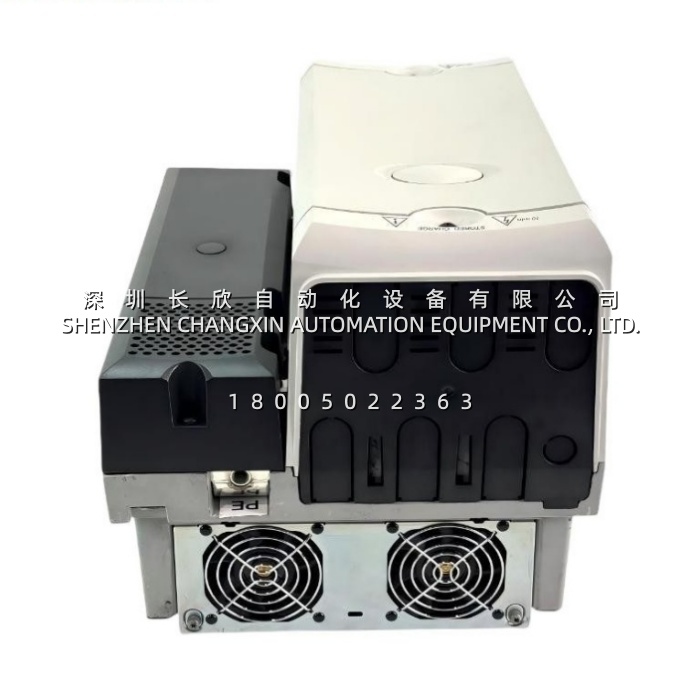
Description
The Emerson SPMC2402 is a Controlled Input Rectifier Module manufactured by Emerson (now Vertiv) as part of its family of industrial power-conversion and UPS (Uninterruptible Power Supply) components. Classified as a controlled input rectifier, it performs the critical function of converting three-phase AC input power into a regulated, controlled DC bus voltage that powers downstream inverters, DC links, and critical load circuits.
In essence, the Emerson SPMC2402 is far more than a simple diode bridge. It uses phase-controlled thyristor (SCR) technology to actively regulate the DC output voltage, manage inrush current, correct power factor, and minimize harmonic distortion—ensuring that the DC link remains stable even when the AC supply fluctuates or the load changes abruptly. This makes it an indispensable building block in UPS systems, variable-frequency drives (VFDs), and other applications where clean, reliable DC power is non-negotiable.
Application Scenarios
Consider a large data center operating in a region with an unreliable utility grid. The facility’s UPS system must provide seamless power to hundreds of server racks, network switches, and storage arrays—even during voltage sags, swells, or complete utility outages. At the heart of that UPS sits a controlled rectifier stage that draws power from the utility, converts it to DC, and maintains the DC bus that feeds the inverter and charges the battery bank. If the rectifier is inefficient, the data center suffers from poor power factor, excessive harmonic currents that distort the facility’s electrical distribution, and thermal stress that shortens component life. If the rectifier cannot regulate quickly enough, voltage transients can propagate to the critical load.
This is where the Emerson SPMC2402 delivers its value. Installed as the input rectifier stage in an Emerson UPS or industrial power system, the module actively controls the firing angle of its SCR bridge to maintain a precisely regulated DC bus voltage. When the AC input dips during a utility disturbance, the module instantly adjusts its firing angle to compensate, preventing the DC bus from collapsing. When the load steps up suddenly—say, during a transfer from bypass to inverter—the controlled rectifier ramps up current smoothly, avoiding the damaging inrush that would occur with a passive diode bridge. And throughout normal operation, the Emerson SPMC2402’s phase-control strategy maintains a high power factor and low harmonic signature, keeping utility bills down and protecting the facility’s distribution equipment.
For electrical engineers and facility managers, the core pain points are clear: passive rectifiers generate harmonics and poor power factor; diode bridges cannot regulate output voltage; and uncontrolled inrush current stresses both the power system and the load. The Emerson SPMC2402 resolves all three through intelligent, phase-controlled conversion. Whether deployed in a data center UPS, an industrial VFD front end, or a critical process-control power supply, the module ensures that the DC bus—and everything downstream—remains stable, efficient, and protected.
Parameter
| Main Parameters | Value/Description |
|---|---|
| Product Model | SPMC2402 |
| Manufacturer | Emerson (Vertiv) |
| Product Category | Controlled Input Rectifier Module |
| Input Voltage | Three-phase AC (typical 380–480 VAC, 50/60 Hz) |
| Input Phase | 3-phase, 3-wire or 3-phase + ground |
| Output Type | Controlled DC (regulated DC bus voltage) |
| Output Voltage Range | 500–750 VDC (load- and configuration-dependent) |
| Output Current Rating | Continuous current rating per module (system-specific) |
| Switching Technology | Phase-controlled thyristors (SCRs) |
| Control Method | Firing-angle phase control with closed-loop voltage regulation |
| Power Factor | >0.95 at full load (typical, with phase control) |
| Harmonic Distortion | Significantly reduced vs. passive diode rectifier |
| Inrush Current Limiting | Controlled soft-start via delayed firing-angle ramp-up |
| Cooling Method | Forced air or conduction cooling (module-dependent) |
| Mounting | Chassis or rack-mounted within power system enclosure |
| Protection Features | Over-voltage, over-current, over-temperature, and phase-loss protection |
| Communication | Status and fault signaling to system controller (analog/digital interface) |
| Operating Temperature | −10 °C to +50 °C (industrial power-equipment rating) |
| Certifications | CE compliant; UL listed (verify per manufacturing batch) |