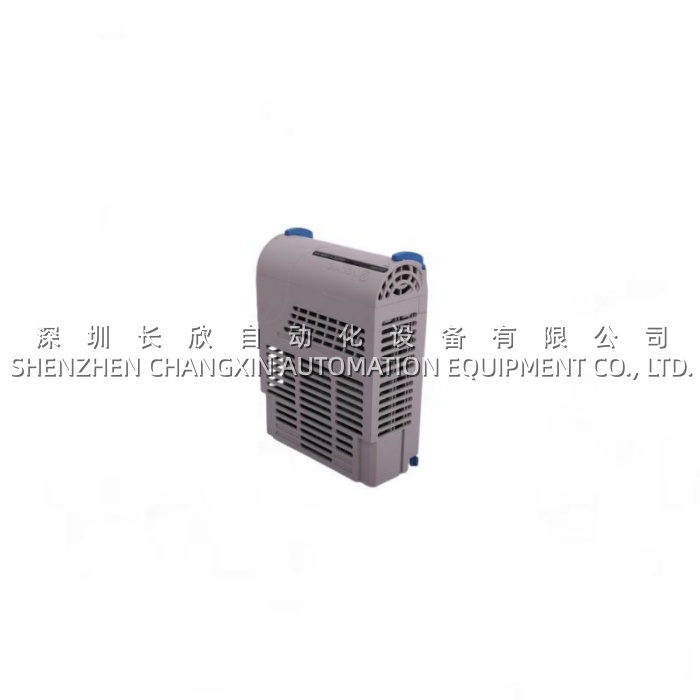
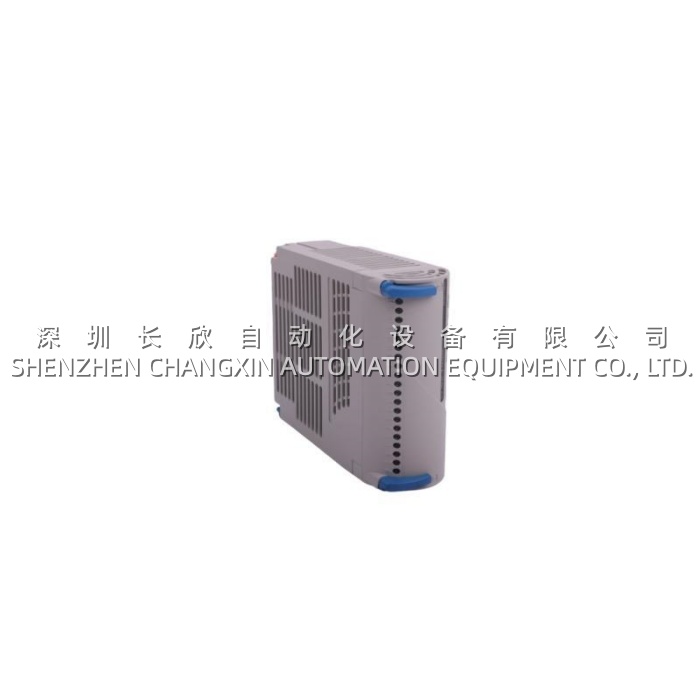
Application Scenarios
In a 400 MW combined-cycle plant running Emerson Ovation across the GT, HRSG, and balance-of-plant, the #2 HRSG’s I/O drop #7 (drum-level + attemperator zone) began logging intermittent “I/O interface comms loss” alarms every 3–4 weeks—always during a hot-restart when the duct-firing ramped and the drop’s ambient climbed toward 52 °C. The drop housed sixteen I/O modules (mix of 1C311xx AI and 5X000xx DI/DO) under a 5X00226G03 that had been in service since the 2004 Westinghouse-era original install. The plant’s I&C lead suspected the drop controller’s electrolytic bypass caps on the 24 V backplane input were aging—Ovation’s own diag logged “backplane voltage ripple > 200 mV” during the alarm windows. Because the 5X00226G03 is hot-swappable, the swap happened during a 20-minute “hold at low load” window: unlatch the front handle, pull the old unit (the drop’s other side kept running—local I/O in pure-scan mode doesn’t need the interface controller alive for fail-safe outputs, though inputs freeze), seat the new 5X00226G03, and the backplane re-enumerated the 16 modules in ~8 seconds. Post-swap, the “comms loss” ticket vanished across two monsoon-season restarts. For plants where an Ovation drop serves drum-level or fuel-gas shutoff valves, the 5X00226G03 is the 20-minute insurance swap that prevents a drop-level failure from cascading into a unit trip.
h2 Parameter
| Main Parameters | Value/Description |
|---|---|
| Product Model | 5X00226G03 |
| Manufacturer | Emerson (Ovation / ex-Westinghouse lineage) |
| Product Category | I/O Interface Controller (Drop Controller Module) |
| Compatible Platform | Emerson Ovation™ DCS |
| Managed I/O Capacity | Up to 128 I/O points (16 modules × typical 8-pt avg) |
| Supported I/O Types | AI, AO, DI, DO, RTD, TC, Pulse Input |
| Supply Voltage | 24 V DC (from Ovation I/O rack backplane) |
| Communication | Ovation system backplane bus + Ovation control network |
| Hot-Swap | Yes (live replacement without drop power-down) |
| Status Indicators | LEDs: Power, Status, I/O Active, Fault |
| Dimensions (L×W×H) | 44 × 178 × 114 mm |
| Weight | 0.7 kg |
| Operating Temp. | 0 °C to +60 °C |
| Storage Temp. | –40 °C to +85 °C |
| Humidity | 5 % to 95 % RH, non-condensing |
| Mounting | Ovation I/O chassis / DIN-rail adapter |
| Certifications | CE, RoHS, FCC Class A |
h2 Technical Principles and Innovative Values
Innovation Point 1: Drop-Level Autonomy via Backplane Scan Engine. The 5X00226G03 isn’t just a network-to-I/O translator—it runs its own scan scheduler for the 16 local modules on the Ovation backplane bus, batching AI/AO/DI/DO reads into network packets bound for the central OCR. That keeps the Ovation control-network bandwidth steady even when a drop has 100+ AI points updating at 100 ms—each AI doesn’t generate a separate packet; the 5X00226G03 aggregates.
Innovation Point 2: Hot-Swap with State Re-Sync. In a DCS drop serving fuel-gas or drum-level, you can’t always power down for a controller swap. The 5X00226G03 is designed for live pull-and-replace: when a new unit seats, it reads the backplane’s I/O module presence map, re-syncs scan rates from NVRAM (or inherits from the OCR on reconnect), and the OCR sees the drop re-join the network in < 10 seconds. Output modules in the drop either hold-last-state or fail-safe per their configuration during the gap—no “wild output” spike.
Innovation Point 3: Multi-Signal-Type Drop Head in One 0.7 kg package. Some DCS platforms need separate “analog drop controller” and “digital drop controller” SKUs. The 5X00226G03 handles mixed AI/AO/DI/DO/RTD/TC/pulse on the same backplane—one SKU covers a boiler-drum drop (mostly TC/AI) and a turbine-lube drop (mostly DI/DO) alike. That halves the stores SKU count in a multi-unit plant.
Innovation Point 4: Diagnostic Transparency to the OCR. The 5X00226G03 continuously monitors backplane health—CRC errors on module comms, channel open-wire (on capable DI modules), overrange on AI—and rolls those up to the OCR as quality flags on the process variable. A technician watching the Ovation operator station sees “I/O quality degraded” on a drum-level tag before the loop actually fails, because the 5X00226G03 tagged the AI channel’s 16-bit data word with a quality bit the OCR respects.
h2 Application Cases and Industry Value
A regional water-authority’s pump station #4 runs Ovation on a 3-drop layout (intake, wet-well, discharge). During a lightning strike that took out the station’s UPS for 4 seconds, drop #2’s 5X00226G03 came back with a corrupted NVRAM signature—the OCR logged “Drop #2 I/O Interface – Config Mismatch” and the wet-well level (4–20 mA radar) froze at last value. The plant’s SCADA alarmed “wet-well level stale,” the lead operator put the influent pumps to hand, and the I&C tech hot-swapped the 5X00226G03 in 12 minutes (the rack’s 24 V DC held through the swap because the station’s 125 V DC → 24 V DC PSU rode through). After re-seat, the OCR pushed the drop config down automatically (Ovation’s “broadcast config” feature), and the wet-well level tag came live again—no laptop, no engineering workstation visit to the pump station (it’s 40 miles from the main plant). The authority subsequently stocked one 5X00226G03 per 3–4 drops across its 11-station network, and added “drop controller NVRAM health” to the quarterly Ovation PM checklist.