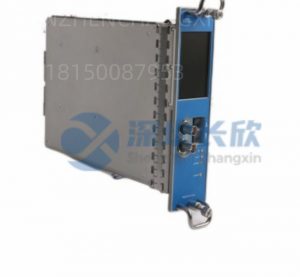
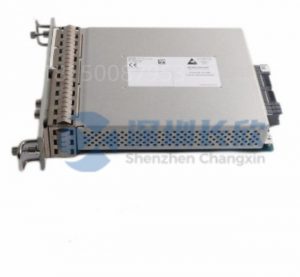
BENTLY NEVADA 3500/42 (140471-01): The Gold Standard in Dual-Channel Vibration and Position Monitoring for Critical Rotating Machinery
In the high-stakes world of power generation, oil & gas, and heavy industry, the health of rotating equipment—turbines, compressors, pumps, and generators—is not merely an operational concern but a matter of safety, environmental compliance, and financial viability. A single bearing failure can cascade into millions in repair costs, weeks of unplanned downtime, and even catastrophic safety incidents. For decades, the Bently Nevada 3500/42 (model number 140471-01) has served as a cornerstone of machinery protection systems worldwide, delivering reliable, high-fidelity monitoring of vibration and axial position on critical assets. As a dual-channel monitor within the modular 3500 Rack System, this module combines precision analog signal processing with configurable alarm logic and robust hardware design to provide early fault detection and fail-safe trip functionality that plant engineers trust implicitly.
Core Functionality: Precision Monitoring for Critical Parameters
The 3500/42 is specifically engineered to interface with proximity probe systems—most commonly Bently Nevada’s own 3300 or 3300 XL series eddy-current sensors—that measure:
Radial vibration (shaft displacement relative to bearing housing);
Axial thrust position (rotor location along the shaft axis).
Each of its two independent channels supports:
Dynamic (AC-coupled) vibration input for oscillatory motion analysis;
Static (DC-coupled) position input for thrust collar monitoring;
Programmable full-scale ranges (e.g., 0–200 µm peak-to-peak for vibration, ±1.0 mm for thrust);
High-resolution 16-bit A/D conversion with anti-aliasing filters;
Configurable alarm and danger thresholds with time-delay options to prevent nuisance trips.
Unlike generic data acquisition modules, the 3500/42 performs real-time RMS, peak, and peak-to-peak calculations in hardware, ensuring deterministic response even during transient events like rotor rubs or imbalance-induced surges. Its outputs include both relay contacts (for direct connection to turbine trip systems) and analog 4–20 mA signals (for integration with DCS or SCADA).
“On a 200 MW steam turbine, a 50-micron increase in vibration might seem minor—but if it’s trending upward during load changes, it could signal blade fouling or misalignment,” explains Dr. Elena Rodriguez, a vibration analyst at a combined-cycle plant in Texas. “The 3500/42 doesn’t just alert us—it gives us the fidelity to act before it becomes an emergency.”
Integration Within the 3500 System Architecture
The true power of the 3500/42 emerges when deployed within the full Bently Nevada 3500 framework, which includes:
3500/20 Rack Interface Module for communication and power distribution;
3500/25 Keyphasor Module for speed reference and phase measurement;
3500/32 Relay I/O Module for consolidated trip logic;
3500/85 Modbus or Ethernet Gateway for remote access.
This modular design allows plants to scale protection from a single pump to a multi-turbine complex using identical hardware and configuration logic. All modules synchronize via the Keyphasor signal, enabling phase-accurate orbit plots, Bode diagrams, and polar maps when used with System 1® machinery diagnostics software.
Critically, the 3500/42 supports redundant sensor inputs (via optional transducer redundancy modules) and voting logic—essential for SIL-rated applications where spurious trips must be avoided without compromising safety.
Real-World Impact: Preventing Failures Across Industries
Case Study 1: LNG Compression Train (Qatar)
A centrifugal compressor exhibited intermittent high vibration during startup. The 3500/42 captured waveform data showing sub-synchronous oscillations indicative of oil whirl. Engineers adjusted lube oil temperature and bearing clearance during the next planned outage, avoiding a potential rotor seizure. “Without the 3500/42’s continuous monitoring, we’d have missed the early warning,” said Ahmed Al-Mansoori, reliability engineer.
Case Study 2: Nuclear Power Plant (USA)
Following NRC guidelines, the plant upgraded its main coolant pump protection system to meet IEEE 603 standards. The 3500/42’s SIL 2-certified relay outputs and hardware-based voting (with triple-redundant probes) provided the required fault tolerance. “Regulators approved our design because Bently Nevada’s architecture is proven in nuclear environments,” noted Robert Jenkins, I&C manager.
Case Study 3: Petrochemical Refinery (Singapore)
After a fire damaged field wiring, a hydrocracker feed pump began tripping randomly. Diagnostics revealed EMI-induced noise on the vibration signal. By switching the 3500/42 to DC-coupled mode with digital filtering, technicians restored stable operation until rewiring was completed. “The module’s flexibility saved us a $2M unscheduled shutdown,” recalled Mei Lin Tan, automation lead.
Rugged Design for Mission-Critical Environments
Built for harsh industrial settings, the 3500/42 features:
Wide operating temperature range (0°C to +65°C);
Conformal-coated PCBs resistant to humidity, salt, and chemical vapors;
EMC immunity tested to IEC 61000-4 standards for operation near VFDs and switchgear;
Front-panel LEDs indicating OK, Alert, Danger, and module status;
MTBF exceeding 150.000 hours.
Its DIN-rail mounting and hot-swappable design allow replacement during operation—critical in continuous-process facilities.
Best Practices and Expert Recommendations
“Configuration is everything,” cautions James Miller, a former Bently Nevada field service engineer with 30 years of experience. He offers three key recommendations:
Use dual-probe radial monitoring (X-Y): Single-axis vibration can miss directional faults; orthogonal probes capture full orbit behavior;
Set alarm delays appropriately: A 0.5-second delay prevents trips from transient events like grid disturbances, but don’t compromise on critical thrust alarms;
Validate probe gaps during installation: A 10-mil error in static gap can shift the entire DC bias—leading to false thrust readings.
Additionally, regularly verify calibration using a TK3-2E Proximity Sensor Calibrator or equivalent to ensure long-term accuracy.
Legacy Support and Modern Relevance
Although newer platforms like the Bently Nevada 3500/44 (4-channel) and Asset Condition Monitoring (ACM) systems exist, the 3500/42 remains in active production due to overwhelming global demand. Emerson continues to provide firmware updates, technical documentation, and factory-refurbished units with tested components. Its compatibility with System 1. AMS Machinery Manager, and third-party historians ensures it remains a vital node in modern predictive maintenance strategies.
Conclusion: Trusted Protection Where It Matters Most
The Bently Nevada 3500/42 (140471-01) is more than a monitoring module—it is a guardian of industrial integrity. By transforming raw eddy-current signals into actionable intelligence with millisecond reliability, it enables operators to detect incipient faults, validate machine health, and execute safe shutdowns when necessary. From arctic LNG terminals to desert refineries, it operates silently but decisively, embodying decades of rotordynamics expertise in every circuit. For engineers tasked with protecting multi-million-dollar rotating assets, the 3500/42 isn’t just a component—it’s peace of mind, engineered into every revolution.