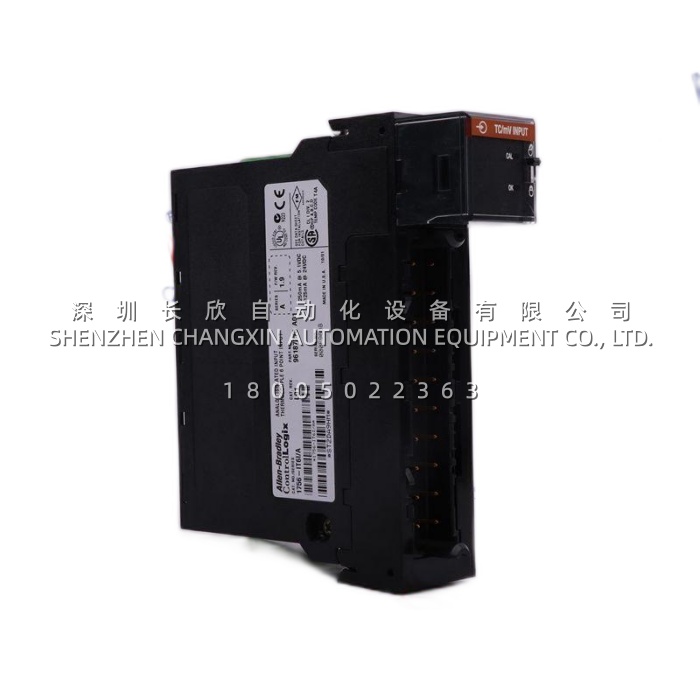
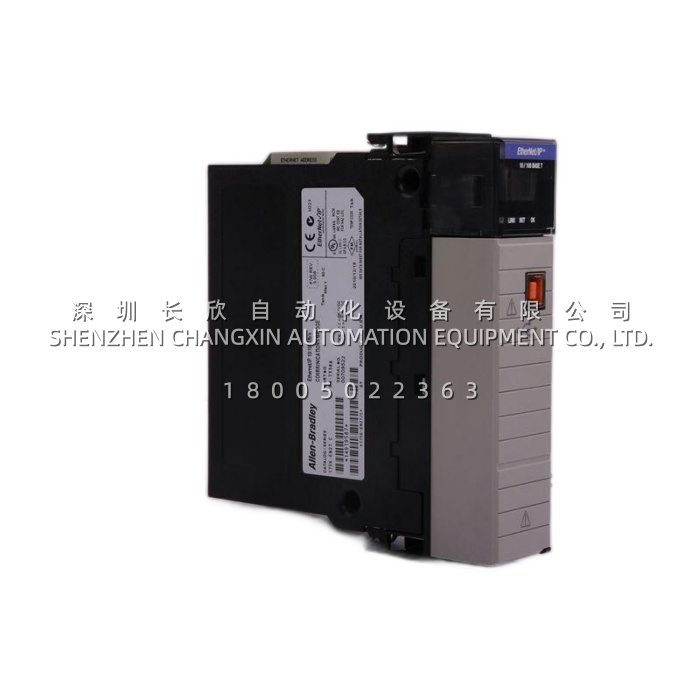
Product Overview
The 1756-EN2T is an EtherNet/IP bridge module from Allen-Bradley, part of the Rockwell Automation ControlLogix 1756 platform. It mounts in any available slot of a ControlLogix chassis and acts as the gateway between the 1756 backplane and an EtherNet/IP network, carrying I/O data, messages, and configuration traffic between the controller and the rest of the automation system. The 1756-EN2T is the mid-capacity member of the family — rated for 256 Logix connections and 128 TCP connections — sitting below the 1756-EN3T (900 Logix / 128 TCP) and above the 1756-ENET legacy module. Its role is to give a ControlLogix controller a high-bandwidth, standards-based path to HMI stations, drives, remote I/O, and peer controllers without consuming the controller’s own communication resources.
The 1756-EN2T carries two 10/100 Mbps Ethernet ports housed in a single RJ-45 connector, with a 1756 backplane interface on the module side and a 1784-CF64 64 MB CompactFlash card slot for nonvolatile storage. It draws 1 A at 5.1 V DC and 2 mA at 24 V DC, dissipating 5.5 W, and it is DLR-capable — Device Level Ring — so the module can participate in a redundant-ring topology rather than leaving the chassis dependent on a single cable. This is the feature that most often determines the 1756-EN2T specification on a production line: a cut cable or a failed switch no longer takes down the cell.
The 1756-EN2T Series B (the “B” in the model string) is the current series in the field, and the 1756-EN2TK is the conformal-coat variant for corrosive or high-contamination environments. Both share the same connection ratings and firmware base. Configuration is done in RSLogix 5000 (version 16 and later) and Studio 5000 Logix Designer (version 21 and later), with the module appearing as a bridge in the I/O tree rather than as a rack of I/O points. The 1756-EN2T is therefore transparent to the control logic: the controller sees the remote devices, not the bridge, which keeps the program portable when the network architecture changes.
Technical Specifications
| Parameter Name | Parameter Value |
|---|---|
| Product Model | 1756- (Series B); 1756-EN2TK (conformal coat) |
| Manufacturer | Rockwell Automation / Allen-Bradley |
| Product Type | ControlLogix EtherNet/IP Bridge Module |
| Product Family / Platform | Bulletin 1756 ControlLogix |
| Ethernet Data Rate | 10/100 Mbps, half/full duplex, auto-negotiating |
| Ethernet Connector | 1 RJ-45, two ports |
| Network Protocol | EtherNet/IP |
| Maximum Logix Connections | 256 |
| Maximum TCP Connections | 128 |
| CIP Messages / s | 500 |
| Maximum Nodes per Network | 64 |
| Cable Type | Category 5 or later, shielded (UTP/STP) |
| Maximum Cable Length | 100 m (328 ft) |
| Backplane Interface | 1756 ControlLogix backplane |
| Memory Card | 1784-CF64 CompactFlash, 64 MB |
| Redundancy | DLR-capable (Device Level Ring) |
| Current Draw @ 5.1 V DC | 1 A |
| Current Draw @ 24 V DC | 2 mA |
| Power Dissipation | 5.5 W |
| Thermal Dissipation | 18.7 BTU/hr |
| Module Location | Any slot in a ControlLogix chassis |
| Module Width | 1 ControlLogix slot |
| Dimensions | 5.51 x 1.46 x 6.30 in (14.0 x 3.7 x 16.0 cm) |
| Weight | 0.68 lb (0.31 kg) |
| Operating Temperature | 0 to 60 °C (32 to 140 °F) |
| Storage Temperature | -40 to 85 °C (-40 to 185 °F) |
| Relative Humidity | 5 to 95%, non-condensing |
| Certifications | CE, CSA, C-UL, FM, ATEX, IECEx, RCM, CCC, EAC, KC, UL |
| Lifecycle Status | Active (no published discontinuation notice) |
Main Features and Advantages
A true bridge rather than a translated port:
The moves data between the ControlLogix backplane and the EtherNet/IP network at the CIP object level, so the controller works with native I/O data and messages rather than with a mapped register set. This is why remote I/O, drive parameters, and HMI data all arrive in the same tag structure as local I/O: the bridge is invisible to the application logic, and a network redesign does not become a program rewrite.
Capacity matched to real cell sizes:
With 256 Logix connections and 128 TCP connections, the is sized for a typical production cell or skid — multiple PowerFlex drives, a remote I/O rack, an HMI, and a handful of peer controllers — without leaving the controller short of connection resources. For applications that outgrow it, the 1756-EN3T doubles the Logix connection count to 900 while keeping the same footprint and configuration, so the upgrade is a module swap rather than a platform change.
Device Level Ring for cable-cut survivability:
The is DLR-capable, which lets the chassis participate in a ring topology where a single cable break does not interrupt communication. On a packaging line or a continuous process where a cut cable means a line stop, this is not a cosmetic feature: it is the difference between a brief network reconfiguration and a production loss. The dual ports in a single RJ-45 connector are what make the ring physically possible without adding a second module.
Built-in storage and diagnostics:
The 1784-CF64 CompactFlash slot on the provides nonvolatile storage on the module itself, useful for project and documentation retention. Combined with the status LEDs and the diagnostics exposed in the I/O tree, this gives maintenance a way to see link state, network traffic, and connection health from the HMI rather than by opening the cabinet.
Low power and flexible placement:
At 5.5 W dissipation and 1 A at 5.1 V DC, the is a light load on the chassis power budget, and it can be placed in any available slot rather than requiring a dedicated position. This makes panel layout straightforward even in retrofits where the chassis is already populated.