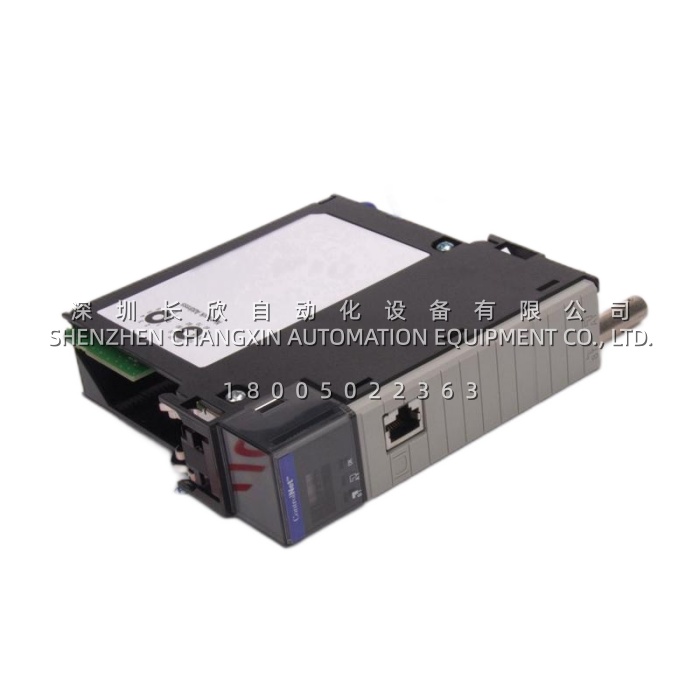
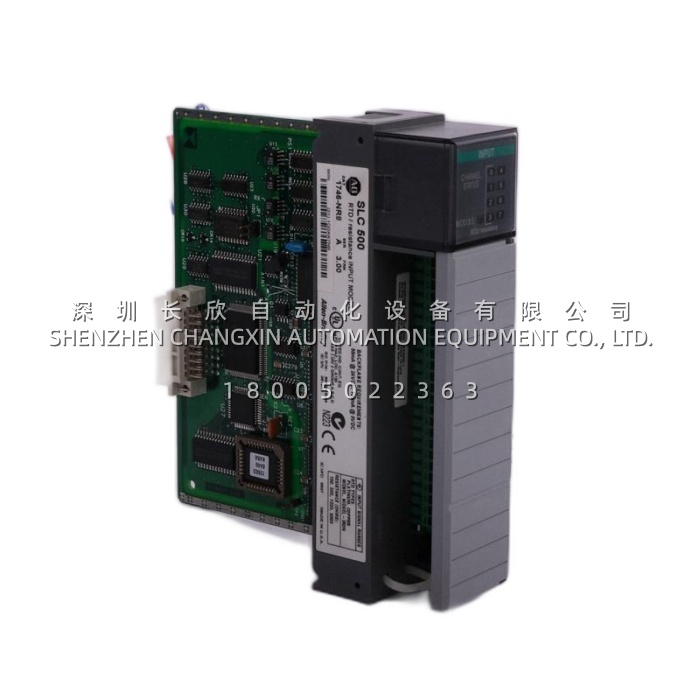
Technical Specifications
| Parameter Name | Parameter Value |
|---|---|
| Product Model | Allen-Bradley 1756-DHRIO Scanner Module |
| Manufacturer | Rockwell Automation (Allen-Bradley) |
| Product Type | DH+ and Remote I/O scanner communication module |
| Product Family | ControlLogix (1756 series) |
| Number of Channels | 2 (1 x DH+, 1 x RIO) |
| DH+ Protocol | Data Highway Plus, token passing |
| DH+ Maximum Nodes | 64 per network |
| DH+ Data Rate | 57.6 KBaud |
| DH+ Cable Distance | 3048 m (10,000 ft) at 57.6 KBaud |
| DH+ Cable Types | 1771-KG (1.5 mm²), 1771-KH (0.75 mm²) |
| DH+ Connector | 6-pin mini-DIN |
| DH+ Isolation | 500 V AC continuous |
| RIO Protocol | Allen-Bradley Remote I/O |
| RIO Data Rate | 5 Mbit/s |
| RIO Maximum Adapters | 32 (with extended-node termination) |
| RIO Segment Length | 250 m (820 ft) |
| RIO Cable Type | RG-6 coaxial, BNC connector |
| Backplane Current Draw | 900 mA at 5 V DC |
| Power Dissipation | 6.0 W maximum |
| Slot Requirement | One ControlLogix chassis slot |
| Indicators | Module status, network status, DH+ activity, RIO activity |
| Configuration Tool | RSNetWorx for DH+ / RSNetWorx for ControlNet, RSLogix 5000 |
| Dimensions (H × W × D) | 127 × 31 × 127 mm (5.0 × 1.22 × 5.0 in) |
| Weight | 0.26 kg (0.57 lb) |
| Operating Temperature | 0 °C to +60 °C (32 °F to 140 °F) |
| Storage Temperature | -40 °C to +85 °C (-40 °F to +185 °F) |
| Relative Humidity | 5 % to 95 % non-condensing |
| Shock and Vibration | 30 g operating shock; 2 g @ 10–500 Hz vibration |
| Certifications | UL 508, CSA C22.2 No. 213, CE, C-Tick; ATEX/CSA Hazardous Location where marked |
Main Features and Advantages
Two legacy networks in one slot: The defining advantage of the Allen-Bradley 1756-DHRIO Scanner Module is that it carries both DH+ and RIO interfaces on a single module. A ControlLogix chassis therefore needs one slot rather than two to integrate with a mixed legacy cell, which is material in a chassis already dense with safety, motion and specialty modules. The DH+ channel handles peer-to-peer data exchange and programming-device access, while the RIO channel carries cyclic I/O image data—two fundamentally different traffic types served by one module.
Deterministic RIO data exchange: The RIO interface operates at 5 Mbit/s and participates in the standard ControlNet-style scheduled data exchange, moving I/O image data in fixed, cyclic frames. For distributed control schemes this predictability is critical: engineers can calculate worst-case update latency and design interlock timing around it, something that is far harder to guarantee on a shared, contention-prone network. The 250 m segment length and support for up to 32 adapters allow a ControlLogix controller to supervise a geographically distributed set of legacy I/O racks without repeaters.
Long-distance DH+ reach: The 3048 m cable distance at 57.6 KBaud gives the DH+ channel genuine plant-wide reach. A ControlLogix controller can therefore supervise PLC-5 and SLC 500 nodes distributed across a large facility or along a pipeline right-of-way without intermediate infrastructure. The 64-node capacity is sufficient for all but the largest DH+ networks, and the token-passing protocol remains deterministic regardless of node count, avoiding the collisions and retries that plague Ethernet-based messaging.
Isolation and diagnostics: Both channels are galvanically isolated from the backplane at 500 V AC, containing transients and ground loops that are endemic in large motor-centric plants. The module presents DH+ and RIO status to the controller through module-owned status tags, allowing the application logic to detect a lost link, a configuration error or a cable fault and act on it—drive an alarm, inhibit a start permissive or force a safe state—rather than discovering the failure only when the process misbehaves.
Phased migration enablement: The Allen-Bradley 1756-DHRIO Scanner Module is the key that turns a forced rip-and-replace into a controlled, cell-by-cell upgrade. A plant can move the supervisory controller to ControlLogix while retaining DH+ and RIO field devices, then migrate individual cells at a pace dictated by budget and production schedule. This protects the existing I/O configuration, field wiring, operator training and validation documentation, and it is the principal reason the module remains in demand long after DH+ and RIO ceased to be strategic platforms for new designs.