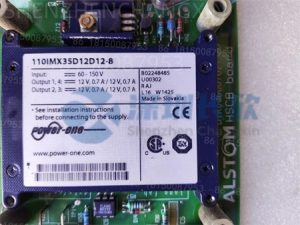
In the heart of any industrial facility—be it a sprawling chemical plant, a high-speed manufacturing line, or a critical power generation unit—lies a network of electronic control systems that orchestrate every process. The uninterrupted and clean operation of these systems is paramount, and it all begins with a reliable power supply. The ABB NGPS-11 power supply module emerges as a pivotal component in this context, designed specifically to meet the rigorous demands of modern industrial automation. More than just a converter, it is an intelligent power hub that integrates robust AC-DC conversion, comprehensive diagnostics, and, most importantly, a hardware- and architecture-level commitment to achieving true N+1 redundancy. This article delves into the technical sophistication of the NGPS-11. explores its implementation in real-world scenarios, and examines how it redefines power supply reliability for critical control applications.
1. Technical Deep Dive: Architecture and Intelligent Features
1.1 High-Efficiency, Compact Power Conversion
The ABB NGPS-11 is engineered around a high-density, modular architecture that consolidates multiple power management functions into a single, compact unit. At its core lies an advanced switch-mode power supply design, utilizing fixed-frequency current mode control technology for superior regulation and transient response. This design incorporates high-voltage MOSFETs, which contribute to its high conversion efficiency, often exceeding 92% under full load conditions. Such efficiency not only reduces energy consumption and heat dissipation within the control cabinet but also enhances the long-term reliability of the module itself and surrounding components.
A notable feature is its intelligent power management during low-load states. Employing a skip-cycle mode operation, the module dynamically reduces its switching frequency when output power demand falls below a certain threshold (e.g., 25% of capacity). This significantly cuts standby losses—by up to 30% compared to conventional designs—and eliminates audible noise, making it ideal for environments where both energy savings and quiet operation are valued.
1.2 Comprehensive Diagnostics and Real-Time Monitoring
Moving beyond basic functionality, the NGPS-11 incorporates a suite of diagnostic tools that transform it from a passive component into an active participant in system health management. The front panel is equipped with multi-color LED indicators that provide immediate, at-a-glance status information. A steady green typically signifies normal operation, while specific flashing patterns or a red light can indicate conditions such as output overload, overvoltage protection activation, or an internal fault.
Furthermore, the module supports integration into plant-wide monitoring networks. Through standard industrial communication interfaces, it can relay real-time operational parameters—including input voltage, output current and voltage, internal temperature, and operational hours—to a central control system or asset management platform. This capability enables predictive maintenance, as trends in performance data can alert personnel to potential issues before they lead to a failure, thereby maximizing uptime.
1.3 The Cornerstone of Reliability: True N+1 Redundancy on TB850 Backplane
The most defining characteristic of the ABB NGPS-11 is its native support for building truly redundant power systems. The concept of “N+1” redundancy is simple: ‘N’ modules supply the necessary power load, with one additional (‘+1’) module standing by to seamlessly take over if any active module fails. However, achieving this in practice requires careful architectural design.
The NGPS-11 is designed to work in conjunction with specific ABB system backplanes, such as the TB850. This backplane provides the critical electrical and logical infrastructure that allows multiple NGPS-11 modules to operate in parallel and in a coordinated manner. Key to this is an integrated load-sharing and hot-swap capability:
Active Current Sharing: Multiple modules connected to the same backplane automatically balance the output load evenly among themselves. This prevents any single unit from being overstressed and ensures uniform aging.
True Hot-Swap Functionality: If a module fails or needs to be removed for maintenance, it can be physically extracted from its slot on the powered backplane without interrupting the power supply to the connected loads. The remaining modules instantly and transparently compensate for the lost capacity.
Automatic Failover: The system continuously monitors each module. Upon detecting a fault in an active power supply, the backplane logic instantly disconnects it and transfers its share of the load to the remaining healthy modules, including the standby unit if configured. This transition happens within milliseconds, ensuring no voltage dip or interruption to the critical control equipment.
This architecture eliminates single points of failure in the power supply chain, providing a level of availability that is essential for processes where even a momentary power glitch is unacceptable.
2. Application Scenarios: From Theory to Industrial Practice
2.1 Distributed Control System (DCS) Cabinets in Process Industries
In a large refinery or petrochemical plant, dozens of DCS cabinets are distributed throughout the facility. Each cabinet houses controllers, I/O cards, and communication modules that control reactors, valves, and pumps. A power failure in one cabinet could lead to a process unit shutdown or, worse, an unsafe state.
Application Case: A major chemical plant upgraded the power supplies in its safety-critical DCS cabinets to the ABB NGPS-11 configured in a 2+1 redundant setup on TB850 backplanes. During a site-wide voltage sag caused by a grid disturbance, one NGPS-11 module in a key cabinet tripped on an internal protective function. Thanks to the true N+1 architecture, the backup module assumed the load instantly. The control system registered no interruption, and the process continued unaffected. The plant’s electrical maintenance lead noted: “The diagnostic LED immediately flagged the faulted module, and we were able to schedule its replacement during the next routine maintenance window without any production impact. The system’s transparency and resilience turned a potential incident into a non-event.”
2.2 Safety Instrumented Systems (SIS) and Turbine Control
For safety systems and critical machinery control (e.g., gas turbine protection), power supply integrity is often mandated by functional safety standards. A redundant, monitored power source is a fundamental requirement.
Application Case: A combined-cycle power plant utilized the NGPS-11 to power its turbine control and protection modules. The dual power feeds, each with its own N+1 redundant NGPS-11 bank, provided fault-tolerant power to the safety controllers. This design was a key element in achieving the required Safety Integrity Level (SIL) for the protection functions, as it drastically reduced the probability of a dangerous failure due to loss of power.
2.3 Manufacturing Automation and Robotics
High-speed automotive assembly lines or robotic welding cells depend on continuous operation to meet production targets. PLCs and servo drives in these environments benefit from the clean, stable power and high availability provided by a redundant NGPS-11 system, minimizing downtime due to power-related faults.
3. Industry Perspectives and Implementation Insights
3.1 User Feedback on Operational Benefits
Feedback from system integrators and end-users highlights several practical advantages:
Reduced Engineering Time: The pre-engineered redundancy solution with the TB850 backplane simplifies system design compared to building redundant power systems from discrete components.
Lower Total Cost of Ownership (TCO): While the initial investment might be higher, the dramatic reduction in unplanned downtime, coupled with the ease of maintenance and hot-swap capability, leads to significant cost savings over the system’s lifecycle.
Enhanced Troubleshooting: The clear diagnostic indicators and remote monitoring capabilities drastically reduce mean time to repair (MTTR). Engineers can pinpoint a faulty power module from the control room or via the LED status, rather than manually checking multiple units.
3.2 Expert Recommendation on System Design
“Implementing a redundant power architecture is not just about buying extra modules,” advises Sarah Chen, a senior automation consultant specializing in critical infrastructure. “The choice of the power supply and its supporting backplane is crucial. Solutions like the ABB NGPS-11 on the TB850 backplane are compelling because the redundancy logic is baked into the hardware. This offers a more robust and predictable failover compared to software-managed solutions. When specifying for high-availability applications, always verify that the claimed ‘N+1’ is supported by the physical bus architecture for true load sharing and hot-swap, and that diagnostics are comprehensive. The NGPS-11 checks these boxes effectively for a wide range of industrial control applications.”
4. Conclusion: A Strategic Investment in System Resilience
The ABB NGPS-11 power supply module represents a significant evolution in how power is delivered to industrial control systems. It moves beyond the basic promise of conversion efficiency to deliver intelligent diagnostics, seamless maintainability, and, most importantly, architecturally guaranteed redundancy. By enabling true N+1 redundancy through its integration with backplanes like the TB850. it provides a concrete solution to one of the most common causes of system failure: power supply loss.
For engineers designing new systems or modernizing existing ones, selecting the NGPS-11 is more than a component choice; it is a strategic decision to embed resilience into the very foundation of the control infrastructure. It ensures that the heartbeat of automation—clean, continuous power—remains strong, safeguarding productivity, safety, and profitability in an increasingly demanding industrial landscape.