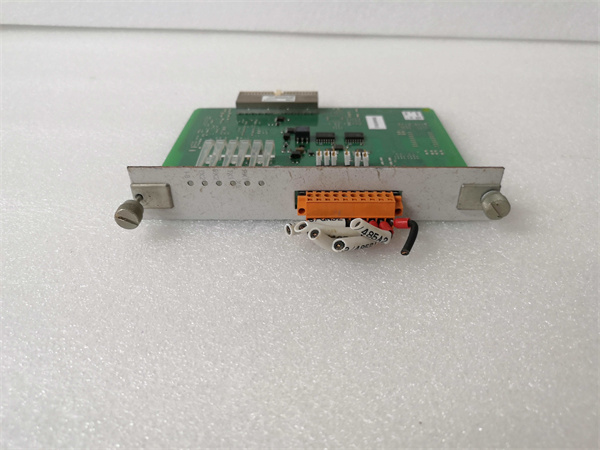
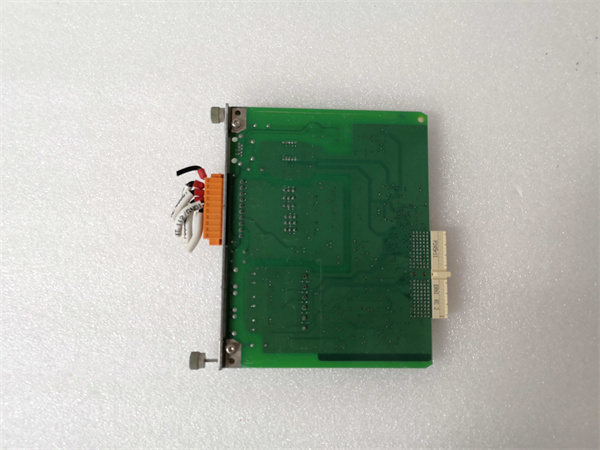
ABB COM0003 Control Driver Card: Enables Seamless Integration in Oil, Chemical, and Metallurgy Industries
In the demanding environments of heavy process industries—where extreme temperatures, corrosive substances, high-voltage equipment, and stringent safety protocols define daily operations—the reliability of control hardware is non-negotiable. Among the critical yet often overlooked components enabling stable automation in these sectors is the ABB COM0003 Control Driver Card. Designed as a core interface module within ABB’s legacy MasterPiece 200/300 (MP200/MP300) and early Industrial IT 800xA distributed control systems (DCS), the COM0003 serves as the communication backbone between central controllers and field I/O modules. Far from being a mere data conduit, this card delivers deterministic messaging, robust fault tolerance, and seamless interoperability across analog, digital, and smart device networks—making it a linchpin in continuous-process applications ranging from crude distillation units to electric arc furnaces.
Core Functionality: Bridging Control Logic and Field Devices
The COM0003 functions as a high-speed serial communication driver that manages data exchange between the central processing unit (CPU) and remote I/O stations via ABB’s proprietary MB300 fieldbus protocol. Each card supports dual redundant channels, enabling hot-standby operation—a critical feature in processes where unplanned shutdowns can cost hundreds of thousands of dollars per hour.
Key technical attributes include:
Dual RS-485 communication ports with galvanic isolation for noise immunity;
Support for up to 31 I/O modules per channel, covering AI, AO, DI, DO, and specialty modules (e.g., RTD, thermocouple);
Cyclic redundancy checking (CRC) and automatic retransmission for data integrity;
LED indicators for power, communication activity, fault status, and redundancy synchronization;
Operating temperature range of 0°C to +60°C, suitable for control rooms adjacent to harsh process areas.
Unlike generic serial cards, the COM0003 is tightly integrated into ABB’s system architecture, allowing the controller to poll I/O updates at millisecond-level intervals while maintaining full diagnostic visibility. “It doesn’t just pass data—it validates it,” notes Dr. Lena Petrova, a senior controls engineer at a European petrochemical complex. “If a signal drops out due to a loose terminal, the system flags it before the operator even notices.”
Role in Mission-Critical Process Control
In oil refining, chemical synthesis, and metallurgical smelting, processes run 24/7 under tightly controlled parameters. The COM0003 ensures that critical signals—such as reactor temperature, pressure relief valve status, or oxygen lance position—are transmitted reliably and without delay.
For example:
In a fluid catalytic cracking (FCC) unit, the COM0003 relays real-time readings from dozens of thermocouples to the main controller, enabling precise regulation of regenerator temperature to prevent catalyst deactivation.
In an aluminum smelter, it interfaces with high-current rectifier systems, transmitting DC voltage and amperage feedback to maintain optimal Hall-Héroult cell conditions.
In a chlor-alkali plant, it supports fail-safe shutdown logic by continuously monitoring hydrogen concentration sensors and emergency dump valves.
Because the MB300 protocol used by the COM0003 is deterministic—unlike Ethernet-based protocols subject to collision delays—it guarantees consistent scan times, which is essential for closed-loop control of fast-acting safety systems.
Real-World Deployments Across Heavy Industry
Case Study 1: Offshore Oil Platform (North Sea)
A floating production storage and offloading (FPSO) vessel upgraded its aging control system but retained MP300 I/O racks due to their proven resilience in salty, high-vibration environments. Engineers installed new COM0003 cards with updated firmware to restore communication stability after intermittent dropouts plagued the original drivers. “The dual-channel redundancy meant we could replace a faulty card during production—no shutdown required,” said Lars Eriksson, offshore automation lead. Over three years, zero communication-related trips were recorded.
Case Study 2: Sulfuric Acid Plant (Chile)
Corrosive fumes had degraded older communication modules, causing sporadic loss of pump status signals. After switching to conformal-coated COM0003 units with enhanced EMI shielding, the plant achieved 99.98% system availability. “In sulfuric acid service, every component must earn its place,” remarked Carlos Mendoza, plant manager. “The COM0003 did.”
Case Study 3: Steel Mini-Mill (USA)
During an arc furnace retrofit, the facility needed to integrate legacy MP200 I/O with a new 800xA operator station. The COM0003 enabled transparent data mapping between old field devices and the modern HMI, avoiding a full I/O replacement. “We saved over $1.2 million by reusing existing wiring and sensors,” explained James Miller, project engineer. “The COM0003 was the glue that held it all together.”
Maintenance and Reliability Best Practices
Despite its ruggedness, the COM0003 benefits from disciplined care:
Ensure proper termination resistors on MB300 bus lines to prevent signal reflections;
Verify grounding continuity between I/O cabinets to avoid ground loops that corrupt data;
Monitor communication error counters via ABB’s Composer or System 800xA diagnostics;
Keep spare cards powered periodically to prevent capacitor degradation during long-term storage.
“Most ‘failed’ COM0003 cards we troubleshoot are actually victims of poor cabling or voltage sags—not component wear,” observes Robert Jenkins, a veteran ABB service technician. “Clean power and clean signals make all the difference.”
Experts also recommend labeling spares with firmware revision numbers, as mismatched versions can cause handshake failures—even if hardware appears identical.
Enduring Relevance in Modernization Strategies
While ABB has transitioned to AC 800M controllers and Profibus/Profinet-based I/O, thousands of plants still operate MP200/MP300 systems due to their longevity and reliability. The COM0003 remains in demand for:
Brownfield upgrades where only the controller or HMI is replaced;
Life-extension programs supported by ABB’s long-term service agreements;
Hybrid architectures that bridge legacy I/O to OPC UA servers for IIoT integration.
Factory-refurbished COM0003 units—tested with updated capacitors and firmware—are widely available, ensuring continued support without compromising safety or performance.
Conclusion: The Quiet Enabler of Industrial Continuity
The ABB COM0003 Control Driver Card may lack the visibility of HMIs or the computational power of modern PLCs, but its role is indispensable. By ensuring rock-solid communication between brain and body of a control system, it upholds the integrity of processes where failure is not an option. In oil refineries humming through the night, chemical reactors maintaining exact stoichiometry, and steel mills melting scrap at 1.600°C, the COM0003 operates silently—yet decisively—keeping data flowing, alarms responsive, and production safe. For engineers entrusted with the heartbeat of heavy industry, this unassuming card represents more than hardware: it’s a promise of continuity, engineered into every bit.