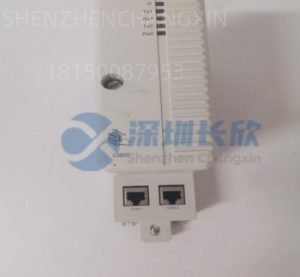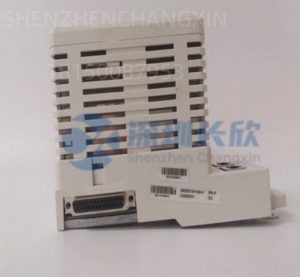
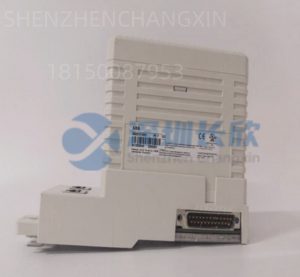
ABB CI855K01 – Hot-Swappable Serial Interface Module with Real-Time Diagnostics
In today’s industrial control environments—where legacy equipment coexists with modern digital architectures—the ability to seamlessly integrate disparate systems is no longer a convenience; it’s a necessity. The ABB CI855K01 serial communication module answers this challenge head-on. Designed for the AC 800M distributed control system (DCS), this hot-swappable interface unit provides dual isolated RS-485 ports with real-time diagnostics, enabling robust, deterministic communication with third-party devices such as flow meters, variable frequency drives (VFDs), remote terminal units (RTUs), and legacy PLCs. What sets the CI855K01 apart isn’t just its protocol flexibility—it’s the combination of field-proven ruggedness, live-replacement capability, and intelligent monitoring that transforms serial connectivity from a potential point of failure into a pillar of system reliability.
For engineers managing brownfield upgrades or hybrid automation landscapes, the ABB CI855K01 is more than an adapter—it’s a bridge between past and future, built to last.
Why Hot-Swappability and Diagnostics Matter in Mission-Critical Networks
Traditional serial gateways often require a full controller shutdown for maintenance—a process that can halt production for 20 minutes or more when factoring in reboots, safety checks, and re-synchronization. In a continuous-process industry like power generation or water treatment, such downtime carries significant operational and financial risk. The ABB CI855K01 eliminates this vulnerability through true hot-swappable design: technicians can replace a faulty module without powering down the AC 800M rack, and the system automatically reloads configuration from non-volatile memory within seconds.
Equally critical is its real-time diagnostic capability. Each RS-485 port features dedicated LEDs for transmit (TX), receive (RX), and error (ERR) states, providing immediate visual feedback. Beyond hardware indicators, the module logs detailed communication metrics—including message timeouts, CRC errors, and baud rate mismatches—accessible via ABB’s Control Builder M engineering tool. This visibility turns troubleshooting from guesswork into data-driven action.
As one controls engineer at a European combined-cycle power plant noted: “Before the CI855K01. we’d spend hours chasing phantom Modbus errors. Now, the ERR LED tells us instantly if it’s a wiring issue, device fault, or noise problem.”
Technical Architecture: Isolation, Flexibility, and Determinism
The ABB CI855K01 (part number 3BSE018106R1. firmware variant MB300) is engineered for harsh industrial conditions:
Dual independent RS-485 ports, each supporting baud rates from 300 bps to 115.2 kbps
2500 VAC galvanic isolation between field circuits and backplane logic, preventing ground loops and protecting the controller from voltage transients
Support for multiple protocols on separate ports—e.g., Modbus RTU on Port 1 for VFDs, Profibus DP Slave on Port 2 for legacy analyzers
Cycle times as low as 10 milliseconds, ensuring timely data exchange for closed-loop control
Operating temperature range of –25°C to +70°C, suitable for outdoor cabinets or unconditioned enclosures
Unlike generic serial converters, the CI855K01 is natively integrated into ABB’s automation stack. No external drivers, no configuration conflicts—just plug into an S800 I/O rail, assign I/O tags in Control Builder M, and go.
Real-World Impact: From Water Infrastructure to Mining Operations
Case Study: Municipal Water Distribution Network
A major city in North America needed to modernize its SCADA system while retaining hundreds of existing electromagnetic flow meters communicating via Modbus RTU over long cable runs (up to 1.2 km). Early attempts with off-the-shelf gateways failed due to ground potential differences and lightning-induced surges. After deploying ABB CI855K01 modules with proper shielding and termination, communication reliability jumped to 99.99%. During a severe thunderstorm that induced 1.5 kV on signal lines, the module’s isolation barrier protected the AC 800M controller—and all flow data remained uninterrupted. “The CI855K01 didn’t just connect our meters—it future-proofed them,” said the project lead.
Case Study: Copper Mine Dewatering System
In a deep underground mine in South America, dewatering pumps were controlled by legacy RTUs using custom ASCII protocols. Integrating them into the new ABB DCS seemed impossible—until the team leveraged the CI855K01’s user-definable message templates. By configuring custom start/stop delimiters and checksum logic in Control Builder M, they achieved seamless bidirectional communication. When one module later failed due to condensation, it was replaced during normal operation—no pump shutdown required. Over two years, unplanned outages related to communication dropped to zero.
User Feedback and Expert Recommendations
“We’ve deployed over 50 CI855K01 units across three refineries. Not one has failed due to electrical noise. And when we had a wiring mistake during commissioning, the ERR LED saved us three hours of debugging.”
— Senior Automation Specialist, Oil & Gas Sector
Expert Best Practices:
Always use shielded, twisted-pair cable (e.g., Belden 3105A) and terminate with 120 Ω resistors at both ends of the RS-485 line
Ground the shield at one point only—typically at the control cabinet—to avoid ground loops
Enable input filtering in software for mechanical contacts to suppress bounce
For long-distance runs (>500 m), reduce baud rate to improve signal integrity (e.g., 9600 bps instead of 115.2 kbps)
Store spares in ESD-safe packaging; though rugged, the PCB remains sensitive to static discharge during handling
Seamless Integration Within the ABB Ecosystem
The CI855K01 thrives as part of a unified architecture:
Mounts directly on S800 I/O baseplates (e.g., TB820. TB850) alongside analog and digital I/O
Fully supported in Control Builder M for protocol configuration, data mapping, and diagnostic logging
Compatible with AC 800M PM864/PM866 controllers, enabling deterministic scan cycles
Can be paired with fiber-optic extenders (e.g., GFD563) for electrically isolated long-haul serial links
This native integration ensures that adding serial devices doesn’t compromise system performance or cybersecurity posture.
Installation, Maintenance, and Lifecycle Support
Installation is straightforward: insert the module into an available S800 slot, connect field wiring to the terminal base, and configure protocols in software. For hot-swap replacement:
Verify the module is not in a critical fault state (red ERR LED = investigate first)
Pull the handle firmly—no tools required
Insert the new unit until fully seated
Confirm LED activity and validate communication in Control Builder M
Routine maintenance involves periodic inspection of LEDs and terminal tightness. ABB recommends replacing modules every 8–10 years in continuous-duty applications, though many installations exceed this with no degradation.
Conclusion
The ABB CI855K01 exemplifies how thoughtful engineering can turn a seemingly mundane component—like a serial interface—into a strategic asset. By combining hot-swappability, real-time diagnostics, robust isolation, and native DCS integration, it solves the persistent challenge of legacy device connectivity without sacrificing reliability or performance. In an era where operational continuity is paramount, the CI855K01 doesn’t just transmit data—it safeguards the very integrity of the control loop. For engineers building resilient, future-ready automation systems, it remains an indispensable tool in the integration toolkit.