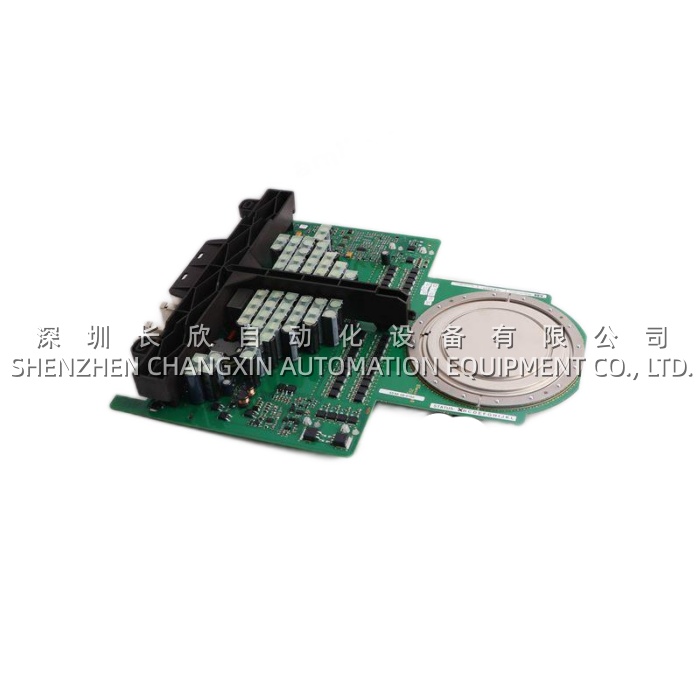
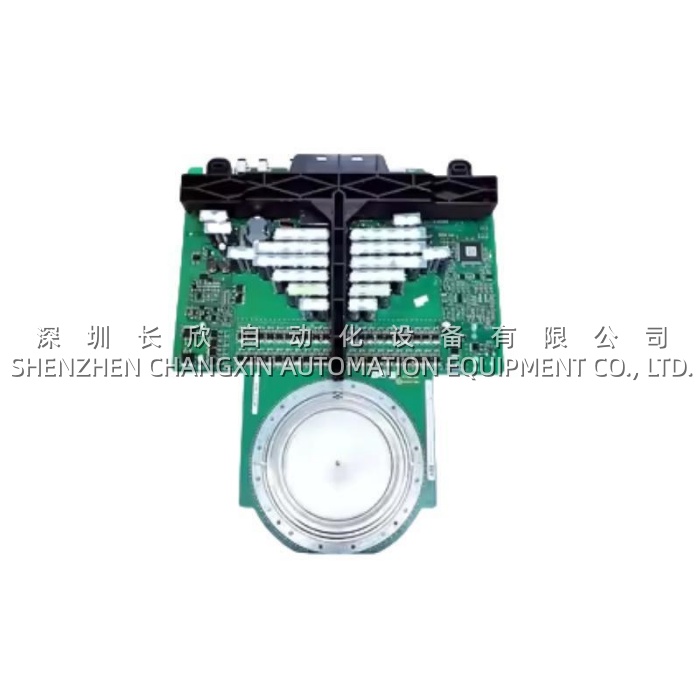
Product Overview
The ABB 5SHY3545L0014 is a high-power asymmetric IGCT (Integrated Gate-Commutated Thyristor) in ABB’s 5SHY press-pack family, rated 4500 V reverse-blocking and 3500 A maximum controllable turn-off current, with a 10 ms surge rating up to ~8000 A. It is the power-switching heart of ABB’s medium-voltage drive and converter cabinets — most prominently the ACS6000 inverter bridge arms, LCI (Load Commutated Inverter) converters for pumped-storage and large wind, STATCOM reactive-power compensators, and marine pod-propulsion rectifier/inverter stages. The ABB 5SHY3545L0014 is almost never ordered alone: in ABB’s packaging it ships / spares against the gate-drive pair 3BHB013085R0001, because an IGCT is only as good as its low-inductance gate-unit and fiber trigger — the GDU clamps the gate, shapes dV/dt, detects desaturation, and talks fiber to the converter controller (e.g. AC 800PEC or the ACS6000 control cubicle).
What makes the ABB 5SHY3545L0014 distinct from a module IGBT is the press-pack construction: no bond wires, no solder layers, the silicon die sits between two molybdenum/copper composite electrodes under a calibrated hydraulic clamping force (~35 kN, ±15%) delivered by the converter’s press-plate assembly. This gives the ABB 5SHY3545L0014 two signature behaviours: (1) it’s fail-short — if the die fuses internally during a fault, it goes short-circuit rather than open, so the series string (typically 4–6 IGCTs per MV bridge arm at 6.6–11 kV) can still be commutated by the neighbours while the faulty unit is identified; (2) thermal cycling and surge-current tolerance are an order above module IGBTs — relevant when a 20 MVA LCI takes a grid fault and every arm sees 2× nominal for cycles.
The ABB 5SHY3545L0014 is an asymmetric IGCT (blocking only in reverse direction, forward conducting like a thyristor until gate-commutated off) — this is the standard 5SHY 3545 type used in voltage-source inverter (VSI) and current-source LCI bridges in ABB’s MV portfolio. Cooling is double-sided liquid (water + glycol, typical 40–50% EG, flow per arm designed by ABB’s thermal kit), with the heat flux handled through the press-pack’s two faces into the water-cooled heat sinks above/below. Gate trigger is fiber-optic from the 3BHB013085R0001 GDU, isolating the 4500 V switching noise from the 24–40 VAC gate supply and the controller. Switching frequency is optimised <1 kHz (reseller claims of 20 kHz / 1600 Hz belong to smaller 5SHY frames or are marketing inflation — the 3545’s sweet spot is 300–800 Hz in MV drive PWM, LCI line-commutated runs even lower).
From a lifecycle view, the ABB 5SHY3545L0014 is an A-class legacy/heavy-spare: ABB’s active 5SHY successors have moved to 5SHY5045L0020 (5 kV/5000 A) and the newer StakPak IGBT lines for some apps, but the installed base of ACS6000/LCI/STATCOM running 3545s is huge (mining drives, pumped-storage LCI, marine pod, steel-plant MV drives, HVDC Light poles). Plants running these typically hold 1 spare ABB 5SHY3545L0014 + 1 spare 3BHB013085R0001 GDU per 2–3 converter arms (i.e. ~1 per cabinet for a 6-pulse, 2 per 12-pulse). The IGCT itself rarely fails electrically (press-pack is robust) — the failures are usually thermal (cooling-flow loss), mechanical (clamping-force relaxation after 15+ years, visible as rising junction-Rth trend), or GDU-side (gate-unit capacitor/IGBT driver in 3BHB013085R0001 ages). Swapping the ABB 5SHY3545L0014 is a cabinet-level job: depressurise the press-plate, unbolt heat sinks, extract the old pack, inspect moly discs, seat new, re-torque 35 kN, re-connect GDU fiber + power tails — not a 10-minute DIN-rail job (that reseller claim is for a different ABB product mistakenly cross-pasted).
Technical Specifications
| Parameter | Value |
|---|---|
| Product Model | ABB 5SHY3545L0014 (paired GDU: 3BHB013085R0001) |
| Manufacturer | ABB (Switzerland / Germany) |
| Product Type | Asymmetric Press-Pack IGCT (Integrated Gate-Commutated Thyristor) |
| Series | ABB 5SHY |
| Repetitive Peak Off-State / Reverse Voltage (VDRM) | 4500 V |
| Maximum Controllable Turn-Off Current (ITGQM) | 3500 A |
| Nominal Current (IC, some sources) | ~4000 A @ 25 °C junction |
| 10 ms Surge Current (non-repetitive) | ~8000 A |
| Switching Frequency | Optimised <1 kHz (MV drive PWM 300–800 Hz typical) |
| Gate Trigger | Fiber-optic from 3BHB013085R0001 GDU |
| Gate Supply (GDU side) | 24–40 VAC (per GDU spec) |
| Thermal Resistance, Junction–Case (RthJC) | ~0.012 K/W |
| Isolation Test Voltage | 10 kV AC / min (press-pack to heat sink) |
| Mounting / Clamping Force | ~35 kN ±15% (hydraulic press-plate, requires calibration) |
| Cooling | Double-sided liquid (water + glycol), flow per ABB thermal kit |
| Fail Mode | Fail-short (press-pack characteristic) |
| Operating Junction Temp. | –40 to +125 °C (some datasheets +150 °C transient) |
| Storage Temp. | –40 to +85 °C |
| Dimensions (press-pack body) | ~190 × 140 × 38 mm (L×W×H) — some listings give 263×58×28 as packed-with-sink |
| Weight | ~2.3 kg (bare pack) / ~4.3 kg (with heat-transfer elements, per reseller) |
| Safety / SIL | SIL-2 capable per IEC 61508 (system-dependent) |
| Standards | UL 1557, IEC 60747-9, RoHS |
| Typical Deployments | ACS6000 inverter arm, LCI converter, STATCOM, HVDC Light pole, marine pod drive |
| Successor Reference | ABB 5SHY5045L0020 (5 kV / 5000 A, enhanced dv/dt) |
Main Features and Advantages
Press-pack fail-short architecture:
The defining trait of the ABB 5SHY3545L0014 is the press-pack: silicon die sandwiched between molybdenum/copper composite electrodes, clamped at ~35 kN by the converter’s hydraulic press-plate. No bond wires, no solder — so no wire-lift, no solder-joint fatigue. And critically: if the die fuses under a fault, it fails short-circuit rather than open. In a 6-pulse or 12-pulse MV bridge (4–6 IGCTs per arm at 6.6–11 kV), a shorted IGCT lets the arm still commutate via the neighbours while protection isolates the faulty string — this is why IGCT (and press-pack IGBT) dominates HVDC/LCI where a single open-device would kill the whole pole. The ABB 5SHY3545L0014 inherits this “survivable fault” DNA.