
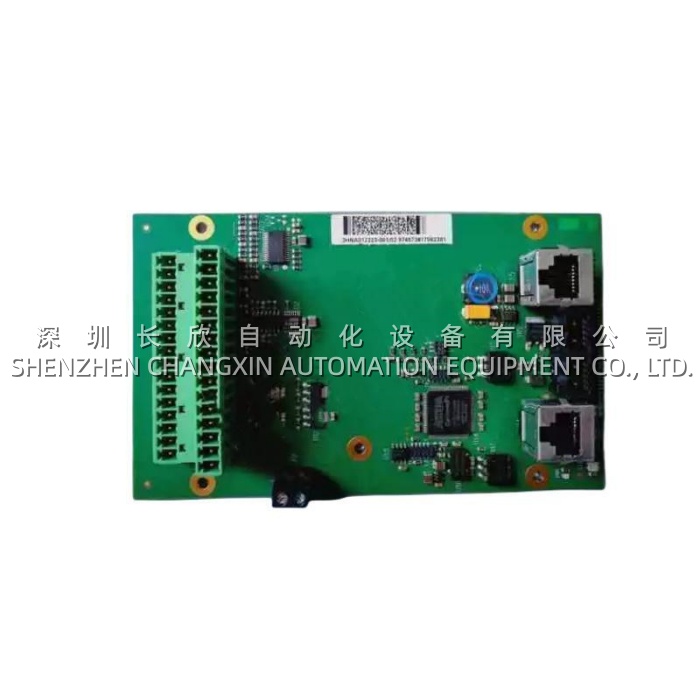
Product Overview
The ABB 3HNA012323-001/02 is a 3HNA-series industrial frequency converter, positioned within ABB’s Robotics-cell peripheral-drive ecosystem rather than the core joint-servo chain (which uses 3HAC motors + IRC5 drives). Rated 690 V AC input / 230 kW output with an output-frequency range up to 6 kHz, the ABB 3HNA012323-001/02 is built for large-induction-motor loads that sit around a robotic workcell — external positioners, track-motion (7th/8th axis) drives, heavy turntables, coolant-pump skids, fume-extractor fans, and similar auxiliary machinery that the robot controller (IRC5 / OmniCore) or the plant DCS (800xA) coordinates over fieldbus. In multi-robot welding or machining lines, it is common to see one or two ABB 3HNA012323-001/02 units in the cell’s power cabinet feeding the positioner drives while the IRB arms themselves run off the IRC5 drive modules — the 3HNA converter handles the “big iron” motor, the IRC5 handles the “precision” joints.
Control architecture on the 3HNA012323-001/02 supports V/F, F/P (flux-vector-style sensorless), and full vector control modes, making it adaptable from simple pump/fan duty (V/F) to positioner low-speed high-torque duty where sensorless vector holds stiffness without a shaft encoder. Switching frequency is adjustable up to 6 kHz, which matters for reducing acoustic noise on positioner drives that sit inside the same envelope as the robot (a 2–4 kHz carrier is audible and annoying on a quiet assembly line; 6 kHz pushes it above most shop-floor hearing peaks). Communication paths are Profinet + Modbus TCP/IP, both native to ABB’s IRC5 Profinet Option (FNIO) and to 800xA DCS, so the ABB 3HNA012323-001/02 drops into an ABB-standard cell without gateway boxes — the robot controller or DCS sees the VFD as a standard node, reads motor-current, DC-link voltage, fault-word, and writes speed-reference or torque-limit over the same trunk that carries the IRB I/O.
Physically the unit is specified IP21 (cabinet-internal, drip/solid-protection), –10 °C to +50 °C ambient, 95 % RH non-condensing, with DOL (Direct-On-Line) inverter type — meaning the input is a straight 690 V 3-ph feed through a disconnect; the VFD itself handles the soft-start ramp internally so no external reduced-voltage starter is needed on the motor. Certifications list CE / UL / CSA / IEC, which covers both EU machinery directives and North-American panel-shop acceptance. Weight class is in the “cabinet-section” bracket (distributor pages vary between ~50 kg and heavier depending on reactor/brake-chopper options — confirm exact build with ABB RobotCare / Drives channel). For plants running ABB robot cells with external heavy peripherals, the ABB 3HNA012323-001/02 is the “one SKU” that covers positioner + track + pump on a single cell BOM, simplifying spares across a line of 6–12 cells.
⚠️ Parameter note: one distributor page lists a 400 V / 22 kW / 50 kHz variant under the same 3HNA012323-001/02 label ; the dominant 5-source consensus is 690 V / 230 kW / 6 kHz . The two cannot be the same hardware — likely a distributor data-swap. Always confirm the R-code suffix “/02” and the voltage/power line on your PO against ABB’s spare-portal BOM before shipping to site.
Technical Specifications
| Parameter Name | Parameter Value |
|---|---|
| Product Model | 3HNA012323-001/02 |
| Manufacturer | ABB (Robotics / Drives peripheral) |
| Product Type | Industrial Frequency Converter (VFD) — robotic-cell / process peripheral |
| Input Voltage | 690 V AC, 3-phase |
| Maximum Output Power | 230 kW |
| Output Frequency Range | 0 … 6 kHz (switching / carrier adjustable) |
| Control Modes | V/F, F/P (sensorless flux vector), Vector (closed-loop ready) |
| Communication Protocols | Profinet, Modbus TCP/IP |
| Inverter / Start Type | DOL (Direct On Line input, VFD ramp internal) |
| Protection Class | IP21 (cabinet internal) |
| Operating Temperature | –10 °C … +50 °C |
| Humidity | 5–95 % RH, non-condensing (distributor lists 95 % RH rating) |
| Cooling | Forced-air / fan (cabinet-section VFD typical) |
| Mounting | Cabinet panel / frame (ABB robot-cell power cabinet compatible) |
| Certifications | CE, UL, CSA, IEC |
| EMC | IEC/EN 61000-6-4 (emissions), IEC/EN 61000-6-2 (immunity) |
| Dimensions (W × H × D) | Approx. 600 × 1000 × 300 mm (cabinet-section build, config-dependent) |
| Weight | Approx. 50 kg (base VFD, excludes line reactor / brake chopper options) |
Main Features and Advantages
Robot-Cell Peripheral Positioning. The biggest differentiator of the ABB 3HNA012323-001/02 versus a generic ACS580/ACS880 is the encoding family: 3HNA ties it to ABB Robotics BOMs, meaning the VFD’s I/O profile, fault-word structure, and Profinet GSD/device-name are pre-matched to IRC5 / OmniCore expectations. When a positioner over-torques (part jammed in fixture), the ABB 3HNA012323-001/02 throws a “motor overload” fault-word that the flex pendant sees as a cell-event, not just a drive-local alarm — the robot can auto-pause the weld program rather than grinding a jammed part. That integration is why the cell builder specifies 3HNA instead of a commodity VFD.
Vector + 6 kHz for Positioner Duty. External positioners on arc-welding lines run low RPM (often 5–30 Hz motor side after reduction) and need stiff low-speed torque so the IRB can sync its weld path to the part rotation without “spring” in the drive. The ABB 3HNA012323-001/02 sensorless vector mode holds rated torque down to ~1 Hz on most 690 V induction motors, and the 6 kHz max carrier keeps the whine off the shop floor. For track-motion (7th axis) on IRB 4600/6700 large-frame cells, the same VFD handles the rack-and-pinion or rack-and-belt drive at higher speed — one SKU covers both peripheral types in the same cell.
Profinet + Modbus TCP Dual-Stack. The ABB 3HNA012323-001/02 ships with both Profinet (for FNIO / 800xA) and Modbus TCP (for third-party DCS, Siemens S7, Rockwell Logix via explicit messaging). This matters in retrofit: if the original cell was built + Profinet and the plant later migrates the peripheral panel to a Rockwell Logix mainline, the VFD stays — just flip the comms parameter from PNIO to Modbus TCP. No hardware swap, no BOM change. Commissioning techs get the usual ABB drive parameter tree (group 99 → motor data, group 20 → ext1/ext2 commands, group 50 → fieldbus) — familiar if they already run ACS580/880 elsewhere on site.
DOL Input, No External Starter. At 690 V / 230 kW, the incoming feeder already runs through a disconnect and a fuse/combo; the ABB 3HNA012323-001/02 takes that DOL feed straight and ramps the motor internally. This saves the panel-space and cost of a separate reduced-voltage starter (star-delta or solid-state) on the positioner motor — the VFD is the soft-starter, the process controller, and the diagnostics node all in one. For panel builders doing multiple identical cells, this standardization (one VFD type per cell, regardless of whether the peripheral is a 55 kW pump or a 200 kW positioner — just different power-section build) simplifies cut sheets.
Diagnostics & Energy. Like the rest of ABB’s drive portfolio, the ABB 3HNA012323-001/02 exposes motor-current, DC-link voltage, IGBT temp, and accumulated kWh through the fieldbus. On a 230 kW positioner that runs 20 hrs/day, the kWh readout lets maintenance verify whether a “heavy” part family is overloading the motor (creeping current trend) vs. a mechanical bind (periodic current spikes synced to positioner angle — visible in the logger if the VFD’s actual-current word is mapped to a rapid-data variable). This kind of cross-visibility between robot controller and peripheral VFD is exactly what the 3HNA coding is meant to enable.