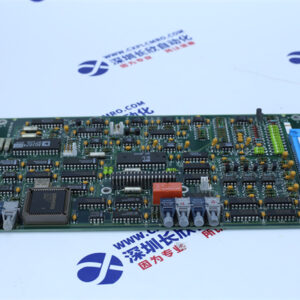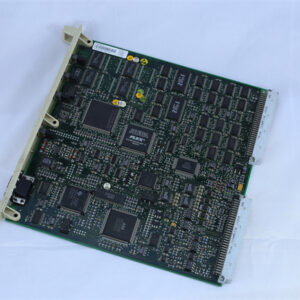
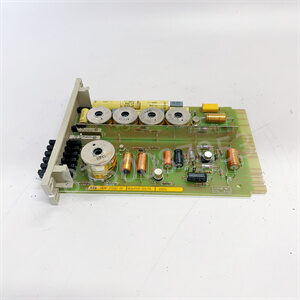
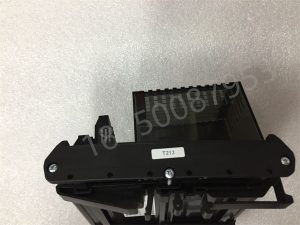
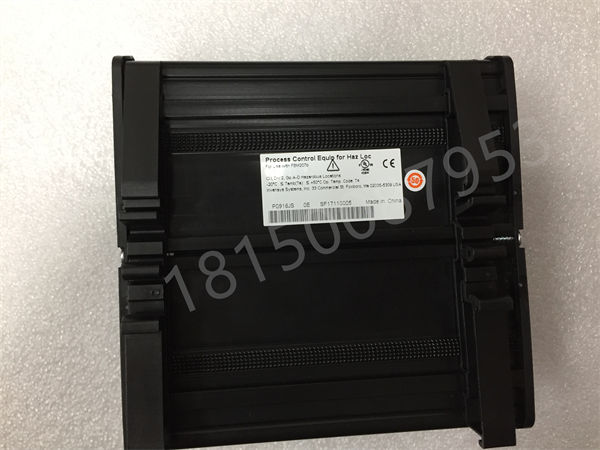
FBM207B P0916JS FOXBORO
There are two very important components outside of the PLC itself:programming devices and human-machine interfaces(HMI).Programming devices can be desktop computers,laptops,or handheld instruments from the same manufacturer.Some small PLCs even have buttons on the front that can program very basic logical operations without the need for a computer.
Although programming devices allow users to view and modify the code running on the PLC,HMI provides a way to display information and obtain input,modeling the control system as a whole.HMI usually does not provide any methods for modifying logical programs.
Figure 3 shows an HMI touch screen that can be used in the control room or in a”field”closer to the process.These types of interactive displays are very common and are usually installed directly on or near the PLC casing for operator use.
All DCS supports historical data storage and trend display functions.Historical databases are typically generated by users without the need for programming,using screen editing and compilation technology to generate a data file that defines the structure and scope of each historical data record.In historical databases,data is generally divided into groups,with the same data type and sampling time within each group.Define the relevant information of each data point during generation.
The biggest characteristic of DCS in control is that it relies on the flexible configuration of various control and calculation modules,which can achieve diverse control strategies to meet the needs of different situations,making the implementation of quite cumbersome and complex propositions in unit combination instruments simple.With the requirements of high flexibility and high efficiency put forward by enterprises,control schemes based on classical control theory are no longer suitable.After the introduction and successful application of advanced control strategies represented by multivariable predictive control,advanced process control has received widespread attention in the process industry.It should be emphasized that the widespread application of various advanced control and optimization technologies is the most effective,direct,and valuable development direction for exploring and improving the comprehensive performance of DCS.
In actual process control systems,systems based on PID control technology account for more than 80%.The advantages and disadvantages of PID circuit application play a crucial role in achieving stable,efficient,and high-quality operation of the device.Various DCS manufacturers use this as a strong competitive weight to seize the market and develop their own PID self-tuning software.In addition,based on the control functions of DCS,various improved algorithms can be developed on the basis of basic PID algorithms to meet various needs of actual industrial control sites,such as PID control with dead zones,PID control with integral separation,PID control with differential advance,incomplete differential PID control,PID control with logic selection function,and so on.

Unlike traditional PID control,predictive control algorithms based on non parametric models estimate the future output state of the system through predictive models and use a rolling optimization strategy to calculate the output of the current controller.According to different implementation schemes,there are various algorithms,such as internal model control,model algorithm control,dynamic matrix control,etc.At present,practical predictive control algorithms have been introduced into DCS.For example,IDCOM control algorithm software package has been widely used in practical industrial processes such as hydrocracking,catalytic cracking,atmospheric distillation,naphtha catalytic reforming,etc.
In addition,there are also HPCs from Honeywell,PREDICTROL from Yokogawa,and predictive controllers based on Kalman filters developed by Yamamoto Honeywell in the TDC-3000LCN system.This type of predictive controller does not simply place the Kalman filter before the previous predictive control for noise filtering,but instead uses the Kalman filter as the optimal state speculator,performing both optimal state speculation and noise filtering.