
Application Scenarios
On a gas turbine package, the control system must know within milliseconds whether a fuel shutoff valve is fully closed, whether a lube-oil pressure switch has tripped, and whether the flame detector relay has picked up. A single missed discrete input can mean a false trip; a single stuck output can mean a valve that will not close on demand.
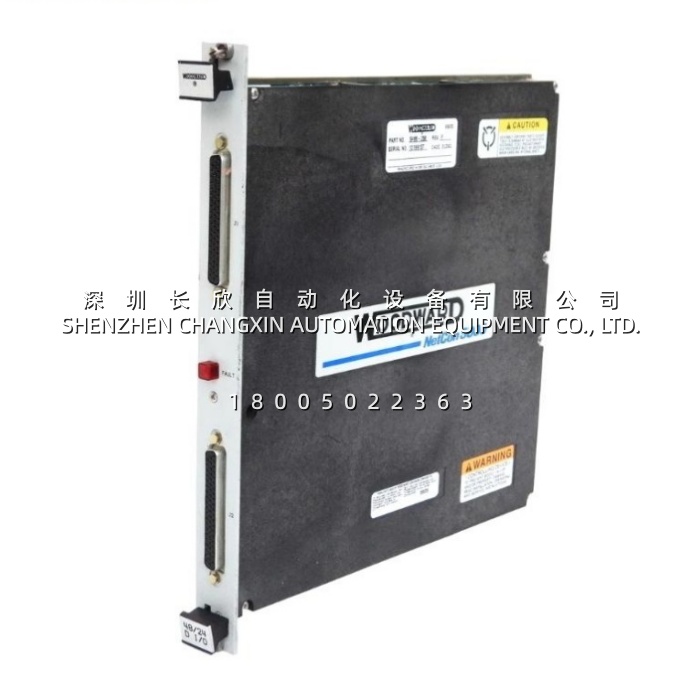
The Woodward 5466-258M is built for exactly this duty. It provides sixteen discrete inputs for field switches and relay contacts, all referenced to a +24 VDC source, and it can be deployed in both simplex and redundant configurations. In a compressor station running unattended, the module’s discrete inputs feed the safety interlock logic while its outputs drive the ESD sequence — the two functions that matter most when no operator is on site. The practical pain point it solves is straightforward: field switching hardware is where most nuisance trips originate, and a module with clean input filtering and protected outputs removes that failure mode from the equation.
Parameter
表格
| Parameter | Value / Description |
|---|---|
| Product Model | Woodward 5466-258M |
| Manufacturer | Woodward |
| Product Category | Discrete input/output module (MicroNet I/O) |
| Discrete Inputs | 16 channels for field switches / relay contacts |
| Input Power Requirement | +24 VDC source for all sixteen inputs |
| Output Type | Discrete outputs to relays, solenoids, trip devices |
| System Configuration | Simplex and redundant system compatible |
| Mounting Method | Card guides in control chassis, mated to motherboard |
| Retention | Two front-panel screws plus top/bottom release handles |
| Front Panel Indication | Single LED for fault indication |
| Field Connection | Via discrete FTM and high-density discrete/analog cables |
| Environmental Rating | Industrial-grade, high-vibration and wide-temperature design |
Technical Principles and Innovative Values
- Innovation Point 1 — Chassis-native architecture. The Woodward 5466-258M slides into card guides and mates directly with the motherboard connector. There is no separate terminal block to rewire on replacement, which removes the most common source of commissioning error in discrete I/O.
- Innovation Point 2 — Tool-free extraction. Two handles at the top and bottom of the front panel push outward to disengage the board from the motherboard connectors. A technician can free the module in seconds without levering on the PCB or disturbing adjacent cards.
- Innovation Point 3 — Simplex and redundant in one part number. The same Woodward 5466-258M serves both single-channel and redundant control architectures, so a spares inventory does not need to split between two variants.
- Innovation Point 4 — Field termination separated from the pack. Discrete signals arrive through dedicated FTMs and high-density cables. The pack itself stays clean, and field wiring stays put when the module is swapped.
- Innovation Point 5 — Front-panel fault visibility. A single LED on the faceplate reports module health at a glance, so a technician walking the cabinet sees a fault without opening the engineering tool.