
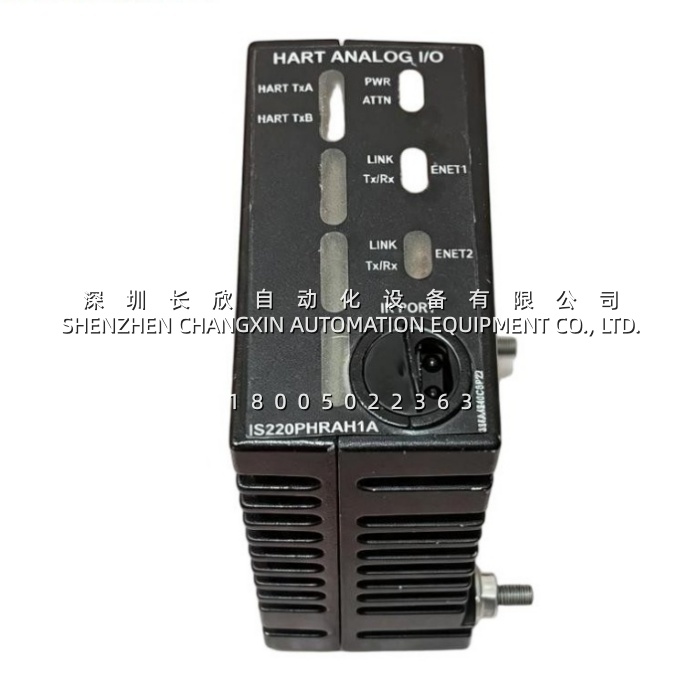
Product Overview
The GE IS220PHRAH1A is a specialized HART-enabled Analog Input/Output Pack 3 module engineered for the GE Mark VIe Speedtronic turbine control system. As a critical interface component within the Mark VIe distributed I/O architecture, the IS220PHRAH1A bridges the gap between field instrumentation and the central control processor. It is specifically designed to handle 4-20mA analog signals while simultaneously supporting the HART (Highway Addressable Remote Transducer) communication protocol. This dual capability allows the module to process standard analog process variables—such as temperature, pressure, and flow—while enabling bidirectional digital communication for configuration and diagnostics1.
In modern industrial automation, particularly in gas and steam turbine applications, the GE IS220PHRAH1A serves as a robust data acquisition and transmission hub. It features high-precision analog-to-digital conversion to ensure accurate signal reading from smart transmitters. The module’s architecture supports galvanic isolation between channels, which is essential for preventing ground loops and rejecting electrical noise in harsh power generation environments. By integrating HART technology, the IS220PHRAH1A empowers engineers to remotely configure smart instruments, read secondary variables, and perform predictive maintenance without physically accessing the field device. This combination of reliable analog control and advanced digital diagnostics makes the IS220PHRAH1A an indispensable asset for maximizing the efficiency and availability of critical rotating machinery.
Technical Specifications
| Parameter Name | Parameter Value |
|---|
| Parameter Name | Parameter Value |
|---|---|
| Product Model | IS220PHRAH1A |
| Manufacturer | GE (General Electric) / GE Vernova |
| Product Type | HART Analog I/O Pack 3 |
| Series | Mark VIe Speedtronic |
| Communication Protocol | HART (Highway Addressable Remote Transducer) |
| Input Signal Type | 4-20mA Analog (HART compatible) |
| Output Signal Type | 4-20mA Analog (HART compatible) |
| Signal Isolation | Channel-to-Channel and Channel-to-System Isolation |
| Operating Temperature | -20°C to +70°C |
| Mounting Type | DIN Rail / Rack Mount (Mark VIe I/O Carrier) |
| Redundancy Support | Yes (System Level) |
| Diagnostics | On-board Self-Diagnostics & HART Device Diagnostics |
| Certifications | UL, CSA, CE, ATEX (depending on terminal board) |
Main Features and Advantages
The offers a distinct advantage in turbine control by seamlessly integrating legacy analog signaling with modern digital communication. One of its most significant features is its full HART protocol support. This allows the to act as a HART master or gateway, enabling the control system to communicate with intelligent field devices. Operators can utilize this feature to remotely calibrate transmitters, change range settings, or troubleshoot instrument failures directly from the control room, significantly reducing maintenance time and improving plant safety.
Reliability and signal integrity are paramount in the design of the . The module employs advanced signal conditioning and isolation techniques to ensure that the 4-20mA analog signals are immune to the high levels of electromagnetic interference (EMI) often found in power plants. The “Pack 3” designation indicates its specific pinout and functional grouping within the Mark VIe ecosystem, ensuring compatibility with specific terminal boards designed for HART applications. Furthermore, the module supports redundant configurations, a critical requirement for the Mark VIe system’s Triple Modular Redundancy (TMR) or dual redundant architectures, ensuring that a single module failure does not disrupt turbine operation.
The physical design of the emphasizes durability and serviceability. It features a ruggedized construction with conformal coating to protect against humidity, dust, and chemical fumes. The module is equipped with comprehensive LED status indicators that provide immediate visual feedback on power status, communication activity (HART and Ethernet), and fault conditions. This facilitates rapid troubleshooting during commissioning or maintenance windows. Its hot-swappable nature (when supported by the specific rack configuration) allows for module replacement without shutting down the entire control system, thereby maximizing plant availability.