
Application Scenarios
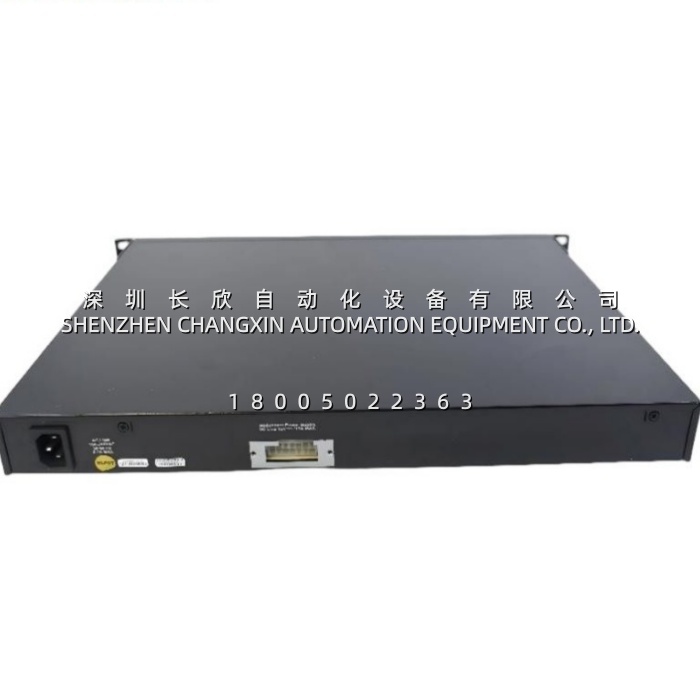
A refinery’s remote I/O rack room sits 400 meters from the central control building, well beyond the 100-meter limit of copper Ethernet. The field-mounted FBM modules feed analog and digital signals into the control system, but running copper cable through an area dense with variable frequency drives and high-current motor starters introduces relentless electromagnetic interference. CRC errors accumulate, and controllers drop offline during unit startups. The A4H124-24FX P0973JN solves this at the physical layer: its 24 MT-RJ multimode fiber ports accept the FBM fiber drops directly, eliminating standalone media converters and their associated rack clutter and spare-parts overhead. Because the switch is factory-configured for Foxboro I/A DCS traffic, Modbus TCP and control packets receive priority queuing ahead of historian background traffic, keeping the control network deterministic under load.
Parameter
| Main Parameters | Value/Description |
|---|---|
| Product Model | A4H124-24FX P0973JN |
| Manufacturer | Enterasys Networks (OEM for Foxboro/Invensys) |
| Product Category | Managed Fiber Ethernet Switch (L2/L3 stackable) |
| Fiber Ports | 24 × 100BASE-FX MT-RJ multimode (62.5/125 µm) |
| Uplink Ports | 2 × 10/100/1000 RJ-45 + 2 × Gigabit SFP |
| Switching Capacity | 12.8 Gbps standalone |
| Throughput | 9.5 Mpps |
| MAC Address Table | 16K entries |
| VLAN Support | 4096 IEEE 802.1Q VLANs |
| Stacking | Up to 8 units as single logical switch |
| Power Input | 100–240 V AC, 50/60 Hz, internal PSU |
| Operating Temperature | 0°C to +50°C (cabinet environment) |
| Form Factor | 1U rack-mount, 442 × 44 × 368 mm |
Technical Principles and Innovative Values
Innovation Point 1: Fixed MT-RJ Fiber Termination for DCS Edge. The A4H124-24FX P0973JN uses 24 fixed MT-RJ multimode fiber connectors rather than SFP cages for its primary ports. This is a deliberate DCS-oriented design: field FBM fiber drops terminate directly into the switch without requiring 24 individual SFP transceivers, each of which represents a failure point, a spare-part line item, and a configuration variable. The MT-RJ connector’s compact footprint allows 24 fiber terminations in a 1U chassis, replacing what would otherwise require multiple media converter shelves.
Innovation Point 2: Split-Isolation PCB Architecture. The switch employs a split-isolation board layout in which the front-panel optical transceiver bank is electrically decoupled from the main switching ASIC and CPU section. This design provides 1500 VAC surge isolation between the field-side fiber interface and the core control logic, protecting the switch from electrical transients that can couple onto cabinet wiring during motor switching events or lightning-induced surges on plant grounding systems.
Innovation Point 3: Foxboro Factory QoS Pre-Configuration. Unlike a generic Enterasys switch, the A4H124-24FX P0973JN ships with Foxboro I/A DCS-specific QoS rules preloaded. Proprietary control traffic and Modbus TCP packets are automatically tagged to the highest forwarding queue ahead of non-critical background data such as historian polling. This means a plant can deploy the switch without a network engineer manually crafting QoS policies for DCS protocols, reducing commissioning time and eliminating a common source of misconfiguration in process control networks.
Application Cases and Industry Value
Case 1: Refinery CDU Remote I/O Aggregation. A refinery’s crude distillation unit relied on copper Ethernet to connect remote FBM cabinets to the central control network, but persistent CRC errors caused intermittent controller offline events during startup sequences when large motors were energized. The plant replaced the copper aggregation points with A4H124-24FX P0973JN switches, using the MT-RJ fiber ports to terminate existing multimode fiber runs from the field cabinets. The 1500 VAC isolation barrier on the fiber transceiver bank blocked surge transients that had previously propagated into the switch ASIC. Controller offline events dropped to zero over the following six months, and the plant eliminated the standalone media converters that had consumed rack space and maintenance budget.
Case 2: Fossil Power Plant Turbine Auxiliary DCS. A coal-fired power station’s turbine auxiliary control system used Foxboro I/A controllers distributed across boiler feedwater and draft fan cabinets. The cabinets were separated by distances exceeding copper limits and ran through areas with high electrical noise from switchgear. The A4H124-24FX P0973JN was deployed as the edge aggregation switch in each cabinet room, collecting fiber drops from the FBM modules and uplinking to the plant backbone via its Gigabit SFP ports. The switch’s preconfigured QoS ensured that turbine trip signals and control loop updates maintained priority over non-critical diagnostic polling. The plant reported stable DCS communication through multiple unit startup events that had previously triggered network faults.