Application Scenarios
A packaging machinery OEM in Southeast Asia was designing a new horizontal form-fill-seal machine. The horizontal sealing jaw needed to accelerate a relatively heavy mass from rest to line speed in under 80 milliseconds, hold pressure during the dwell, then reverse direction for the return stroke. The motion profile was brutal: the drive sat idle for most of the cycle, then demanded three times its continuous rating for a fraction of a second. A standard drive sized on continuous current alone would either trip on overload or require an oversized frame that blew the enclosure dimensions. The engineering team specified the DST1405 for its 24 A peak rating and 250 ms overload window—enough to handle the sealing jaw‘s acceleration spike without derating the continuous capacity. The drive’s built-in braking resistor also absorbed the return-stroke regenerative energy internally, eliminating the need for an external brake unit in the already crowded cabinet. For machine builders facing similar pulse-duty profiles—injection molding ejectors, press feed axes, flying shear cutters—the DST1405 provides the headroom that continuous-current specifications alone cannot capture.
Parameter
| Main Parameters | Value/Description |
|---|---|
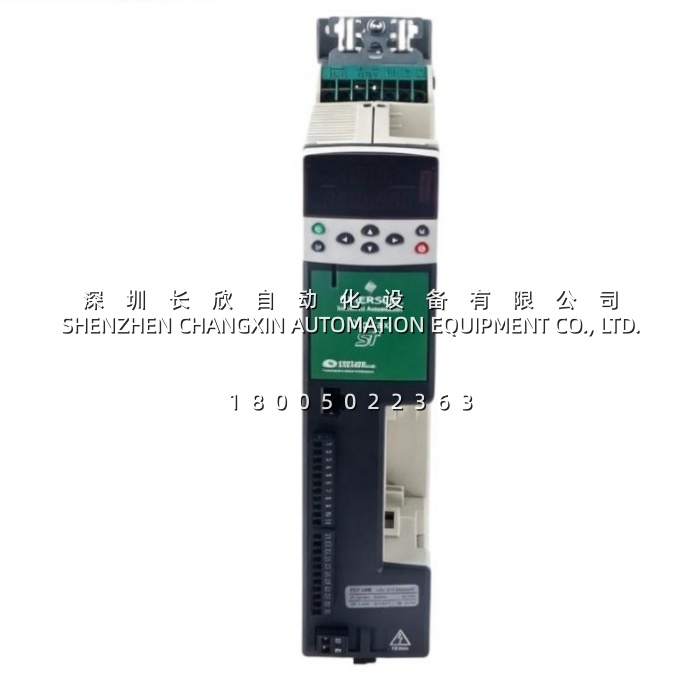
| Product Model | DST1405 (manufacturing part number 3098-0070) |
| Manufacturer | Emerson / Control Techniques (now Nidec) |
| Product Category | Three-Phase Servo Drive, Digitax ST Series |
| Input Voltage | 380–480 VAC, 3 phase, 48–65 Hz |
| Nominal Current | 8.0 A rms |
| Peak Current | 24.0 A rms (3× overload for 0.25 s) |
| Continuous Output (max) | 9.9 A under favorable thermal conditions |
| Supply Power | 3.32 kW without line reactor; 3.65 kW with line reactor |
| Switching Frequency | 6 / 8 / 12 kHz selectable |
| Internal DC Bus Capacitance | 220 μF (660 μF additional allowable) |
| Internal Braking Resistor | 70 Ω, 50 W average |
| Safe Torque Off | SIL 3 per EN 61800-5-2, PL e per EN ISO 13849-1, Cat. 3 |
| Feedback Support | Incremental encoder, absolute encoder, SinCos, resolver (via option) |
| Communication Options | Modbus RTU onboard; Ethernet/IP, PROFIBUS-DP, CANopen via option slots |
| Protection Rating | IP20 (UL Type 1 / NEMA 1) |
| Weight | 2.1 kg (excluding keypad and options) |
The current rating discrepancy across sources deserves clarification: the 8.0 A figure is the nominal rating used for overload calculations and motor matching, while 9.9 A represents the maximum continuous output achievable under specific thermal and switching conditions . In practice, the DST1405 is selected for applications where the peak current requirement drives the sizing decision, not the continuous thermal limit.
Technical Principles and Innovative Values
Innovation Point 1: Pulse-duty design philosophy over continuous-rating marketing. Most servo drives are specified and sold on continuous current. The DST1405 is engineered around a different question: how much torque can you deliver for how long when the machine actually needs it? The 3× overload for 250 ms and 2× for 2 seconds reflect the reality of acceleration-dominated motion profiles . A sealing jaw, a pick-and-place head, or a fly-cutting axis doesn’t care about 8 A continuous—it cares about whether the drive can push 24 A through the motor windings long enough to complete the move without tripping.
Innovation Point 2: Onboard braking resistor eliminates external hardware. The DST1405 includes a 70 Ω, 50 W braking resistor as standard . For machines with moderate inertia and frequent deceleration cycles, the regenerative energy dissipates internally. This is not a minor convenience—it removes a component from the bill of materials, frees panel space, and eliminates the wiring and failure points associated with external brake units. The internal DC bus capacitance of 220 μF, with allowance for up to 660 μF additional, provides further buffering for multi-axis systems sharing a common DC bus .
Innovation Point 3: Option-slot architecture that decouples the drive from the network. The has two universal option slots that accept fieldbus modules (Ethernet/IP, PROFIBUS-DP, CANopen) and additional feedback interfaces . A machine builder can stock a single drive variant and configure it for different customer network requirements by swapping a card. For export-oriented OEMs, this means one spare-parts inventory serves multiple protocols—a practical advantage that compounds across a product line.
Innovation Point 4: Integrated safety that meets SIL 3 without an external safety relay. The Safe Torque Off function is onboard and certified to SIL 3, PL e, and Cat. 3 . The safety terminals are separate from standard I/O, allowing a dual-channel safety circuit to remove torque without routing through a separate safety contactor. For machine designs where cabinet space and wiring complexity are constant pressures, embedding STO in the drive simplifies the safety architecture and reduces component count.