Application Scenarios
Picture a high-speed bottling line running 24/7 in a major beverage plant. Dozens of motors, drives, conveyors, and fillers are controlled by a ControlLogix PLC. Conventional threshold alarms are set conservatively—they only catch a problem after it has already crossed a red line. A motor that is slowly developing bearing damage may run for months with vibration levels just below the alarm setpoint, invisible to the control system until it fails catastrophically on a Friday night, halting production for an entire weekend.
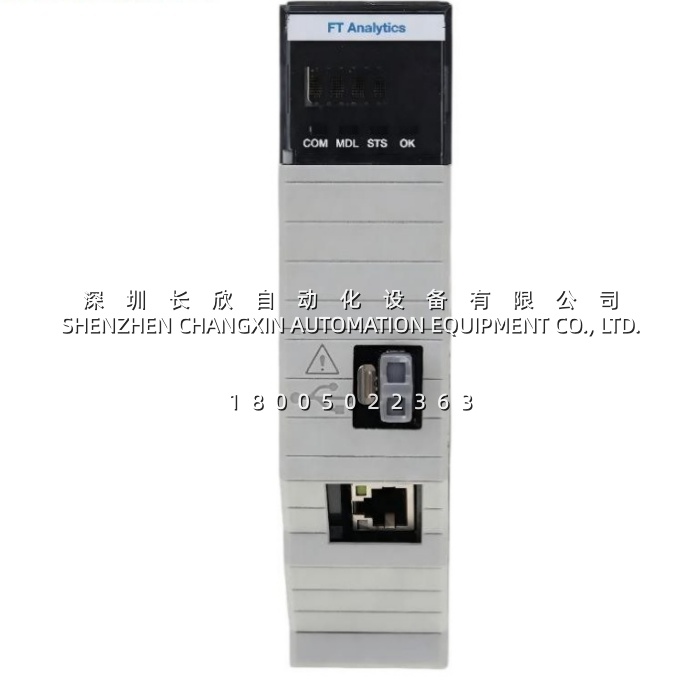
This is exactly the problem the Allen-Bradley 1756-CMS1B4 is designed to solve. The module is installed directly into the existing ControlLogix chassis—no new network drops, no external servers, no cloud connection required. Using data already present on the backplane (motor current, drive frequency, cycle times, valve positions), the LogixAI module applies an automatically trained AI model to establish a “fingerprint” of normal operation. When the motor’s vibration signature, current draw, or cycle-time pattern begins to drift—even while still within all traditional alarm limits—the module raises an anomaly score. Maintenance receives an early warning through the existing HMI, schedules a bearing inspection during the next planned stop, and replaces the failing component before it fails.
For plant engineers, the pain points are familiar: threshold alarms catch problems too late, cloud-based analytics introduce latency and cybersecurity concerns, and data scientists are rarely available on the plant floor. The Allen-Bradley 1756-CMS1B4 addresses all three by delivering automatic model training, edge-resident inference, and native integration with Studio 5000—all within the secure, familiar Rockwell Automation ecosystem. Whether deployed on a food-and-beverage line, a pharmaceutical filler, a mining conveyor, or an automotive paint shop, the module turns the control system itself into an early-warning engine for asset health.
Parameter
| Main Parameters | Value/Description |
|---|---|
| Product Model | 1756-CMS1B4 |
| Manufacturer | Allen-Bradley (Rockwell Automation) |
| Product Category | FactoryTalk Analytics LogixAI Edge Inference Module |
| Chassis Compatibility | ControlLogix 5580 and GuardLogix 5580 controllers; 1756 chassis |
| Module Type | Single-slot, chassis-based edge AI module |
| Onboard Processor | Intel Cyclone V SoC FPGA with ARM Cortex-A9 |
| Memory | 1 GB DDR3L SDRAM; 4 GB eMMC Flash storage |
| AI Capability | Anomaly detection via trained neural-network inference |
| Data Source | ControlLogix backplane tags (Controller Organizer tags) |
| Training Method | Automatic model training using historical controller data |
| Model Type | Autoencoder neural network (unsupervised learning) |
| Inference Update Rate | 1 second per trained process (model-dependent) |
| Number of Process Models | Up to 4 independent process models per module |
| Input Tags per Model | Up to 100 tags per process model |
| Communication | ControlLogix backplane; dual Ethernet ports (diagnostic/configuration) |
| Power Consumption | 3.6 W typical at 5.1 VDC (backplane-powered) |
| Operating Temperature | 0 °C to +60 °C (ControlLogix chassis rating) |
| Certifications | UL listed; CE compliant; cULus; ATEX/CUL available on select variants |
| Configuration Software | Studio 5000 Logix Designer (version 32 or later) |
Key annotations: The 1-second inference update rate means the module evaluates process health in near-real time—fast enough to catch gradual degradation but conservative enough to avoid false positives. Support for up to 4 independent process models allows a single Allen-Bradley 1756-CMS1B4 to monitor four distinct machines or process areas simultaneously. The 100-tag capacity per model provides ample room for multi-variable pattern recognition, which is far more effective than single-tag threshold monitoring.
Technical Principles and Innovative Values
- Innovation Point 1 – Automatic Model Training with No Data Science Required: The Allen-Bradley 1756-CMS1B4 trains its own AI models using historical data already stored in the controller. The module samples normal operating data over a configurable training window (typically 1–2 weeks), automatically extracts patterns across all selected tags, and generates an autoencoder neural-network model. No Python coding, no data scientist, and no external analytics platform are required.
- Innovation Point 2 – Edge-Resident Inference with Zero Cloud Dependency: All model training and inference occur entirely within the module, inside the control chassis. No process data leaves the facility, eliminating cloud-latency concerns, connectivity costs, and attack surfaces associated with internet-connected analytics platforms. This makes the module ideal for high-security and regulated environments.
- Innovation Point 3 – Multi-Variable Anomaly Detection vs. Single-Threshold Alarms: Traditional PLC alarms evaluate one tag against one limit. The LogixAI module simultaneously evaluates up to 100 interrelated tags, detecting subtle cross-variable deviations that precede failures. For example, a rising motor current combined with a lengthening cycle time and a slight drop in drive frequency may collectively indicate an emerging mechanical problem—even when each individual value remains within its alarm limit.
- Innovation Point 4 – Four Independent Process Models in One Module: A single Allen-Bradley 1756-CMS1B4 can run four separate anomaly-detection models concurrently—allowing one module to monitor a pump, a compressor, a heat exchanger, and a conveyor drive simultaneously. This dramatically improves the cost-per-monitored-asset ratio.
- Innovation Point 5 – Native Studio 5000 Integration: Models and results are configured directly within Studio 5000 Logix Designer. Anomaly scores, model status, and health indicators appear as standard controller tags, meaning they can be consumed by existing ladder logic, function blocks, HMIs, and alarm systems with no additional middleware or custom drivers.
- Innovation Point 6 – Continuous Model Adaptation: The module supports incremental retraining, allowing the model to adapt to legitimate process changes (such as seasonal temperature shifts or new product recipes) without discarding the baseline. This prevents the “model drift” problem that plagues many offline analytics deployments.