Technical Specifications
| Parameter Name | Parameter Value |
|---|---|
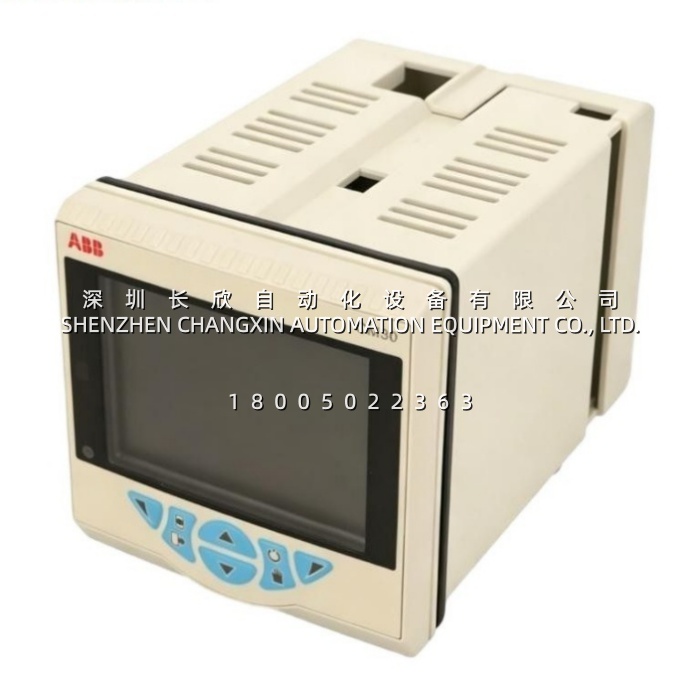
| Product Model | CM30/1 (ControlMaster CM30, 1/4 DIN) |
| Manufacturer | ABB Measurement & Analytics |
| Product Type | Universal PID Process Controller |
| Display | Full-colour 3.5 in (9 cm) TFT with softkeys and trend display |
| Universal Input | Thermocouple, RTD, resistance, mA, V, mV, frequency, volt-free digital, 24 V digital |
| Process Input | Thermocouple, mA, V, mV, volt-free digital, 24 V digital |
| Primary Outputs | 1 × analogue / digital and 1 × relay |
| Additional I/O Option 1 | 1 × analogue output, 2 × digital I/O, 3 × relay |
| Additional I/O Option 1a | 1 × relay (motorised-valve builds) |
| Additional I/O Option 2 | 1 × universal analogue input, 1 × process input, 2 × transmitter PSUs, 4 × digital I/O |
| Communications | Ethernet (Modbus TCP) and RS485 Modbus RTU |
| Control Functions | PID, on/off, time proportioning, autotune, gain scheduling, predictive (pPI), adaptive, split output, bank control, motorised-valve control |
| Supply Voltage | 100 to 240 V AC ±10 %, 50/60 Hz; 110 to 240 V DC |
| Panel Cut-Out | 92 mm × 92 mm (1/4 DIN) |
| Front-Panel Rating | IP66 / NEMA 4X |
| Operating Temperature | 0 °C to +50 °C |
| Configuration Tools | Front-panel menus and ABB ConfigPilot PC software |
| Recommended Applications | Single loop, remote setpoint, cascade, feed-forward, ratio, dual-loop, setpoint profiling |
Main Features and Advantages
Full-Colour TFT Display With Trend and Diagnostic Visibility:
The defining operator advantage of the ABB CM30/1 is its 3.5-inch full-colour TFT screen. Standard display templates are selected automatically to match the configured control strategy — single loop, cascade, dual loop, or ratio — and extensive customisation allows the panel to be tailored precisely to the process. Alarm and diagnostic messages are shown in plain text on a dedicated status page, and any two analogue values can be plotted together on the on-screen trend display, giving commissioning engineers immediate visual feedback while tuning. Because the diagnostics log retains historical events, root-cause investigation no longer depends on an external recorder or SC trend buffer.
Autotune, Gain Scheduling and Predictive Control:
Once basic configuration is complete, the CM30/1 uses a powerful autotune routine to calculate PID terms automatically, dramatically shortening commissioning time on new installations and on processes that have been revalidated after a mechanical change. For non-linear applications, gain scheduling automatically selects one of three pre-stored PID parameter sets based on a reference signal, keeping loop response consistent across the full operating envelope. Long-dead-time processes — pH dosing in a pipeline, thermal loops on long conveying systems — are handled elegantly by predictive pPI control, which needs only three parameters (gain, integral time, dead time) and can be combined with gain scheduling for even tighter regulation.
Adaptive, Split-Output, Bank and Ratio Control:
Adaptive control on the ABB CM30/1 continuously retunes the loop as process dynamics drift, which is particularly valuable when raw-material temperature, viscosity, or load profile changes seasonally. Split output control lets one PID drive two complementary actuators — for example steam heating and cooling water on a pasteuriser — while bank control levels the wear of multi-element heater, pump, or fan installations using either rotate or first-in-first-out duty allocation. Full ratio and cascade templates, with internal or external ratio reference and optional feed-forward, cover the demanding multivariable loops commonly found on OEM process skids and chemical dosing packages.
Highly Scalable Function-Key Architecture:
A basic CM30/1 handles a simple single-loop control application with process alarms and basic setpoint switching, and additional function keys progressively unlock more capable templates without changing the hardware. Level 1 adds auto/manual station, low-signal-selection backup, gain scheduling, motorised-valve control, math, logic, custom linearisers, delay timers and standard setpoint profiling. Level 2 brings cascade, ratio, feed-forward, totalization, advanced profiling, predictive and adaptive control, and historical trending. Level 3 adds full dual-loop operation across local/local, remote/local and remote/remote configurations. This “buy what you need, grow when you must” model protects the initial investment and simplifies future specification changes.
Built to Survive Industrial Front Lines:
With an IP66 / NEMA 4X front-panel rating, the withstands wash-down in food, beverage and pharmaceutical production, dust-laden air in materials processing, and the humidity challenges of water-treatment and outdoor installations. Ethernet, RS485 Modbus and Modbus TCP connectivity allow the controller to integrate cleanly with PLC, SCADA and MES layers, and the ConfigPilot PC tool provides offline configuration, version control, and report generation — a decisive advantage for OEM builders who must document every controller shipped.