Technical Specifications
| Parameter Name | Parameter Value |
|---|---|
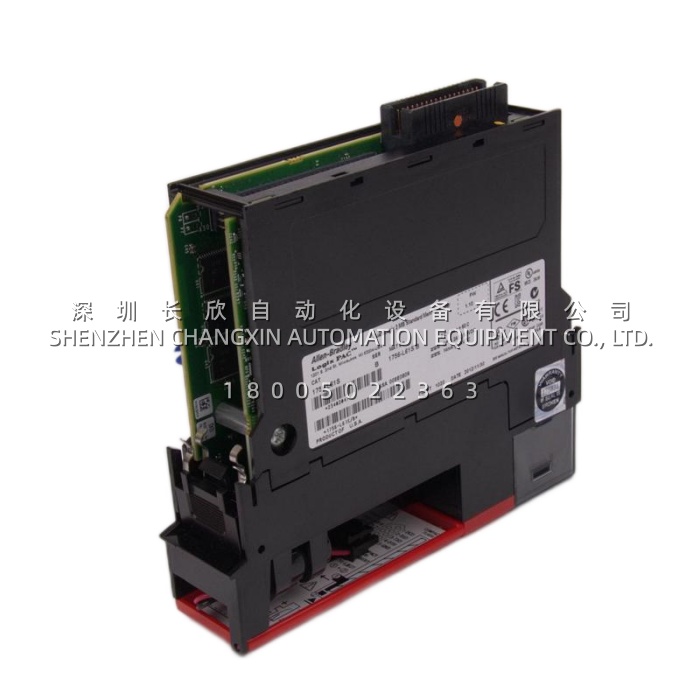
| Product Model | 1756-L63S |
| Manufacturer | Allen-Bradley (Rockwell Automation) |
| Product Type | GuardLogix 5563S Safety Processor (Primary Safety Controller) |
| User Memory | 8 MB |
| Safety Memory | 3.75 MB |
| Optional Nonvolatile Storage | 128 MB CompactFlash (1784-CF128) |
| Maximum Digital I/O | 128,000 |
| Maximum Analog I/O | 4,000 |
| Total I/O, Maximum | 128,000 |
| Safety Rating | TÜV-certified Cat. 4 / PL e (EN ISO 13849-1), SIL 3 (EN 62061/IEC 61508), UL SIL CL 3 |
| Required Safety Partner | 1756-LSP (installed in slot immediately right of primary) |
| Programming Software | RSLogix 5000 version 18 or later; Studio 5000 Logix Designer |
| Backplane Current | 1200 mA @ 5.1V DC; 14 mA @ 24V DC |
| Power Dissipation | 3.5 W (11.9 BTU/hr) |
| Isolation Voltage | 30V continuous (Basic Insulation, RS-232 to system); type-tested at 720V DC for 60 s |
| Replacement Battery | 1756-BA2 (0.50 g lithium) |
| Slot Width | 2 slots total (controller + safety partner, one slot each) |
| Compatible Chassis | 1756-A4, 1756-A7, 1756-A10, 1756-A13, 1756-A17 |
| Compatible Power Supplies | 1756-PA50, 1756-PA72, 1756-PA75, 1756-PB50, 1756-PB72, 1756-PB75 |
| Operating Temperature | 0 to 60 °C (32 to 140 °F) |
| Nonoperating Temperature | –40 to 85 °C (–40 to 185 °F) |
| Relative Humidity | 5 to 95% noncondensing |
| Vibration / Shock | 2 g @ 10–500 Hz; 30 g operating, 50 g nonoperating |
| Weight | 0.32 kg (0.70 lb) |
| Certifications | c-UL-us Listed (File E65584; Class I Div 2 Groups A,B,C,D per File E194810), CSA (LR54689C, LR69960C), CE, RCM, FM, KC, TÜV Functional Safety, North American Temperature Code T4A |
| Country of Origin | United States |
Main Features and Advantages
Memory architecture and processing capacity define the core value of the Allen-Bradley 1756-L63S. With 8 MB of standard user memory and 3.75 MB of dedicated safety memory, the controller offers the largest memory allocation in the 1756-L6S GuardLogix generation — double the 4 MB user memory of the 1756-L62S and four times the 2 MB of the 1756-L61S — allowing large safety programs, extensive alarm handling, and complex interlocking logic to be built without memory-driven compromises. Supporting up to 128,000 digital I/O and 4,000 analog I/O points, the 1756-L63S handles plant-wide safety architectures that smaller controllers cannot serve, while the optional 1784-CF128 CompactFlash card provides 128 MB of nonvolatile storage for application backup and rapid disaster recovery.
Functional safety certification is the defining differentiator. The 1756-L63S carries TÜV certification to Category 4 / Performance Level e per EN ISO 13849-1 and SIL 3 per EN 62061/IEC 61508 — the highest safety integrity levels recognized internationally — enabling deployment in emergency shutdown, burner management, and other high-consequence applications where SIL 3 compliance is mandatory. UL certification for SIL CL 3 (File E256621) and FM Approval for Class I Division 2 Groups A, B, C, D hazardous locations extend deployment across North American process facilities, while CE marking to EN 60204-1, EN ISO 13849-1, and EN 62061 supports European machinery directive compliance. These certifications allow a single controller platform to serve globally distributed plants without regional hardware variations.
The dual-controller 1002 architecture that pairs the 1756-L63S with the 1756-LSP Safety Partner delivers continuous safety integrity through active self-diagnostics, cross-checking of safety task execution, and automatic transition to a safe state upon detected fault. Safety and standard logic execute in the same chassis and the same programming environment, eliminating the need for separate safety PLCs, hardwired safety relays, or standalone safety networks in most applications. CIP Safety communication over EtherNet/IP, ControlNet, and DeviceNet supports zone-to-zone interlocking between up to 16 GuardLogix controllers and distributed safety I/O across remote chassis — dramatically reducing engineering effort compared with legacy safety relay architectures.
Environmental robustness completes the value proposition. Operating temperature tolerance of 0 to 60 °C, 5–95% noncondensing humidity, 2 g vibration, and 30 g operating shock tolerance allow the Allen-Bradley 1756-L63S to perform reliably in vibration-prone machinery cabinets, outdoor-adjacent process enclosures, and electrically hostile production halls. Because the controller slots directly into any standard 1756 ControlLogix chassis alongside conventional I/O, motion, and communication modules, a single unified architecture can serve combined standard and safety control zones — reducing panel space, spares inventory, and operator training burden. For facilities with established 1756 ControlLogix infrastructure, adding the requires no new programming platform, no new HMI architecture, and no new spares strategy beyond the controller and its Safety Partner.