
Technical Specifications
| Parameter | Value |
|---|---|
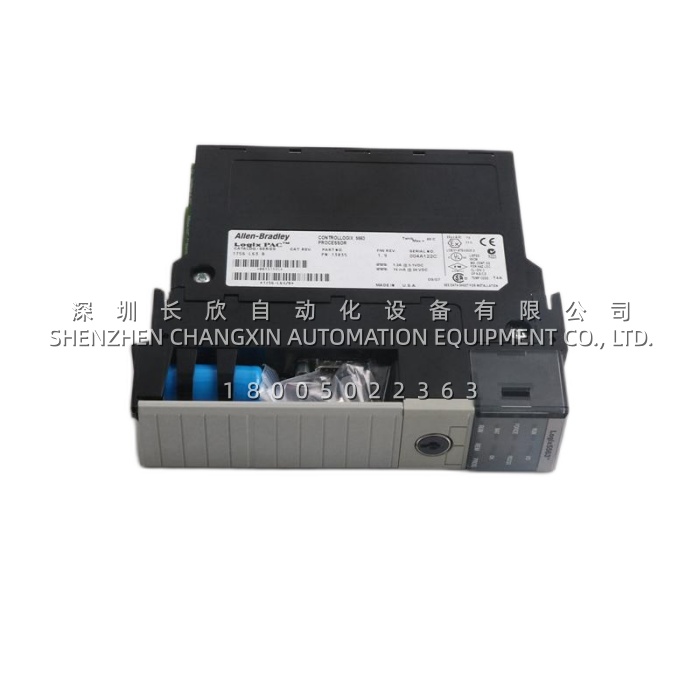
| Product Model | 1756-L55M23/A (Series A) |
| Manufacturer | Allen-Bradley / Rockwell Automation |
| Product Type | ControlLogix Logix5555 Processor Module (CPU / PAC) |
| Controller Family | ControlLogix 5555 (1756-L55 series) |
| User / Logic Memory | 1.5 MB RAM (data, logic, tags, programs) |
| Nonvolatile Memory | 1.5 MB onboard (integrated 1756-M23 submodule) |
| I/O Memory | 208 KB |
| Maximum Digital I/O | 128,000 points |
| Maximum Analog I/O | 4,000 inputs / 2,000 outputs |
| Execution Speed | ≈ 0.08 ms per 1K logic instructions (typical, program-structure dependent) |
| Tasking | Continuous, periodic and event tasks; programs and routines |
| Programming Languages | Ladder, Structured Text, Function Block Diagram, SFC |
| Onboard Communication | 1 × RS-232 DB-9: DF1, DH-485, ASCII (no onboard Ethernet) |
| Network Expansion | Via 1756-ENxT, 1756-CNB/CN2, 1756-DNB and other bridge modules |
| Serial Programming Cable | 1756-CP3 or 1747-CP3 |
| Backup Battery | 1756-BA1 lithium (real-time clock and volatile-state retention) |
| Redundancy | Supported in a redundant controller pair over ControlNet (matched hardware/firmware required) |
| Chassis Compatibility | 1756 Series A and Series B chassis: 1756-A4, A7, A10, A13, A17 |
| Slot Requirement | 1 slot, left-most recommended controller position |
| Backplane Current | 1.23 A @ 5.1 VDC; 0.014 A @ 24 VDC |
| Power Dissipation | 5.6 W (≈ 19.1 BTU/hr) |
| Operating Temperature | 0…60 °C (32…140 °F) |
| Storage Temperature | -40…85 °C (-40…185 °F) |
| Relative Humidity | 5…95% non-condensing |
| Shock / Vibration | 30 g operating shock; 2 g @ 10…500 Hz |
| Enclosure / Protection | Open-style module, IP20 (panel/enclosure required) |
| Weight | ≈ 0.35 kg (12.5 oz) |
| Programming Software | RSLogix 5000, versions v13 through v16 (firmware-matched); early Studio 5000 revisions |
| Typical Firmware | v13.25 common on installed base; v16.023 is the final retired release |
| Status Indication | Dual-color OK LED (green/red), serial and module-status semantics per Logix model |
| Lifecycle Status | Discontinued / obsolete — spare, refurbished, repair and migration support |
Main Features and Advantages
Integrated nonvolatile memory is the defining advantage, and it changes the failure maths. A bare L55 plus a plug-in 1756-M22 or M12 card is a two-piece relationship: the card edge, the Torx screws and the battery all have to be healthy for the program to survive a power cycle. The 1756-L55M23/A bakes the 1.5 MB nonvolatile store into the module, so the project is carried inside the unit you swap. On a machine where the only copy of the application lives in the controller, that is the difference between a shift-long download-and-debug and a module exchange that leaves the I/O tree and the HMI talking within minutes.
Dual-CPU architecture keeps control deterministic. The Logix CPU runs your logic; the backplane CPU owns rack I/O transfers and communication. On a densely populated 1756-A17 with analog, motion and remote-I/O modules mixed together, that separation prevents a chatty network or a slow module from stealing scan time from the machine routine. The 208 KB I/O memory and the 128,000-point addressing ceiling mean the 1756-L55M23/A scales with an I/O tree that has been added to over a decade, rather than forcing a memory-split rewrite the moment a new servo or remote rack appears.
A serial port that is actually a recovery tool. No onboard Ethernet sounds like a limitation until the network bridge is what failed. The front DB-9 on the 1756-L55M23/A gives you DF1 straight to a laptop running RSLinx Classic and RSLogix 5000, which is enough to go online, pull the program, force a bit, read the major-fault code and decide whether you are looking at a module fault or a project problem. It also carries ASCII for barcode readers, weight transmitters and other serial devices without consuming a rack slot. For a site that still treats the serial cable as part of the toolkit, this port is worth more than a second Ethernet port would be.
Software continuity without a conversion project. The 1756-L55M23/A runs the native Logix5000 tag database — no mapped registers, no translation layer, no separate addressing scheme to maintain. Add-on instructions, producer/consumer tags, message instructions and event tasks all behave the way the original commissioning engineer left them. When the replacement processor matches the firmware major revision, the existing .ACD uploads and downloads without a project migration, which protects every undocumented rung, every MSG routing path and every HMI tag binding that nobody wants to rediscover at two in the morning.
Application Field
The 1756-L55M23/A is at its best on the mature, high-value line where the control logic is proven and the cost of change is measured in validation, not in hardware. Packaging, converting, cartoning, filling and printing presses are the classic installations: a complex I/O tree of discrete inputs, analog tension and pressure loops, servo and drive interfaces, and a dozen remote racks, all supervised by a controller that has run the same cell since the late 2000s. Here the processor is not just executing logic — it is preserving institutional knowledge. A like-for-like swap keeps the OEM safety documentation, the machine acceptance test and the change-control record intact, which is why pharmaceutical, food-grade and automotive stamping cells still hunt for this exact module.
Material handling and discrete manufacturing use the controller’s headroom differently. Conveyor networks, transfer lines, palletisers and assembly cells tend to grow sideways: more zones, more remote I/O, more MES and barcode transactions, more alarm history. The 128,000-point I/O ceiling and the 1.5 MB working set mean the can absorb that growth without the rewrite a smaller-memory L55 would force. Producer/consumer tags let adjacent cells share state over ControlNet or EtherNet/IP, while the event-task model keeps the high-priority reactions — a guard opening, a jam detector, a robot interlock — out of the periodic scan path.
Water, wastewater, HVAC and skid-mounted process equipment are the quieter application set, and the suits them because the workload is mixed rather than fast: hundreds of discrete points, a raft of analog transmitters, PID loops, alarm summaries and serial instruments on the ASCII port, all in one rack. The nonvolatile store matters most in these plants, where an unplanned outage and a flat battery should never mean a lost program. And because the module is happy in a Series A chassis with the original power supply and the original communication bridges, the path of least resistance is to keep the controller identity stable and carry a verified spare rather than re-engineer the panel.


