
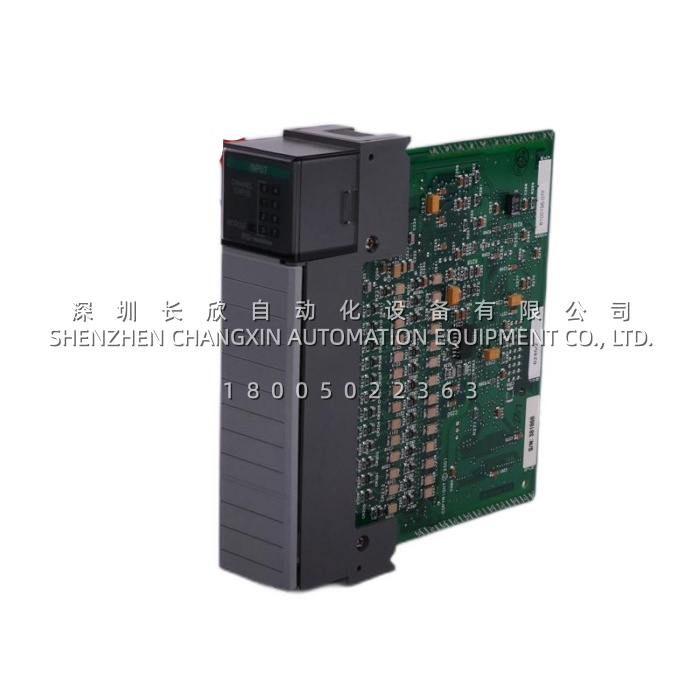
Description
The 1756-ENBT is a ControlLogix EtherNet/IP communication bridge module from Allen-Bradley (Rockwell Automation), providing a single copper RJ45 port for connecting a ControlLogix chassis to an EtherNet/IP network at 10/100 Mbps. It supports messaging, produced/consumed tags, HMI communication, and distributed I/O, and can act as a remote I/O adapter when placed in a distant chassis. Rockwell Automation discontinued this catalog number on December 31, 2021, and identifies the 1756-EN2T as the functional replacement .
Application Scenarios
A legacy production line running a ControlLogix chassis with an 1756-ENBT as its sole network path faced a familiar end-of-life dilemma: the module was working, but a spare was no longer available from the manufacturer. The maintenance team sourced a tested replacement through the secondary market rather than migrating the entire rack to the EN2T, because the existing Studio 5000 project, the IP addressing scheme, and the HMI communication paths were all configured and proven. For plants with operating 1756-ENBT modules, the practical reality is that the installed base still runs, and the secondary market remains the only source for like-for-like replacement .
Parameter
| Main Parameters | Value/Description |
|---|---|
| Product Model | 1756-ENBT (Series A) |
| Manufacturer | Allen-Bradley (Rockwell Automation) |
| Product Category | EtherNet/IP Bridge Module |
| Ethernet Port | 1 x RJ45 copper, Category 5, 10/100 Mbps |
| Logix Communication Connections | 128 |
| TCP/IP Connections | 64 |
| Current Draw | 700 mA @ 5.1V DC; 3 mA @ 24V DC |
| Power Dissipation | 3.65 W (12.6 BTU/hr) |
| Isolation | 30V continuous, basic insulation, Ethernet to backplane |
| Slot Width | 1 slot, any chassis position |
| Operating Temperature | 0°C to 60°C |
| Lifecycle Status | Discontinued December 31, 2021 |
| Functional Replacement | 1756-EN2T |
The 128 CIP connection count is half what the EN2T offers, and the 64 TCP connections are similarly reduced. For racks with a moderate device count—a controller, an HMI, a handful of remote I/O drops—these limits are workable. For dense EtherNet/IP architectures, they become the constraint that eventually forces the EN2T migration.
Technical Principles and Innovative Values
Innovation Point 1: The Original EtherNet/IP Bridge for ControlLogix. The 1756-ENBT was the module that brought native EtherNet/IP connectivity to the ControlLogix platform, replacing the need for separate gateway hardware to reach Ethernet-based supervisory systems. Its 128 CIP connections support a combination of explicit messaging for HMI and programming traffic and implicit I/O connections for distributed devices, with the split determined by the application rather than a fixed allocation . For the generation of ControlLogix systems built before the EN2T became standard, this module is the network foundation.
Innovation Point 2: Web-Enabled Diagnostics. The module exposes diagnostics through a standard web browser—IP configuration, subnet and gateway settings, uptime, and connection statistics are accessible without a programming terminal. For maintenance teams troubleshooting a network fault at an odd hour, this browser-based visibility reduces the need to locate a laptop with Studio 5000 installed. It is a modest feature by contemporary standards but a meaningful one for legacy support .
Innovation Point 3: Redundancy Caveats That Matter. Using the 1756-ENBT in a ControlLogix redundancy system requires firmware revision 6.01 or later, and the module does not swap IP addresses during a switchover the way ControlNet bridge modules do—each redundant chassis keeps its own address, and RSLinx alias topic switching handles the redirection . Field reports confirm that ENBT modules function in non-redundant RSLogix 5000 v16 systems, but redundancy configurations demand firmware and software versions that legacy installations may not support . Knowing this boundary before a redundancy upgrade saves considerable commissioning time.