Application Scenarios
Picture a food processing plant where the original SLC 500 installation spans four buildings. The main processor sits in the central control room, but the I/O for the cooker, filler, palletizer, and refrigeration skid is distributed across remote panels—some up to 300 meters away. Running a separate set of field wires for every discrete and analog point from each remote panel back to the main chassis would mean thousands of meters of multicore cable, hundreds of termination points, and a wiring fault waiting to happen.
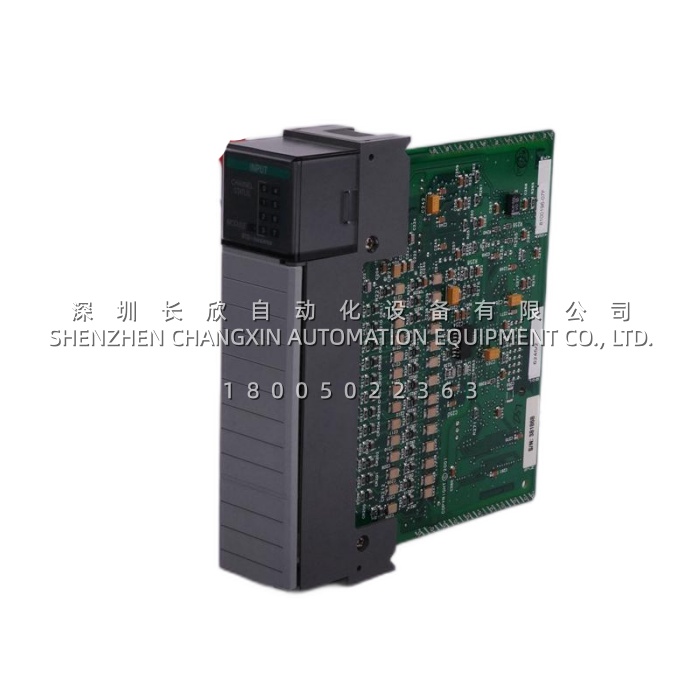
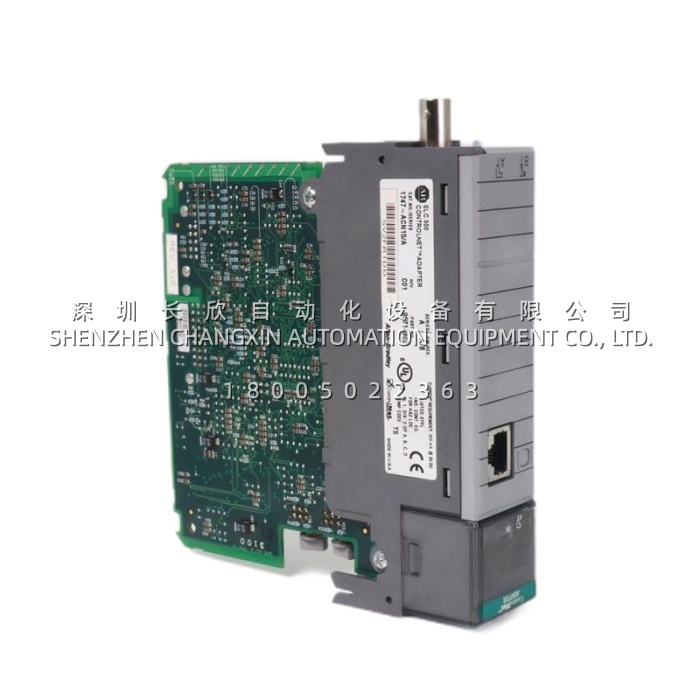
The 1747-ACN15/A changes the math entirely. Each remote 1746 chassis gets one adapter in slot 0, a single RG-6 coaxial drop back to the ControlNet trunk, and the main processor’s scanner sees every I/O point in that rack as if it were local. The plant keeps its existing 1746 I/O modules, its existing wiring, and its existing validation documentation—while gaining a deterministic, scheduled network that is far easier to diagnose than a nest of parallel field cables. When a fault does occur, the adapter’s CHA and OK LEDs and its 7-segment display point directly to the problem: a broken coax tap, a duplicate node address, or a backplane fault in the remote rack.
Parameter
| Parameter | Value / Description |
|---|---|
| Product Model | Allen-Bradley 1747-ACN15/A (Series A) |
| Manufacturer | Rockwell Automation / Allen-Bradley (USA) |
| Product Category | SLC 500 ControlNet I/O Adapter Module |
| Network Protocol | ControlNet (CIP-based, deterministic scheduled + unscheduled messaging) |
| Communication Rate | 5 Mbps (fixed) |
| Network Media | RG-6 quad-shield coaxial cable |
| Connectors | 1 × BNC (ControlNet channel), 1 × NAP (Network Access Port, RJ45-style) |
| Topology | Non-redundant, single channel (no media redundancy) |
| Node Address | 1–99, set via rotary switches on module top (address read at boot) |
| Max Scheduled Connections | 64 |
| I/O per Connection | Up to 251 input words / 249 output words |
| Supported I/O | Up to 3 chassis, 30 slots total |
| Backplane Current | 900 mA at 5 V DC |
| Power Dissipation | 5 W (17.06 BTU/hr thermal dissipation) |
| Compatible Chassis | 1746 (4-, 7-, 10-, 13-slot) |
| Compatible Processors | SLC 5/03, 5/04, 5/05 (with 1747-SCNR scanner); PLC-5; ControlLogix via 1756-CN2 / 1756-CNBR |
| Configuration Tool | RSNetWorx for ControlNet (network scheduling and NUT calculation) |
| Status Indicators | CHA LED (scanner link), OK LED (module health), 7-segment display (address/status codes) |
| Operating Temperature | 0 °C to +60 °C (32 °F to 140 °F) |
| Dimensions / Weight | 36 × 130 × 158 mm; 0.43 kg (0.94 lb) |
Technical Principles and Innovative Values
Innovation Point 1 – Scheduled Plus Unscheduled Messaging on One Cable: The 1747-ACN15/A carries two distinct types of traffic on the same 5 Mbps coaxial medium. Scheduled (implicit) messaging exchanges I/O process data on a fixed, deterministic timetable—essential for interlocks and closed-loop control where jitter is unacceptable. Unscheduled (explicit) messaging handles alarms, recipes, program uploads, and HMI interaction in the remaining bandwidth. This division is what makes ControlNet suitable for real-time control rather than merely data collection.
Innovation Point 2 – Group 2 Only Server Architecture: The adapter functions as a Group 2 Only Server, meaning it does not initiate communication and relies on a scanner module—1747-SCNR in an SLC chassis, or 1756-CN2 / 1756-CNBR in ControlLogix—to request I/O, diagnostic, and system update information. This keeps the adapter simple, inexpensive, and predictable: it has no user program, no scan-time variability, and no way to behave unpredictably under load.
Innovation Point 3 – 64 Scheduled Connections With Bulk Rack Reads: Rather than exchanging I/O point-by-point, the 1747-ACN15/A supports up to 64 scheduled connections, each carrying up to 251 input words and 249 output words. A single connection can transfer an entire 1746 rack’s worth of data in one scheduled transaction, and the multicast output capability allows one output dataset to be consumed by multiple nodes simultaneously. This efficiency is why a coaxial network running at “only” 5 Mbps can still serve a large I/O tree.
Innovation Point 4 – Network Access Port for Local Diagnostics: The built-in NAP (Network Access Port) lets a technician connect a PC directly to the adapter with a 1786-CP cable without disconnecting the trunk line. Combined with RSNetWorx for ControlNet, this provides local access to network status, scheduled connection health, and I/O diagnostics at the rack—valuable when the central engineering workstation is three buildings away.
Innovation Point 5 – 7-Segment Display and Dual-LED Diagnostics: The front-panel 7-segment display shows the node address during normal operation and switches to a status code when an error occurs during initialization or runtime. The CHA LED reports the communication link between the adapter and its scanner, while the OK LED reports overall module health. Together, these give a maintenance technician a complete fault picture without opening a laptop.
Application Cases and Industry Value
In a chemical blending facility in the Netherlands, the 1747-ACN15/A was used to extend an existing SLC 5/05-based control system to three new remote blending skids without replacing the installed base. Each skid received a 1746 chassis with 1746-IF8 analog input modules for tank level and temperature transmitters, 1746-OW16 relay outputs for solenoid valves, and a 1747-ACN15/A in slot 0.
The ControlNet trunk was run as a single RG-6 drop to each skid, and the existing 1747-SCNR scanner in the main chassis was re-scheduled in RSNetWorx to include the three new nodes. The project preserved the original SLC 500 program, the existing 1746 I/O, and the plant’s validated alarm and interlock logic. The engineering manager estimated the savings at approximately €65,000 compared with a full ControlLogix migration, and noted that the scheduled I/O update gave the blending loops a consistency they had not achieved with the previous hardwired remote I/O arrangement.
In a water utility in the southeastern United States, the supports a distributed pump station network where each station has a 1746 chassis with digital inputs from level switches and pump status contacts, plus analog inputs from a pressure transducer. The adapter places each station on a ControlNet segment that terminates at a ControlLogix chassis equipped with a 1756-CN2 bridge module.
The utility’s SCADA system reads pump run status, alarm conditions, and pressure trends from every station on a fixed schedule, while unscheduled messaging carries setpoint changes and maintenance notifications. When a coaxial tap was partially dislodged during cabinet work at one station, the CHA LED went off and the 7-segment display showed a network fault code. The operator identified the exact station and the nature of the fault from the central HMI before dispatching a technician—avoiding a guesswork-driven service call that would have left the pump station unmonitored.