Technical Specifications
| Parameter Name | Parameter Value |
|---|---|
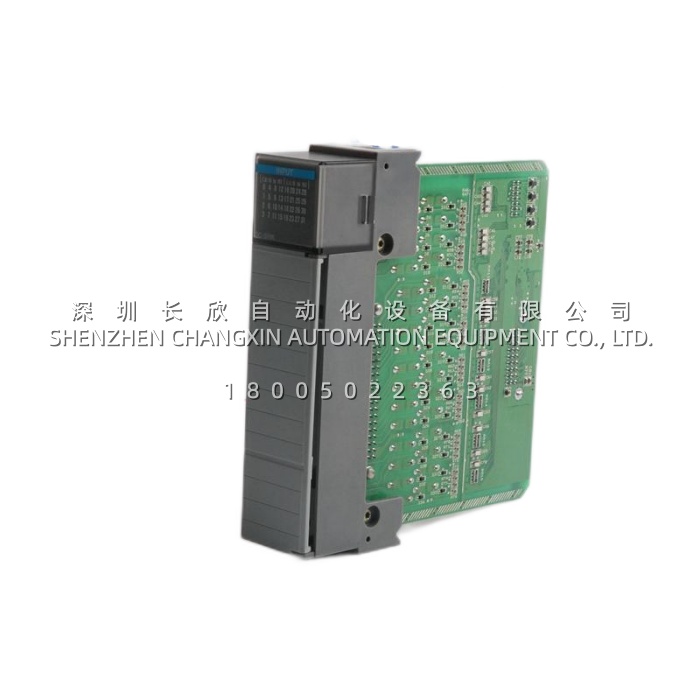
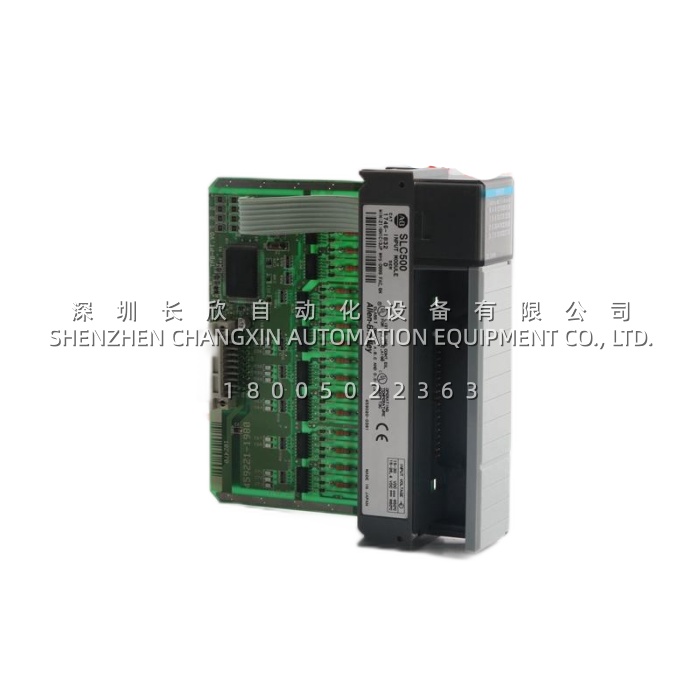
| Product Model | Allen-Bradley 1746-OX8 Relay Output Module |
| Manufacturer | Rockwell Automation (Allen-Bradley) |
| Product Type | Relay output module |
| Product Family | SLC 500 (1746 series) |
| Number of Outputs | 8, normally open (form A) contacts |
| Output Rating per Point | 2 A at 250 V AC, 2 A at 125 V DC |
| Total Load Capacity | 1250 VA |
| Maximum Switching Voltage | 250 V AC, 125 V DC |
| Contact Type | Dry, galvanically isolated relay contacts |
| On-State Delay | 16 ms nominal |
| Off-State Delay | 16.5 ms nominal |
| Contact Life | 100,000 operations minimum at rated load |
| Fusing | Individually fused per output, user-replaceable |
| Backplane Current Draw | 250 mA at 5 V DC |
| Power Source | SLC 500 chassis backplane (no external supply required) |
| Indicators | 2 green status LEDs, 2 yellow fuse-status LEDs, 8 yellow point-status LEDs |
| Wiring Terminals | Removable terminal block, 2 terminals per output |
| Mounting | DIN rail mount / 1746 chassis slot |
| Dimensions (H × W × D) | 118.5 × 34.6 × 87.9 mm (4.66 × 1.36 × 3.46 in) |
| Weight | 0.17 kg (0.38 lb) |
| Operating Temperature | 0 °C to +60 °C (32 °F to 140 °F) |
| Storage Temperature | -40 °C to +85 °C (-40 °F to +185 °F) |
| Relative Humidity | 5 % to 95 % non-condensing |
| Shock and Vibration | 30 g operating shock; 2 g @ 10–500 Hz vibration |
| Certifications | UL 508, CSA C22.2 No. 142, CE, C-Tick; CSA Class I Division 2 Groups A–D where marked |
Main Features and Advantages
Universal load compatibility through dry contacts: The principal advantage of the Allen-Bradley 1746-OX8 Relay Output Module is that each output is a genuine relay contact rather than a semiconductor switch. The controller side is isolated from the load side, so a 120 V AC motor starter coil, a 24 V DC solenoid, a 48 V DC indicator and a 250 V AC alarm horn can all share the same module without regard to polarity or commoning. In a panel built over many years by different engineers, this universality prevents the costly and error-prone practice of keeping four different output module types in stock and hoping the right one is installed when a failure occurs.
Galvanic isolation and noise immunity: Because there is no direct electrical path between the backplane and the load terminals, the module contains transients, ground loops and common-mode voltage shifts that are endemic in panels with large motors and welding equipment. A contactor coil collapse or a VFD-induced transient on one output cannot propagate into the SLC 500 backplane. This is the reason relay outputs remain the preferred choice for interfacing electromechanical devices even where transistor outputs would offer faster switching: the electrical boundary is absolute, and it protects the controller rather than merely tolerating the disturbance.
Individually fused and independently visible outputs: Each of the eight outputs is fused separately, so a shorted solenoid or a miswired contactor coil takes out one point rather than the entire module. The two yellow fuse-status LEDs divide the module into fuse-monitoring groups, while the eight yellow point-status LEDs show the commanded state of every output. Together with the green status LEDs, this gives maintenance personnel a complete picture of module health without opening the panel door or connecting a programming device. In a darkened motor control centre, that visual information turns a twenty-minute fault search into a five-minute fuse replacement.
No external supply and simple wiring: The outputs are powered from the chassis backplane, so the module needs only the field load connections and the backplane seat. The removable terminal block allows pre-wiring on the bench and transfer to the replacement module in seconds, with no field conductor disturbed. For a panel that must be restored quickly, this is a decisive advantage over output modules that require a separately fused and distributed load supply.