Application Scenarios
On a four-axis CNC machining centre, the original 1394C-SJT10-T-RL began reporting intermittent SERCOS and resolver feedback faults after more than a decade of shift work. The symptoms pointed in three directions at once — cable, motor, or controller — and the machine builder’s recommended cure was a full drive replacement with a migration to Kinetix, rewiring included. That would have meant a week-long line stop and a five-figure control rebuild. Instead, the plant sourced a tested 1394C-SJT10-T-RL of the same Series and firmware, dropped it onto the existing backplane, and reloaded the GML program from backup. The axes were cutting metal again inside one shift. For a legacy 1394 system, that is the entire value proposition: the intelligence, the power stage, and the communications all live in one module, so a like-for-like spare is worth far more than its list price.
Parameter
| Main Parameters | Value/Description |
|---|---|
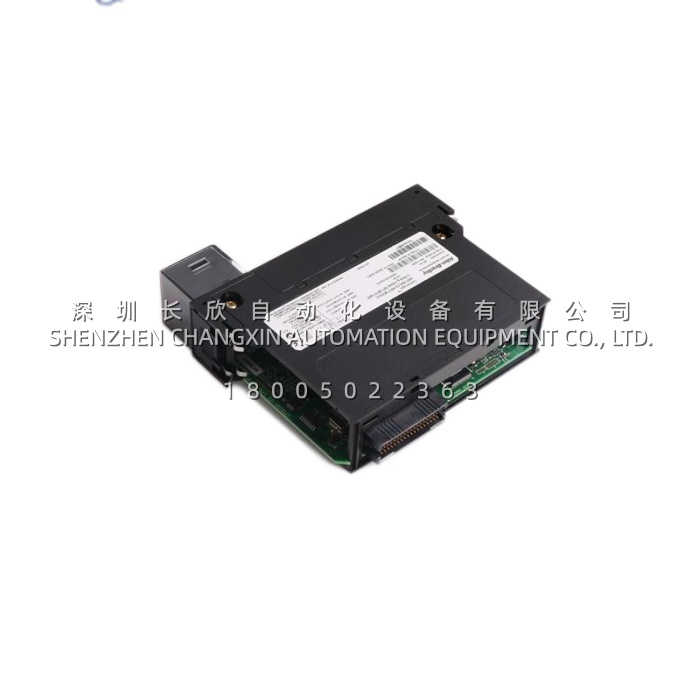
| Product Model | 1394C-SJT10-T-RL |
| Manufacturer | Allen-Bradley / Rockwell Automation (USA) |
| Product Category | Digital GMC Turbo system module (servo controller + power supply) |
| Product Line | Bulletin 1394 Digital Servo Controller / multi-axis motion control system |
| Continuous Power Output | 8 / 10 kW (380 V / 460 V nominal respectively) |
| Peak Power Output | 28 kW |
| Efficiency | 99% |
| Rated AC Input Voltage | 324–528 V AC, 50/60 Hz, three-phase |
| Nominal Input Voltage | 360/480 V AC |
| AC Input Current | 13.0 A |
| DC Bus Output Voltage | 530/680 V DC |
| Continuous Output Current | 14.73 A |
| Peak Output Current | 29.46 A |
| Line Loss Ride-Through | 20 ms |
| Internal Bus Capacitance (Series A/B) | 330 µF |
| Bus Inductance (Series A/B) | 750 µH |
| DC Bus Shunt | External shunt connector (no internal shunt resistor on this module) |
| Processor | 32-bit CPU |
| Memory | 64 K (GML program memory; Turbo option doubles the capacity of the Standard module) |
| Communication | Remote I/O and AxisLink (RL factory options); SERCOS configurable |
| Axes Supported | Up to 4 axis modules |
| Feedback Compatibility | Resolver and Stegmann Hiperface (via matching axis module) |
| Power Conversion | IGBT with digitally adjusted velocity and current-loop compensation |
| Mounting | Panel / cabinet, slide-and-lock module-to-module connection |
| Cooling | Forced air, integrated ventilation |
| Dimensions | 13.8 × 11.0 × 5.91 in (350 × 280 × 150 mm) |
| Weight | 23.5 lb (10.68 kg) — Series C |
| Operating Temperature | 0 to +50 °C (32 to 122 °F) |
| Humidity | 5–95% RH, non-condensing |
| Altitude | Up to 1000 m without derating |
| Protection Rating | IP20 (cabinet installation) |
| Certifications | UL Listed (E59272), cUL, CE |
| Lifecycle Status | Discontinued / obsolete; migration suggested to Kinetix 5700 |
Note: Series A/B units weigh approximately 24.25 lb (11 kg). The “T” denotes the Turbo GMC option; “RL” denotes Remote I/O + AxisLink. Always confirm Series letter and firmware version against the nameplate and existing system configuration.
Technical Principles and Innovative Values
- Innovation Point 1 — Controller and power stage in one module. The 1394C-SJT10-T-RL combines the GML motion controller, the 530/680 V DC bus power supply, and the system backplane in a single assembly. There is no separate controller rack and drive rack to coordinate, which is why a 1394 system saves so much panel and wiring space.
- Innovation Point 2 — Turbo memory for larger motion programs. The Turbo suffix gives the module a 32-bit processor with 64 K of memory, double the 32 K / 16-bit capacity of the Standard GMC module. Larger part programs, more electronic-cam profile points, and faster execution follow directly from that increase.
- Innovation Point 3 — 99% efficiency with IGBT conversion. Three-phase line power is converted through an IGBT bridge rather than a linear regulator, holding losses low and heat manageable. The published 99% efficiency figure is what allows the module to deliver 10 kW continuously without a proportionally large heatsink and fan package.
- Innovation Point 4 — Direct line connection, no transformer needed. Rated for 324–528 V AC, the 1394C-SJT10-T-RL connects straight to 360/480 V plant power. That removes a transformer from the bill of materials and eliminates a source of losses and voltage drop.
- Innovation Point 5 — 20 ms line-loss ride-through. The internal bus capacitance can carry the load through a 20 ms supply interruption without dropping the axes. On a plant where contactor chatter or a fleeting voltage sag would otherwise fault the machine, this keeps production running through disturbances that would stop a less robust drive.
- Innovation Point 6 — Digital velocity and current-loop compensation. Both loops are digitally adjusted, so the module adapts to a range of system inertias without analogue trim pots. The result is repeatable tuning across multiple machines and no pot drift over years of service.