
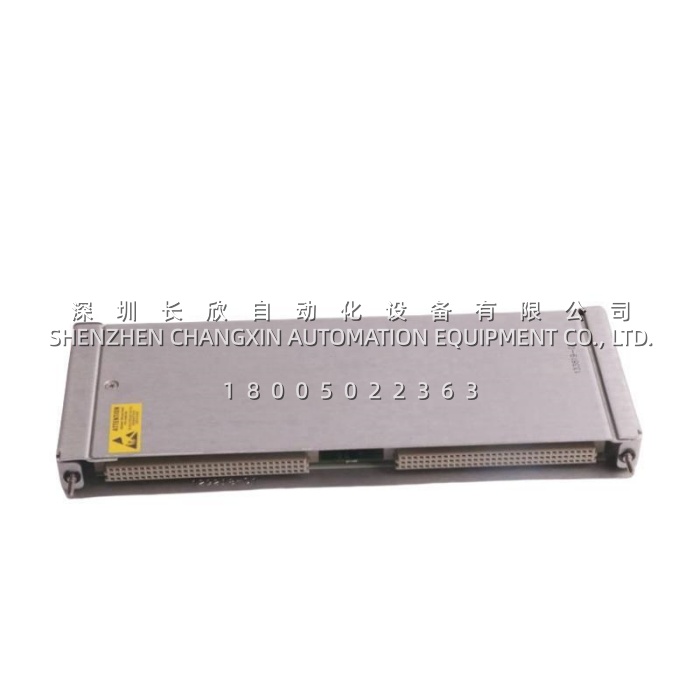
Description
The Bently Nevada 990-04-50-02-CN is a two-wire, loop-powered vibration transmitter from Bently Nevada (Baker Hughes) designed for continuous, non-contact shaft vibration monitoring of rotating machinery. As part of the 990 Series, the 990-04-50-02-CN converts the signal from a single 3300 NSv proximity probe into an industry-standard 4-20 mA output proportional to peak-to-peak vibration amplitude, providing a simple and cost-effective vibration signal for PLC, DCS, or SCADA integration.
Engineered for OEMs of centrifugal air compressors, small pumps, motors, and fans, this transmitter features an integrated Proximitor sensor that eliminates the need for a separate external proximitor unit, reducing wiring complexity and panel space requirements.
Application Scenarios
In a petrochemical plant, maintenance engineers struggled with frequent bearing failures on critical process pumps. The existing monitoring approach relied on periodic manual vibration readings, which failed to detect developing faults between inspection intervals. The Bently Nevada 990-04-50-02-CN transformed this reactive strategy by providing continuous 4-20 mA vibration data directly to the plant’s DCS. With its 0-4 mils peak-to-peak full-scale range and ±1.5% accuracy, the 990-04-50-02-CN detected subtle increases in shaft vibration weeks before bearing degradation became audible or visible. Operators configured DCS alarms based on the proportional current signal, enabling maintenance planning rather than emergency repairs. The transmitter’s Not OK/Signal Defeat circuit proved invaluable when a probe cable was accidentally damaged during adjacent work: rather than reading zero vibration (which could mask a problem), the 990-04-50-02-CN drove its output below 3.6 mA within 100 microseconds, alerting the control system to a fault condition and preventing a dangerous false sense of security. In an OEM compressor skid application, the 990-04-50-02-CN‘s compact bulkhead-mount design allowed direct installation on the machine frame where space was at a premium, while the integrated Proximitor eliminated the panel space and wiring associated with traditional rack-based monitoring systems.
Parameter
| Parameter | Value/Description |
|---|---|
| Product Model | 990-04-50-02-CN |
| Manufacturer | Bently Nevada (Baker Hughes) |
| Product Category | Two-Wire Vibration Transmitter |
| Full-Scale Range | 0 – 4 mils peak-to-peak (0 – 100 µm pp) |
| System Length | 5.0 meters (16.4 feet) |
| Mounting | Bulkhead screws (63.5 × 69.9 mm hole pattern, 5.8 mm diameter) |
| Input | 1 × 3300 NSv Proximity Probe and extension cable |
| Power Supply | +12 to +35 V DC (loop-powered at transmitter terminals) |
| Output Signal | 4 – 20 mA DC, two-wire configuration |
| Loop Accuracy | ±1.5% over specified full-scale range |
| Probe Gap Range | 0.5 to 1.75 mm (20 to 55 mils) from target |
| Frequency Response | 5 Hz to 6,000 Hz (+0, -3 dB) |
| Operating Temperature | -35°C to +85°C (-31°F to +185°F) |
| Fault Output | < 3.6 mA within 100 µs on Not OK condition |
| Dynamic Output | PROX OUT coaxial connector (non-isolated) |
Technical Principles and Innovative Values
Innovation Point 1: Integrated Proximitor Sensor Eliminates External Hardware. Traditional vibration monitoring architectures require a proximity probe, an extension cable, a separate Proximitor driver, and a monitor module. The Bently Nevada 990-04-50-02-CN consolidates the Proximitor signal conditioning electronics directly into the transmitter housing, eliminating the separate driver unit and its associated panel space, wiring, and potential failure points. For OEMs and end users adding vibration monitoring to existing machinery, this integration means a single two-wire loop from the machine to the control room carries both power and signal, dramatically simplifying installation compared to rack-based systems.
Innovation Point 2: Not OK/Signal Defeat Circuit Prevents Dangerous False Readings. A failed probe, broken extension cable, or loose connection in a conventional system can produce a low or zero vibration reading that appears normal but masks a potential machinery problem. The 990-04-50-02-CN addresses this critical safety gap with its Not OK/Signal Defeat circuit, which drives the output below 3.6 mA within 100 microseconds when a fault condition occurs. This behavior signals a fault to the control system rather than a healthy machine at rest, and the loop recovers within 2-3 seconds once the fault clears.
Innovation Point 3: PROX OUT for Diagnostics Without Shutdown. The 990-04-50-02-CN provides a non-isolated PROX OUT coaxial connector that delivers the raw dynamic vibration and gap voltage signal for diagnostic purposes. Technicians can connect a portable analyzer or oscilloscope directly to the transmitter during routine walk-throughs to capture waveforms or spectra without disturbing the probe installation or interrupting the 4-20 mA loop. This diagnostic access enables deeper analysis than the proportional current signal alone permits, supporting root-cause investigation of machinery issues while the equipment remains in service.