
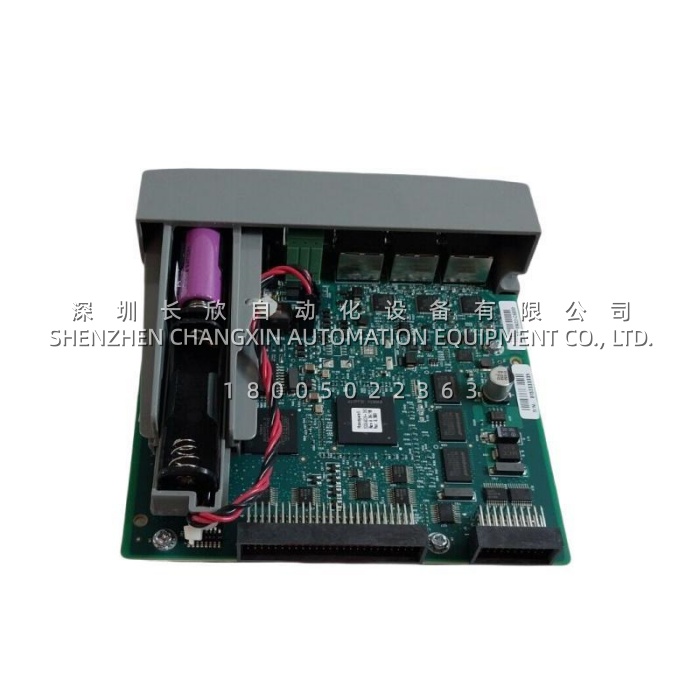
Application Scenarios
In an LNG receiving terminal or refinery process unit, a controller failure at 3 AM means production losses start accumulating by the minute. The 900C75S-0360-00 exists precisely for this scenario. It belongs to Honeywell‘s ControlEdge HC900 series, with a clear dual mandate: run standard process control logic while simultaneously handling SIL-rated safety tasks. The module’s core is a redundant pair of Intel Celeron M processors running at 1.6 GHz each. When the primary CPU faults, the backup takes over in milliseconds without data loss or output bumps. Unlike redundancy schemes that only protect the CPU layer, the 900C75S-0360-00 extends fault tolerance to I/O communication links and power paths, so a single cable fault doesn’t defeat the architecture .
Parameter
| Parameter | Value/Description |
|---|---|
| Product Model | 900C75S-0360-00 |
| Manufacturer | Honeywell |
| Product Category | Redundant CPU Controller Module |
| Platform | ControlEdge HC900 Hybrid Controller |
| Processor Architecture | Dual Intel Celeron M, 1.6 GHz each (redundant pair) |
| User Memory | 10 MB (HC900 specification) |
| Typical Scan Time | Approx. 25 ms |
| Maximum I/O Capacity | Up to 4,000 points via expansion racks |
| Communication Interfaces | 2 × Ethernet 10/100 Mbps; 1 × RS-485; 3 × 10/100Base-T |
| Supported Protocols | Modbus TCP/IP, Modbus RTU, EtherNet/IP, OPC, point-to-point |
| Power Supply | 24 V DC (standard HC900 platform); 5 VDC backplane, 1500 mA max |
| Safety Rating | SIL-compatible (SIL 2 / SIL 3 depending on configuration) |
| Operating Temperature | 0°C to +60°C |
| Mounting | 35 mm DIN rail |
| Weight | Approx. 0.5 kg |
Technical Principles and Innovative Values
Innovation Point 1 — Full-Path Redundancy Beyond the CPU: The 900C75S-0360-00 does not stop at dual processors. The HC900 redundant architecture extends to independent I/O communication channels and redundant power supply capability. When the primary CPU faults, the backup takes over control execution while output signals remain uninterrupted—field device loops never see a bump or dropout . This matters because many “redundant” controllers only protect the processor layer; a communication link failure still takes the system down.
Innovation Point 2 — Safety and Process Control in One Module: Rather than requiring separate safety and process controllers, the 900C75S-0360-00 executes both standard PID loop management and SIL-rated safety interlock logic. It integrates with Honeywell Experion PKS as a safety subsystem, reducing the hardware footprint and engineering effort for plants that previously maintained parallel control and safety architectures .
Innovation Point 3 — Hot-Swap Serviceability: The ControlEdge HC900 backplane supports hot-swapping, meaning the 900C75S-0360-00 can be replaced during system operation without shutdown . In facilities where a controller replacement window requires production stoppage, this capability directly reduces planned downtime and maintenance cost.
Application Cases and Industry Value
Case 1 — Refinery Hydrotreater Safety and Control Integration: A refinery hydrotreater unit required both process control for reactor temperature and pressure, plus emergency shutdown (ESD) capability. Using 900C75S-0360-00 modules in a redundant configuration, the plant consolidated process and safety functions into the platform rather than maintaining separate DCS and SIS controllers. The redundant CPU pair provided seamless failover during a firmware upgrade, and the integrated architecture reduced cabinet space and wiring complexity. The plant reported improved diagnostic visibility, as fault logs from both control and safety domains were accessible through the same engineering interface .
Case 2 — Water Treatment Plant High-Availability Control: A municipal water treatment facility running filtration, chemical dosing, and effluent monitoring needed continuous operation—even brief controller outages could disrupt disinfection processes. The 900C75S-0360-00 in a dual-CPU redundant rack ensured that a processor fault triggered automatic failover without interrupting pump control or valve positioning. The maintenance team particularly valued the hot-swap capability, which allowed controller replacement during a scheduled maintenance window without draining filter basins or shutting down the distribution network .