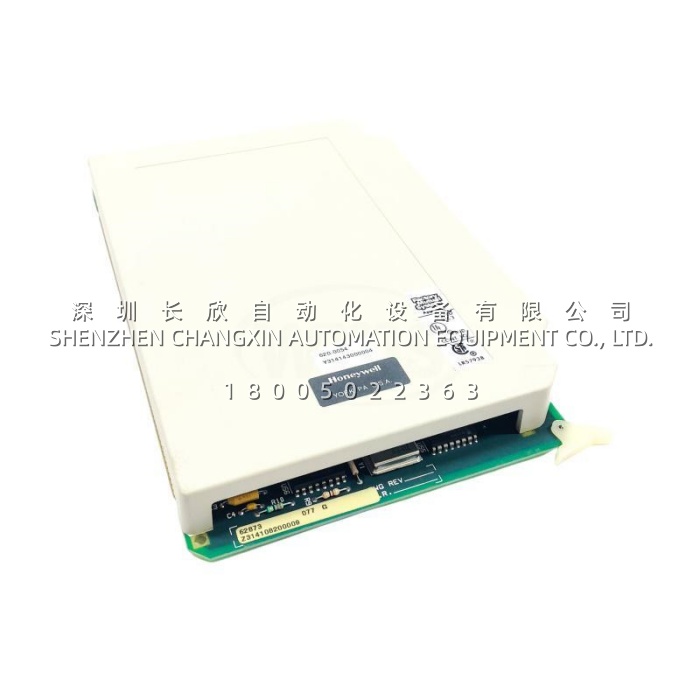
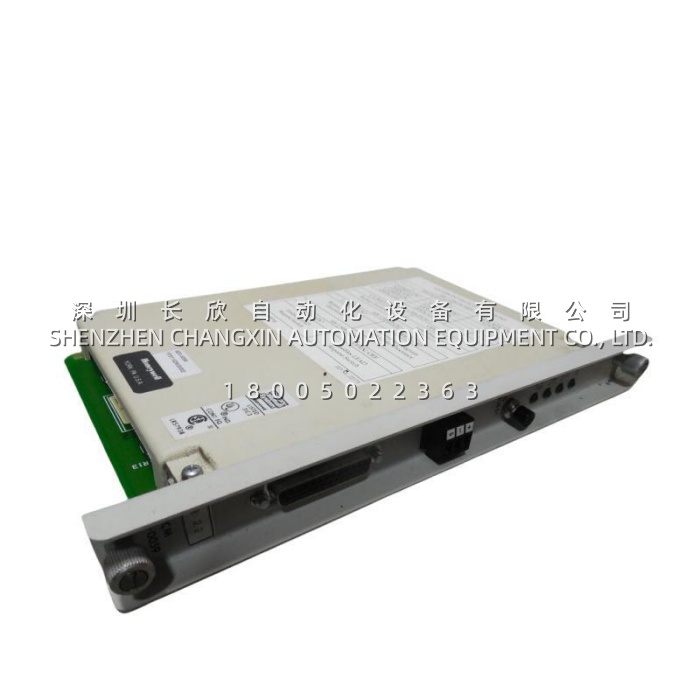
Description:
The Honeywell 620-0059 is a Redundancy Control Module (RCM) for the Honeywell IPC 620 programmable controller family, supplied here in the VR 2.2 EXCH configuration. In Honeywell’s own documentation, the RCM is described as the primary component of the IPC 620 Processor Redundancy System.
It does one job, and does it in hardware: watch the primary processor, keep the secondary synchronised, and hand control over when the primary stops answering. Two identically configured processors — typically IPC 620-25 or 620-35 — each carry an RCM, and the pair is linked by a dedicated data cable.
Application Scenarios:
A refinery runs its crude unit on an IPC 620 redundant pair that was commissioned decades ago. The control logic has been extended, re-commissioned and re-tuned many times, but the rack has never been replaced, because replacing it means revalidating the whole unit — an outage measured in weeks and a cost nobody wants to put in front of the plant manager.
Now the primary processor starts logging intermittent hardware diagnostics. Nothing has tripped yet. But the plant is one card failure away from a unit shutdown, and the redundancy that is supposed to absorb that failure depends entirely on a module nobody has looked at in years: the Honeywell 620-0059.
This is the reality of legacy high-availability systems. Redundancy is not a setting you enable; it is a piece of hardware sitting in a slot, and it ages like everything else around it. On continuous process plants — refining, power generation, chemicals, large water treatment — the RCM is the difference between “the CPU failed and the unit kept running” and “the CPU failed and the unit went down.” Plants that have lived through the second version tend to keep a spare Honeywell 620-0059 on the shelf.
Parameter:
| Parameter | Value/Description |
|---|---|
| Product Model | 620-0059, VR 2.2, EXCH configuration |
| Manufacturer | Honeywell (Honeywell Industrial Automation and Control); country of origin USA |
| Product Category | Redundancy Control Module (RCM), PLC / high-availability processor system card |
| Host System | Honeywell IPC 620 Programmable Controller (IPC 620-25 and IPC 620-35 processor systems) |
| Redundancy Architecture | 1:1 hot standby — two identically configured processors, each fitted with its own Honeywell 620-0059, sharing a common I/O system |
| Core Function | Heartbeat monitoring of the active CPU, controller state and I/O synchronisation, fault arbitration, bumpless transfer to the standby |
| Interconnection | Dedicated data cable between the two RCMs; published figures cite up to 15.24 m (50 ft) separation — confirm against the Redundant Control System User Manual for your configuration |
| Sync Update Time | Published figure of 18 ms for 8 modules (reseller data; verify against the system manual) |
| Supply Voltage | 24 V DC; draws power from the IPC 620 processor rack — no separate external supply |
| Current Draw | Published as 0.090 A at 24 V DC and 1.000 A at 5 V DC by one source, 300 mA typical at 5 V DC by another — treat as approximate |
| Chassis Slots Used | 2 slots in the IPC 620 processor rack |
| Configuration | On-board DIP switches, which must match the primary/secondary controller configuration before power is applied |
| Status Indication | Front-panel LEDs for power, run, fault and active/standby role |
| Isolation | Galvanic isolation between the control module and backplane logic, so an I/O bus fault does not propagate into the synchronisation circuit |
| Operating / Storage Temperature | 0 °C to +60 °C operating; -40 °C to +85 °C storage |
| Humidity | 5–95 % RH, non-condensing |
| Hot Swap | Not supported. Rack power must be removed before the module is inserted or withdrawn |
| Dimensions / Weight | Commonly listed as 200 × 130 × 30 mm and 0.45–0.52 kg; one listing quotes 23.9 × 15.9 × 2.5 cm at 0.3 kg. Dimensions differ between sources — measure the installed unit before ordering |
| Certifications | CE, UL (cULus also cited) |
| Lifecycle Status | Legacy / discontinued by the OEM; supplied as new surplus or exchange stock |
Two notes before you buy. First, “EXCH” is widely used for units supplied on an exchange basis, so always confirm whether you are getting new surplus or a remanufactured exchange unit — the warranty and the core-return terms differ. Second, several reseller pages place Honeywell 620-0059 in Experion PKS C300 architectures; the IPC 620 and C300 are different generations, and I would not rely on that cross-reference without confirming against your own rack’s bill of materials.
Technical Principles and Innovative Values:
- Innovation Point 1 — redundancy decided in hardware, not in logic: the Honeywell 620-0059 implements the entire failover mechanism as a dedicated circuit rather than as ladder logic running on the CPU being monitored. That matters, because a software-based redundancy scheme dies with the processor it is supposed to protect. Here the arbiter is a separate card with its own heartbeat link, so a CPU fault is detected from outside the CPU.
- Innovation Point 2 — bumpless transfer instead of a restart: the RCM continuously synchronises controller state and I/O data between the pair, so on failover the standby picks up mid-scan rather than from a cold start. Outputs hold their last commanded values instead of dropping to their de-energised state — the reason a process can ride through a CPU failure without a trip.
- Innovation Point 3 — galvanic isolation on the synchronisation path: faults on an I/O bus are among the most common ways a redundant pair gets taken down together. Isolation between the module and backplane logic stops that propagation, which is what keeps a shared I/O system from becoming a shared point of failure.
- Innovation Point 4 — parallel, serial or hybrid I/O in one redundancy scheme: Honeywell’s redundant system supports all three I/O configurations, so an existing rack does not have to be re-architected to gain processor redundancy. For brownfield plants, that is usually the deciding factor.
- Innovation Point 5 — minimal hardware, minimal install effort: the RCM drops into the existing processor rack and links to its partner with a single data cable. No additional racks, no gateways, no separate redundancy power feed — a high-availability upgrade measured in hours of cabinet work rather than a capital project.