Technical Specifications
| Parameter Name | Parameter Value |
|---|---|
| Product Model | 317-2AJ12 (CPU 317SE/DPM) |
| Manufacturer | VIPA GmbH, Germany (now part of the Yaskawa group) |
| Product Type | PLC central processing unit (CPU module) |
| Processor / bus technology | SPEED7 32-bit processor with SPEED-Bus parallel extension bus |
| Work memory | 2 MB integrated, expandable to 8 MB, split 50 % program / 50 % data |
| Load memory | 8 MB integrated and maximum; MMC card slot supporting cards up to 1 GB |
| Instruction processing time | Bit, word and double integer 0.01 µs; floating point 0.06 µs |
| Integrated interfaces | Ethernet PG/OP; RS485 switchable MPI or PROFIBUS-DP master; RS485 PtP |
| PROFIBUS-DP capability | DP master up to 12 Mbit/s, maximum 125 slaves; 1 integrated DP master (4 via CP) |
| PtP protocols | ASCII, STX/ETX, 3964(R) on the potential-separated RS485 port |
| I/O address area | 8192 bytes inputs / 8192 bytes outputs; process image preset 256 bytes |
| Memory resources | 2048 S7 counters, 2048 S7 timers, 16384 bytes flags, 8190 data blocks up to 64 KB each |
| Hardware configuration | Maximum 4 racks; 32 modules in single-rack layout, 8 per rack in multi-rack layout |
| Power supply | DC 24 V, permitted range 20.4 – 28.8 V, with reverse polarity protection |
| Current consumption / power loss | 200 mA no-load, 1.5 A rated, 5 A inrush; 6.5 W loss; 4 A maximum backplane drain |
| Real-time clock | Buffered by vanadium rechargeable lithium battery, minimum 6 weeks, maximum 10 s deviation per day |
| Programming software | WinPLC7, SIMATIC Manager (STEP 7) or TIA Portal with the VIPA hardware support package |
| Ambient conditions | 0 °C to +60 °C operating, -40 °C to +70 °C storage, 5 – 95 % RH non-condensing |
| Dimensions (W × H × D) | 40 × 125 × 117 mm, standard S7-300 single-width module on mounting rail |
| Protection class / mounting | IP20, S7-300 mounting rail, connection through the backplane bus |
| Lifecycle status | Discontinued by the manufacturer; successor type 317-2AJ23 |
Figures above follow the published VIPA data sheet for this order number; variants shipped in later production years can differ in memory card type and interface labelling, so the marking on the delivered unit should always be checked against the original manual.
Main Features and Advantages
SPEED7 processing headroom: The VIPA 317-2AJ12 runs bit and word instructions at about 0.01 µs, so scan times that strain a conventional S7-300 CPU are absorbed comfortably here. Machines with fast interlocks, high-speed counting or dense PID loops gain cycle-time margin without changing the application program structure, which matters when a retrofit is done under a tight shutdown window.
Memory that survives expansion: Two megabytes of integrated work memory, split evenly between code and data, already covers most mid-size machine programs, and the option to extend to 8 MB removes the usual ceiling. Add the 8 MB integrated load memory plus an MMC card of up to 1 GB, and the same CPU can host recipe data, alarm archives and diagnostic buffers that would otherwise need an external storage solution.
Three interfaces without extra modules: Ethernet for programming and operator panels, an RS485 port that switches between MPI and PROFIBUS-DP master at up to 12 Mbit/s, and a second isolated RS485 port for PtP protocols such as ASCII, STX/ETX and 3964(R). A plant can therefore run the DP network to drives and remote I/O, keep a serial link to weighers, barcode readers or older drives, and still leave the Ethernet port free for engineering access — all from one slot, with no communication processor to buy or configure.
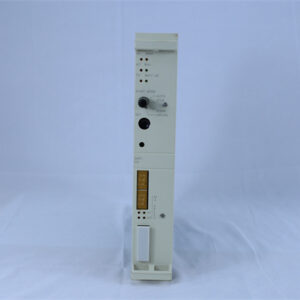
Drop-in mechanics and serviceability: Because the VIPA 317-2AJ12 uses standard S7-300 module dimensions, rail mounting and backplane bus, it slides into existing 300S or mixed racks without mechanical rework. Front-panel status and error LEDs give the technician a first indication before a programming device is even connected, and the buffered real-time clock keeps time-stamped alarms and operating-hour counters alive through power loss for at least six weeks.
Engineering in familiar tools: The VIPA 317-2AJ12 is programmed with WinPLC7 or with SIMATIC Manager and TIA Portal once the VIPA hardware support package is installed, so a maintenance team already fluent in STEP 7 can take over the application without retraining on a foreign toolchain.
Application Field
Machine builders and end users running System 300S racks meet the VIPA 317-2AJ12 most often on packaging lines, where short cycle times and many servo axes are coordinated over PROFIBUS-DP. The fast bit processing keeps the scan short even when several dozen drives and valve terminals exchange data on every cycle, and the PtP port handles serial devices such as printers, label applicators and weigh controllers that never migrated to a fieldbus.
In water and wastewater installations, the CPU typically sits in a remote station cabinet gathering level, flow and pump-status signals. Here the value is less about raw speed and more about the mixed communication: DP for the remote I/O drops, a serial link for analyser instruments that only speak ASCII, and Ethernet for the telemetry connection back to the control centre. The buffered clock also keeps event logs ordered when a station loses mains power.
Material handling and intralogistics is another common home. Conveyor systems spread over long distances generate plenty of discrete I/O, and the 8 kB address area in each direction of the VIPA 317-2AJ12 accommodates that spread without segmentation tricks. Retrofit projects form a large share of demand as well: when an older S7-300 CPU fails or its memory is exhausted, swapping in this SPEED7 module restores the rack at a fraction of a full migration cost, since the existing signal modules, power supply and field wiring stay in place.
Because the type is now discontinued, most of that demand is spare-part driven. Plants holding 300S installations keep one or two units on the shelf as insurance, and the VIPA 317-2AJ23 is evaluated when a rack is being redesigned rather than repaired.